49 works in this view — arrow keys or swipe to move between them.
Dance in Art · 1910
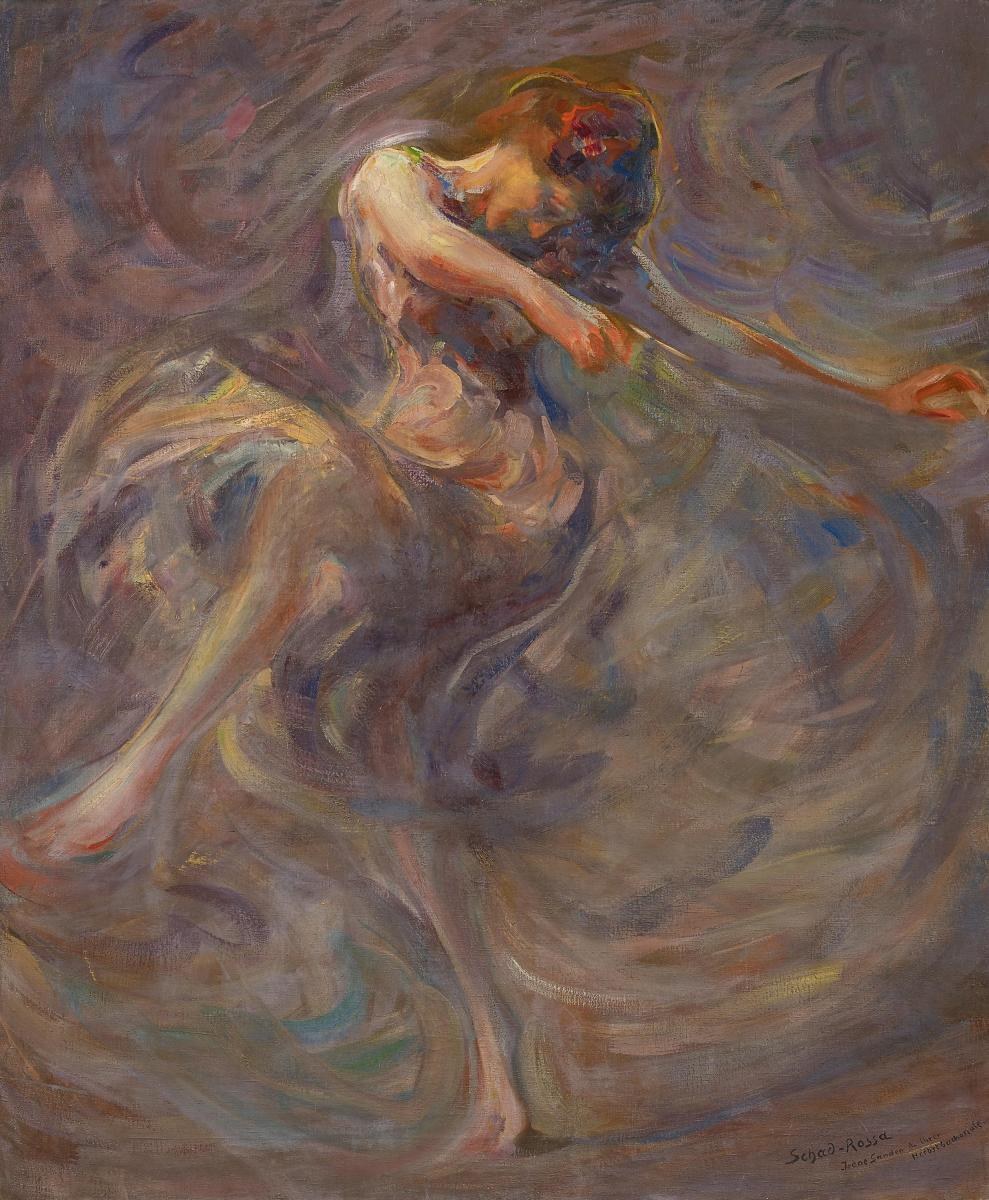
Paul Schad-Rossa - Tänzerin (Irene Sanden)
Paul Schad-Rossa
- Medium:
- Oil Painting
- Era:
- 1900-1920 (Ragtime/Early Jazz)
- Source:
- Wikimedia Commons
- Rights:
- Public domain — free to use, share and adapt.
- Recorded as:
- Public Domain
This work documents the moment when dance was being liberated from classical technique and when painters began to understand movement as a subject worthy of Modernist formal experimentation. For historians of early modern dance and early 20th-century Expressionism, it is evidence that dancers and visual artists were working in concert to develop new aesthetic vocabularies.
What you are looking at
A female dancer is captured in a moment of lyrical movement against a swirling, atmospheric background rendered in warm browns, mauves, and ochres. The figure is caught mid-motion, her body twisted and lifted, with her head tilted back and her gaze directed upward in an attitude of abandon or ecstasy. Her limbs are elongated and graceful; her right arm extends diagonally across her body while her left arm stretches outward. She wears what appears to be a simple, classical draped garment in pale cream and rose tones that clings to her body and flows around her legs, suggesting both the constraints and freedom of movement. The background is not a fixed setting but rather a field of swirling, gestural brushwork that seems to move with the dancer—the paint itself becomes an extension of her motion, creating an almost transcendent quality to the image. The composition is tightly cropped around the figure, with no visible floor or stage edge, which further abstracts the scene and emphasizes the interiority of the moment.
The dancing
The dancer's body is in a contrapposto position with significant torsion through the spine, suggesting a moment of sustained extension rather than a preparatory or grounded pose. Her weight appears to be supported on one leg (not fully visible) while the other is lifted or extended. The raising of her head and the openness of her arm gestures suggest a movement that is upward-bound and emotionally charged—neither the strict verticality of classical technique nor the earthbound weight-sharing of modern dance, but something between. There is a fluidity to the limbs and a sense of the body being animated from within rather than controlled from without.
The dance depicted
This is most likely a representation of theatrical-ballet or theatrical-contemporary dance from the early 20th century, a period when ballet was undergoing radical reimagining through Isadora Duncan's influence and the innovations of the Ballets Russes. The title identifies the subject as Irene Sanden, a known dancer of this era. The pose does not conform to classical ballet vocabulary (no turned-out positions, no defined épaulement) but rather suggests the freer, more emotionally expressive movement vocabulary emerging in modern dance and post-romantic ballet of the period. The painting technique itself—the dissolution of the body into expressive brushwork—is consistent with Expressionist and Modernist representations of dance as an internal, emotional phenomenon rather than a display of technical virtuosity.
How it was made
This is an oil painting executed with loose, gestural brushwork that prioritizes movement and atmosphere over anatomical precision or spatial clarity. The artist builds form through layered, directional strokes that follow and amplify the dancer's motion rather than defining it with contour. The palette of earth tones and muted purples creates a sense of interior lighting—possibly studio light or a contemplative mood—and the dissolving quality of the background suggests the influence of Expressionism and Symbolism. Oil painting allowed Schad-Rossa to work with translucency and build up surface texture in ways that record the act of representation itself as a kind of dance.
About this work
This oil painting by Paul Schad-Rossa depicts a moment of lyrical, ecstatic movement in a female dancer identified as Irene Sanden, rendered circa 1910 in a style that merges early modern dance's emotional and physical innovations with Expressionist painting technique. The work is a product of a pivotal moment in European art and dance when Modernism was displacing academic forms, and when artists across media were seeking to capture the interior experience of movement rather than its external display. The painting belongs to a tradition of artists who have used portraiture of dancers to explore larger questions about expression, the body, and the nature of artistic representation itself.
How to look at it
Attend to the moment of suspension the artist has chosen: the dancer is not caught mid-phrase in a recognizable step, but rather at a moment of maximum lift and openness, where the body seems to transcend the limitations of gravity. Notice how the brushwork in the background echoes and extends the movement of the body, collapsing the distinction between figure and ground. The absence of a defined stage or floor plane is significant—this is not a representation of a dancer performing for an audience, but rather an interior, almost mystical vision of dance as pure expression. The pale, simplified drapery focuses attention on the body's articulation and the emotional tenor of the pose.
The artist
Paul Schad-Rossa (1862–1916) was a Swiss painter and illustrator active during the late 19th and early 20th centuries, working in a style informed by Symbolism and Expressionism. His work often focused on figural subjects and movement, and he was part of the broader European artistic culture that was responding to new developments in dance, theatre, and music. While he is not a major canonical figure, his work is representative of the widespread engagement of visual artists with dance as a subject during this period of radical artistic and cultural change.
The period
In 1910, European dance was in ferment. Isadora Duncan's revolutionary approach to movement—barefoot, unfettered by corsetry, drawing on classical Greek sources and emotional authenticity—had profoundly disrupted the dominance of classical ballet. The Ballets Russes, founded in 1909, was in its first season of performances that would reshape the relationship between dance, music, and visual art. In visual art, Expressionism and Fauvism were emerging as dominant movements, and artists were increasingly interested in capturing interior states, emotion, and the expressive potential of distorted or gestural form. The painting of dancers became a subject through which these artistic concerns could be explored—a way of examining the relationship between body, emotion, and representation.
Where it lives
The work is noted as sourced from Wikimedia Commons, suggesting it is in a public or digitized collection, though the current holding institution is not recorded in the catalogue.
Dance in this work
Questions about this work
Who was Irene Sanden?
Irene Sanden was a dancer active in early 20th-century Europe, noted enough to have been portrayed by Schad-Rossa and to appear in artistic circles of the period. Beyond this painting, little is widely documented about her career or technique, though the style of her portraiture suggests she was associated with modernist and post-romantic approaches to movement rather than classical ballet.
Why does this not look like classical ballet?
By 1910, ballet was being challenged and reimagined. Isadora Duncan's influence and the innovations of the Ballets Russes meant that dancers and artists were exploring movement vocabularies that rejected the turned-out positions and formal codes of 19th-century academic ballet. This painting captures that moment of transition, when new modes of expression were taking hold.
What does the swirling background mean?
Rather than depicting a literal stage or space, the gestural brushwork in the background suggests movement, energy, and emotion radiating outward from the dancer's body. This technique is characteristic of Expressionism, where the painting itself becomes an expression of interior feeling rather than a neutral record of external appearance.
More dance artwork