48 works in this view — arrow keys or swipe to move between them.
Dance in Art · 1585
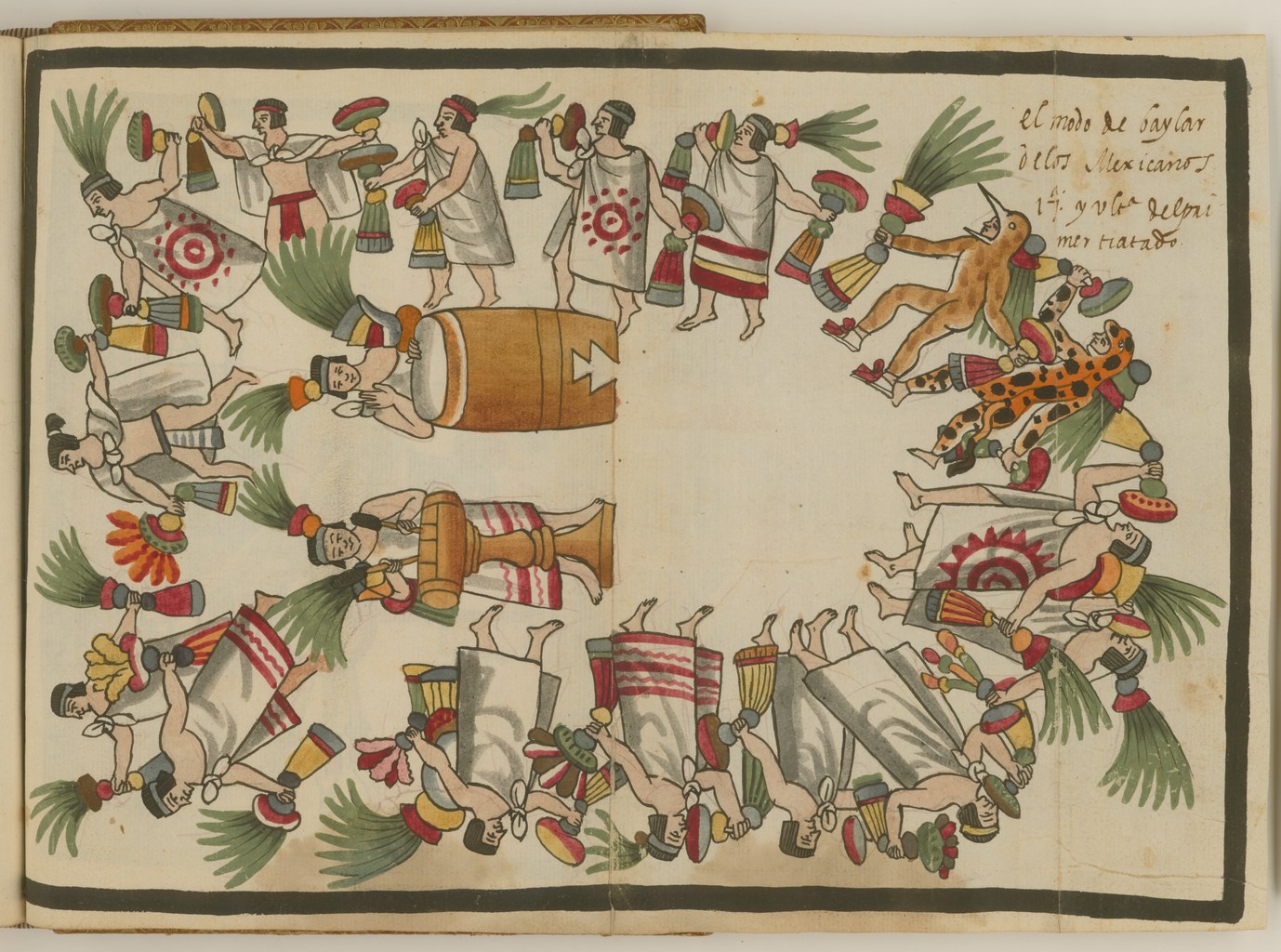
The Dancing Style of Aztec Noble Dancers WDL6751
Tovar, Juan de, circa 1546-circa 1626
- Medium:
- Watercolor
- Era:
- Pre-1700 (Renaissance/Baroque)
- Source:
- Wikimedia Commons
- Rights:
- Public domain — free to use, share and adapt.
- Recorded as:
- Public Domain
This image preserves rare visual evidence of Aztec ceremonial movement in an era when such knowledge was actively being suppressed and forgotten. For dancers and historians, it documents a form of human movement that was central to Aztec religious and political life but survives only in images like this and in fragmentary textual descriptions. The watercolor also demonstrates how indigenous and European artistic traditions intersected in the decades after conquest, offering insight into how knowledge systems collided and merged.
What you are looking at
This watercolor depicts a ceremonial gathering of Aztec nobles arranged in a frieze-like composition around the margins of the page. At the center stand two large figures wearing elaborate headdresses and regalia, likely leaders or ceremonial officials. The surrounding figures, rendered in a smaller scale characteristic of Aztec codices, wear feathered headdresses, elaborate textiles with geometric patterns in red and cream, and carry standardized bundles or insignia. The figures display dynamic postures — some with arms raised or extended, others in forward-leaning attitudes — suggesting coordinated movement or processional activity rather than static assembly. Green feathered elements (likely featherwork or plumage insignia) punctuate the composition, and striped banners or insignia are distributed throughout. The brown ink outlines and watercolor fills create a flat, hieratic visual field consistent with pre-Columbian pictographic traditions, yet the figural variety and attention to individual gesture suggest European artistic influence. The arrangement circles the composition's empty center, drawing the eye around the perimeter in the manner of a ceremonial circuit.
The dancing
The figures display a range of active postures: some stand with both arms raised to shoulder height or above, palms open or gesturing outward; others lean forward from the hips with arms extended. Several appear to hold objects — possibly ritual implements, musical instruments, or insignia bundles — in front of their bodies. The gait and bearing of many figures suggest forward motion or processional movement rather than static stance. All figures are rendered in a stylized profile or three-quarter view, with little anatomical modeling and consistent proportions suggesting a formulaic representation of noble status rather than individual portraiture. The smaller attendant figures are clustered more densely around the two central authority figures, implying a hierarchy of participation or rank.
The dance depicted
This image depicts Aztec ceremonial movement, most likely in the context of a religious or state ritual rather than what would be classified as recreational dance. Tovar's manuscript documents Aztec religious practice, and the composition suggests a ceremonial procession or coordinated ritual movement of nobles. The raised arms, forward-leaning postures, and dynamic spacing indicate that the participants were engaged in synchronized or patterned movement — whether processional, dance-like, or a hybrid ceremonial form is impossible to determine from the static image alone. Indigenous Mesoamerican ritual incorporated music, song, and coordinated body movement, and this watercolor likely documents one such occasion. The emphasis on regalia, insignia, and hierarchical positioning suggests the movement had ceremonial and political significance rather than purely devotional purpose.
How it was made
This is watercolor on paper in the European tradition, executed by a trained hand working within both European and Aztec pictographic conventions. The brown ink outlines, applied before color, are consistent with both European drawing practice and the line-work of native Mexican codices. The watercolor washes — reds, greens, yellows, and ochres — are applied flatly without modeling or shadow, preserving the hieratic quality of Aztec visual language while using a European medium and pigment palette. The technique allowed for large-scale legible reproduction and circulation in manuscript form, making it suited to Tovar's purpose of documenting Aztec religion for a Spanish audience. The precision of the line-work and the consistency of the color application suggest a professional workshop, likely in Mexico City in the decades following the conquest.
About this work
This watercolor from Juan de Tovar's codex (1585) depicts a ceremonial gathering of Aztec nobility engaged in synchronized ritual movement. Tovar, a Jesuit scholar born in Mexico City to a Spanish father and Mexican mother, compiled this visual and textual record of Aztec religious practice drawing on indigenous sources and his own knowledge of Nahua culture. The image sits at a crucial historical moment: it represents the last eyewitness knowledge of pre-conquest Aztec ceremonial practice being preserved in a European medium and for a European audience, while simultaneously using pictographic conventions inherited from Aztec manuscript tradition. As such, it is both an ethnographic document and an act of cultural translation, neither purely indigenous nor purely European, but a hybrid record of a vanished world made visible to outsiders.
How to look at it
The viewer should begin by noting the two central authority figures and their relationship to the surrounding crowd: their larger scale and central placement mark them as focal points of the ritual, yet the composition's circular organization means no single figure dominates. Next, trace the postures and gestures of the surrounding figures, paying attention to the raised arms, forward-leaning attitudes, and object-holding — these suggest coordinated movement even though the image freezes a single moment. Notice also the careful repetition and variation in costume: each figure wears the noble insignia and featherwork appropriate to rank, yet each is individualized through gesture and the specific details of headdress and textile pattern. Finally, observe how the artist uses the flat, outlined style of Aztec pictography while introducing the figural variety and spatial complexity of European drawing — the hybrid visual language itself tells the story of cultural contact.
The artist
Juan de Tovar (circa 1546–circa 1626) was a Mexican-born Jesuit of Spanish and indigenous heritage who became a scholar of Nahua history and religion. He compiled his codex in the 1580s drawing on indigenous pictorial manuscripts and oral testimony from Nahua elders, creating a systematic visual and textual record of Aztec religious calendars, mythology, and ceremonial practice. Tovar's position as a bilingual, bicultural insider gave him access to knowledge that Spanish-only speakers could not obtain, and his scholarly intent — to preserve and understand rather than simply condemn — shaped his careful documentation. The 51 full-page watercolors in his codex represent an extraordinary effort to render Aztec visual culture legible to a European scholarly audience while respecting its internal logic.
The period
Tovar's watercolor dates to the 1580s, more than sixty years after the fall of Tenochtitlan (1521) and in the early decades of the Spanish colonial regime. By this time, many Aztec religious practices had been suppressed or gone underground, and indigenous knowledge was being actively collected and recorded by Spanish friars and scholars who feared it would be lost. Tovar's codex emerges from this archival impulse, but with an unusual sympathy for the culture being documented. In Europe at the same moment, the Renaissance was at its height and the study of non-European cultures through visual documentation was becoming fashionable among scholars. Tovar's work contributed to the European knowledge of the Americas while simultaneously preserving indigenous memory in a form that could survive colonial suppression.
Where it lives
This watercolor is one of 51 full-page paintings comprising the Tovar Codex, attributed to Juan de Tovar and dated to 1585. The codex is a systematic visual record of Aztec religious calendars, mythology, and ceremonial practice, created in Mexico City for both indigenous and Spanish audiences. The current holding collection is not recorded in the available documentation.
Dance in this work
Questions about this work
Did Aztecs actually dance, or is this just ceremonial movement?
Aztec culture made no distinction between what we call dance and what we call ceremony — coordinated movement to music and song was integral to religious ritual, political display, and celebration. Images like this one likely depict a form that combined elements of both. The raised arms, synchronized postures, and hierarchical groupings suggest patterned movement that would qualify as dance in any culture's vocabulary.
Who was Juan de Tovar and why did he make this codex?
Tovar (circa 1546–1626) was a Mexican-born Jesuit of Spanish and indigenous heritage who became one of the foremost scholars of Nahua history. He compiled his codex in the 1580s by interviewing Nahua elders, consulting indigenous pictorial manuscripts, and drawing on his own knowledge. His goal was to preserve Aztec religious knowledge for historical and ethnographic study before it disappeared.
How much of this image is Aztec visual tradition and how much is European?
The flat, outlined style, the hieratic proportions, and the focus on regalia and insignia come from Aztec pictographic tradition. The figural variety, the spatial complexity, the watercolor medium, and the attention to individual gesture reflect European artistic training. The image is a genuine hybrid — neither purely indigenous nor purely colonial, but a new form created at the moment of cultural contact.
What do we actually know about Aztec dance?
We know it from Spanish eyewitness accounts, indigenous codices, Nahua-language texts, and images like this one. Aztec ceremony involved coordinated movement to drums and wind instruments, often in large ceremonial gatherings. Movement was tied to calendrical and religious occasions, and different ceremonies had different movement vocabularies. But much knowledge was lost or suppressed after the conquest, making visual documents like Tovar's codex invaluable.
More dance artwork