48 works in this view — arrow keys or swipe to move between them.
Dance in Art · 1929
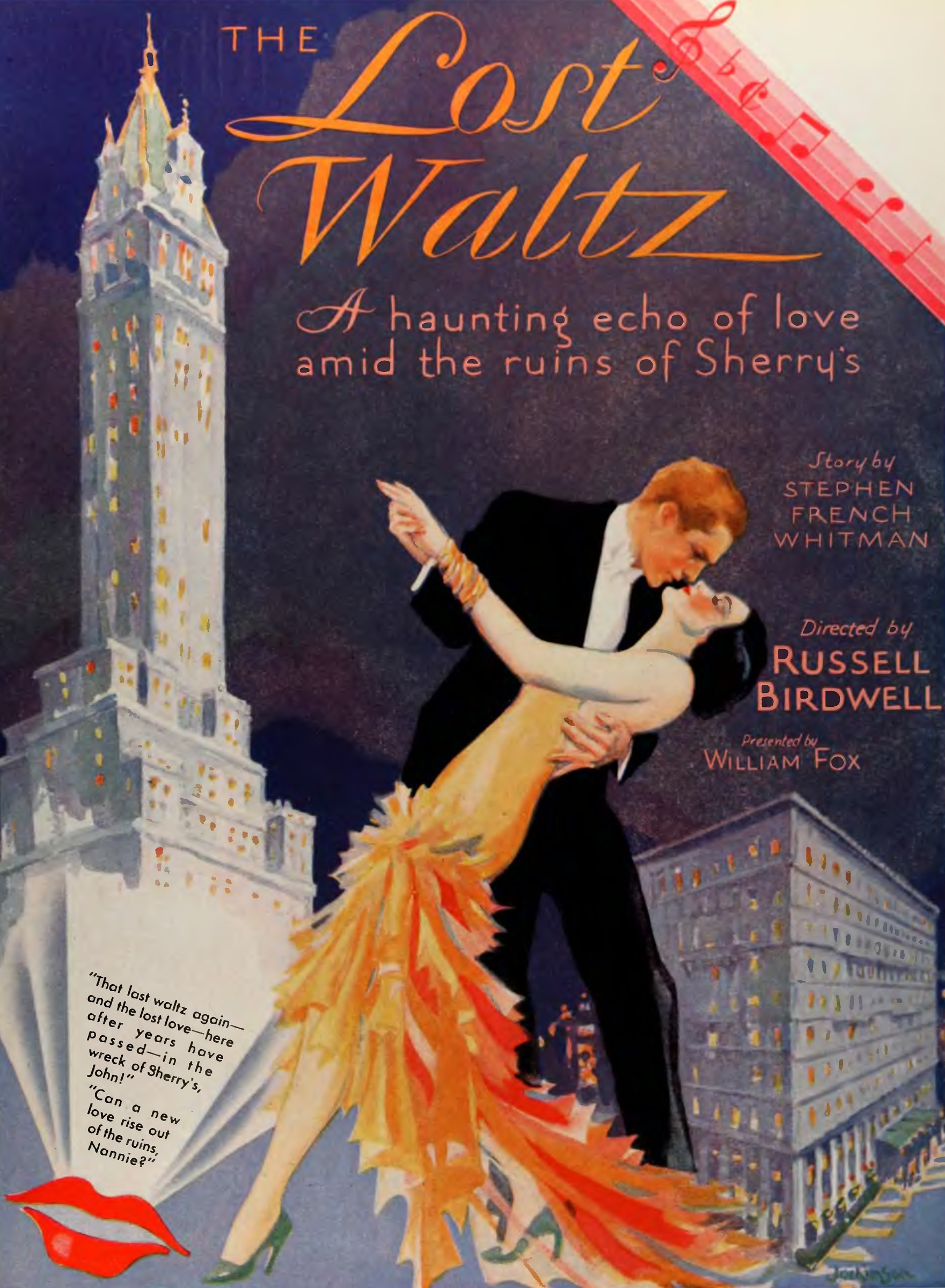
The Lost Waltz ad in The Film Daily, Jan-Jun 1929 (page 1479 crop)
New York, Wid's Films and Film Folks, Inc.
- Medium:
- Oil Painting
- Dance:
- Waltz
- Era:
- 1920-1950 (Swing Era)
- Source:
- Wikimedia Commons
- Rights:
- Public domain — free to use, share and adapt.
- Recorded as:
- Public Domain
This image reveals how the waltz was represented to American audiences in the late 1920s—not as a social practice or folk tradition, but as a theatrical and cinematic spectacle designed to evoke romance and elegance. The dramatic styling of the pose and the prominence of costume over technical accuracy show how commercial art adapted ballroom dance to the visual and narrative demands of mass media.
What you are looking at
This is a theatrical movie advertisement from 1929, rendered in oil paint with the saturated colors and stylized figures characteristic of Art Deco design. The composition centers on a couple in formal evening dress mid-waltz against a nighttime urban backdrop. The male dancer, in black tailcoat and white shirt front, supports a female dancer whose body is arched deeply in his arms, her legs extended in a dramatic line. She wears a golden-yellow gown with a voluminous skirt of orange and red feathers that dominates the lower half of the image, creating a sweeping diagonal across the frame. Behind them rises an illuminated skyscraper with lit windows, and to the right a second building anchors the composition. A red ribbon banner curves across the top; text announces the film title and credits. The artificial lighting casts a warm glow on the figures while the background recedes into cool blue-purple shadow, creating strong contrast that emphasizes the dancers' forms.
The dancing
The male dancer's frame is upright and controlled, his left arm extended to support the woman's back while his right guides her hand. The female dancer is in a dramatic backbend, her weight fully committed to his support, her right leg extended and her torso arched backward in a pose that prioritizes visual spectacle over technical waltz form. This is ballroom theatre rather than strict ballroom technique: the exaggerated arch and the feathered skirt's prominence suggest the pose was chosen for its visual drama and the ability to showcase costume rather than for its fidelity to waltz mechanics. The two figures are tightly bound in closed position, occupying the center of the frame.
The dance depicted
This is waltz, specifically as performed in the theatrical and commercial context of 1920s cinema—a stylized, dramatically posed interpretation rather than a social or competitive ballroom waltz. The pose is recognizable as derived from waltz vocabulary (the closed hold, the extended line of the woman's body), but the extreme backbend belongs to the theatrical tradition of presenting dance as spectacle for an audience rather than as a functional social movement. The feathered skirt and the emphasis on visual costume suggest this is from a Hollywood musical or ballroom-themed picture, where the dance serves the narrative and the visual composition serves the marketing of both the film and the fashion of evening wear.
How it was made
This is an oil painting, likely created specifically as a promotional illustration for the film's release. The technique is representational and illustrative, with careful attention to the rendering of fabric (the feathered skirt is especially detailed) and to the creation of atmospheric depth through color and light. As a theatrical advertisement, it was designed to circulate in trade publications like *The Film Daily* (where this crop was sourced) and in lobby displays, reaching both industry professionals and the cinema-going public. The artistic finish and the saturated, high-key color palette are characteristic of 1920s-30s commercial art, where visual appeal and narrative clarity were paramount.
About this work
This is a 1929 film advertisement for *The Lost Waltz*, a motion picture released by William Fox and directed by Russell Birdwell. The image is an oil painting that captures a moment of theatrical waltz as a form of entertainment spectacle, rendered in the exuberant visual language of Art Deco advertising. It documents the waltz as a central motif in 1920s American cinema and popular culture—a dance form that had already achieved the status of a romantic and nostalgic symbol, even as the advertisement's modern cityscape situates the film in a contemporary setting. The painting exemplifies how ballroom dance was marketed to mainstream audiences during the silent and early sound film era.
How to look at it
Observe the extreme backbend of the female dancer: this pose, while derived from ballroom movement, is held in an exaggerated and sustained manner that would be momentary in actual dance. The artist has frozen a theatrical apex—the moment of maximum visual drama—rather than a functional moment in the waltz's actual footwork. The feathered skirt is rendered with great care and occupies almost as much visual weight as the dancers themselves, signaling that costume and spectacle are integral to how this dance is being presented. Notice also how the urban setting (the skyscraper, the modern dress) anchors the romantic, old-fashioned waltz in a contemporary moment, suggesting the film's narrative plays on nostalgia and loss.
The artist
The attribution in the catalogue record lists "New York, Wid's Films and Film Folks, Inc." as the creator. Wid's Films and Film Folks was a trade publication and film industry service; it is unclear whether the painting was created in-house or sourced from a commercial artist or studio. The style is consistent with the work of theatrical and advertising illustrators of the period, but the specific artist is not identified in the available record.
The period
The late 1920s saw the waltz undergoing a cultural transformation in the United States. Once the dominant social dance of the nineteenth century, it had become increasingly associated with theatrical performance and with a romanticized European past, even as American jazz dances and Latin-influenced rhythms claimed the ballroom. The film industry, then in transition from silent to sound production, used ballroom dance and musical performance as central motifs in the new talkies. Fox Films and other major studios invested heavily in musicals and dance-based narratives, and promotional imagery like this painting were essential tools for reaching audiences and establishing the cultural prestige of dance cinema. The waltz, in particular, carried associations with old-world elegance and tragic or bittersweet romance—precisely the emotional register suggested by the film's title, *The Lost Waltz*.
Where it lives
This painting is sourced from *The Film Daily*, a major trade publication for the motion picture industry, where it appeared as a promotional illustration in the January–June 1929 issue (page 1479). It is a secondary or derivative work created as advertising material rather than a fine art original, and its current holding location is not recorded.
Dance in this work
Questions about this work
Is this a real painting or a poster?
It is a painting—created in oil specifically as advertising material. The distinction is important: this is not a lithographed poster or a photographic image, but a hand-painted illustration designed to be reproduced in print media. Such promotional paintings were common in the 1920s-30s film industry, where studios commissioned artists to create eye-catching images for trade publications and theater lobbies.
What was 'The Lost Waltz' and who danced in it?
The catalogue record confirms only that it was a William Fox film directed by Russell Birdwell, released in 1929. The tagline on the advertisement describes it as 'a haunting echo of love amid the ruins of Sherry's,' suggesting a romantic drama set in a nightclub. No cast information is available in the current record, and the painting serves as promotional imagery rather than documentation of actual performance.
Does the pose shown here match actual waltz technique?
The closed hold and the extended line of the woman's body are recognizable waltz elements, but the extreme and sustained backbend is theatrical rather than ballroom. In social or competitive waltz, the woman's body remains relatively upright, with the arch of the back being subtle. This pose prioritizes visual spectacle and costume display over functional technique, which is typical of how ballroom dance was adapted for stage and film performance.
Why did Hollywood market the waltz in the late 1920s?
By the 1920s, the waltz had become associated with nostalgia, old-world romance, and European elegance—valuable associations for films aiming at sophisticated urban audiences. The film industry was also in transition to sound, and musical and dance-centered narratives were a major draw. The waltz's status as a 'refined' or 'classical' dance made it useful for establishing prestige and pathos in a narrative.
More Waltz artwork