25 works in this view — arrow keys or swipe to move between them.
Dance in Art
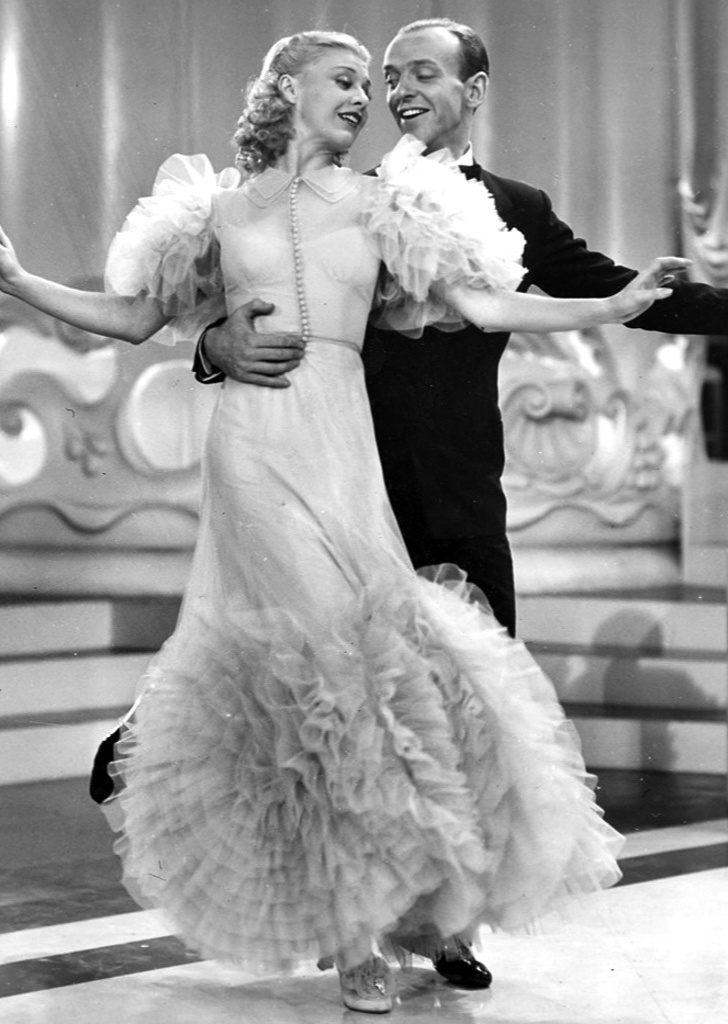
Fred Astaire and Ginger Rogers
Unknown artist
- Medium:
- photograph
- Era:
- 1920-1950 (Swing Era)
- Source:
- Wikimedia Commons
- Rights:
- Public domain — free to use, share and adapt.
- Recorded as:
- public_domain
This photograph documents a partnership that defined American ballroom dance on film and established visual standards for elegance, partnering, and movement that persisted across decades. For dance historians, it represents the moment when film dance became a mass medium and ballroom style became synonymous with Hollywood glamour and sophistication.
What you are looking at
A black-and-white promotional photograph showing two dancers in an elegant ballroom setting. The man, in black tie and tails, stands at the woman's left side with his right arm around her waist. The woman wears a floor-length white gown with voluminous ruffled sleeves and a low neckline, her blonde hair set in finger waves. Both dancers are smiling directly at the camera in a posed moment rather than mid-movement. The setting appears to be a formal stage or studio with classical architectural elements—fluted columns or pilasters—visible in soft focus behind them. The photograph's lighting is even and flattering, characteristic of 1930s studio photography. The composition emphasizes the pair's elegance and the woman's gown, which dominates the visual field with its cascading white fabric.
The dancing
The dancers stand in a semi-closed ballroom position with the man's right hand on the woman's back and his left hand extended. The woman's posture is upright and poised, with her body angled slightly toward the man. Both maintain formal, smiling expressions directed at the camera rather than each other—a convention of promotional still photography rather than a moment of genuine dance interaction. Their positioning suggests readiness to move rather than captured mid-step; the weight appears centered and balanced. The woman's voluminous sleeves extend well beyond her arms, creating visual interest but obscuring any detail of arm position or hand connection.
The dance depicted
This is a promotional still from a Hollywood musical film of the 1930s, capturing the ballroom dancing partnership that was central to the era's entertainment. The hold and posture align with American smooth ballroom styles—waltz and foxtrot—which dominated film choreography of this period. The formal evening wear, the classical studio setting, and the camera's direct address all confirm this as a professional entertainment photograph rather than a document of actual performance. The image shows the dancers as glamorous public figures rather than demonstrating specific choreographic content or footwork.
How it was made
This is a silver gelatin photographic print, a studio promotional still—the standard medium for distributing images of film dancers to press and the public during Hollywood's golden age. The photograph employs professional studio lighting to render both figures and fabric with clarity and flattering dimensionality. The careful composition and posed quality indicate this was shot in a controlled environment for circulation in newspapers, magazines, and fan publications. Such stills shaped public understanding of dance more through glamour and star power than through movement documentation.
About this work
This is a promotional still from a major Hollywood musical partnership of the 1930s, documenting two dancers posed in ballroom evening wear against a classical backdrop. The photograph belongs to the extensive visual archive of film dance from the Swing Era, when cinema was the primary medium through which American audiences encountered professional ballroom dancing. The image exemplifies how promotional photography functioned as both artistic and commercial work—creating an iconic visual of elegance and partnership that circulated far beyond the theater.
How to look at it
This is not a moment of movement but a composed image for public circulation. Notice the direct gaze at the camera and the balanced, stationary pose—conventions of promotional photography that announce the dancers' status as entertainers and public figures. The woman's gown, with its dramatic ruffled sleeves, dominates the composition, signaling luxury and spectacle. The classical architectural setting behind them establishes ballroom dance as refined and formally cultured. This is how the studio wanted audiences to imagine these dancers: elegant, glamorous, and accessible through the camera's gaze.
The artist
The photographer is not recorded in the catalogue. Studio still photography during Hollywood's golden age was typically the work of in-house studio photographers or contracted portrait specialists who remained uncredited. Such photographs were corporate assets produced under studio contracts rather than signed artworks, and their creators often remain anonymous in historical records.
The period
In 1936, ballroom dance in America was at the height of its popular visibility, driven by radio broadcasts of dance music and the massive reach of sound film. The Swing Era was establishing new standards for partner dancing in mainstream culture. Hollywood studios were producing musicals as major entertainment events, and ballroom sequences—particularly waltzes and foxtrots—were central to their appeal. The aesthetic of this photograph reflects 1930s modernist glamour: streamlined elegance, formal evening wear, and the cult of the star.
Where it lives
This photograph comes from Wikimedia Commons and is identified as a promotional still from 1936. It circulated publicly as part of the studio's marketing apparatus for the film, reaching audiences through newspapers, fan magazines, and theater lobbies.
Dance in this work
Questions about this work
Is this an action photograph or a posed studio portrait?
This is a posed promotional still. The dancers are not in motion; they are positioned and lit in a studio setting for the camera. Studio stills were shot separately from the film itself, often featuring the stars in elegant poses rather than mid-choreography. The direct camera gaze and stationary balance make this clear.
What ballroom dances would this partnership have performed?
The hold and evening wear align with American smooth styles—primarily waltz and foxtrot. These were the dominant ballroom dances in Hollywood film of the 1930s and the foundation of this partnership's reputation. The photograph does not show active footwork, so the specific choreography remains unknown from the image alone.
Why is the photographer uncredited?
Studio still photographers were contracted employees whose work was corporate property. Hollywood studios controlled and distributed these images without crediting individual photographers, treating them as commodities for marketing rather than as signed artworks. Photographer attribution for 1930s studio stills remains incomplete in many archives.
What does the gown tell us about 1930s ballroom fashion?
The white gown with voluminous ruffled sleeves exemplifies 1930s evening wear for women dancers—luxurious fabric, dramatic silhouettes, and bare shoulders were markers of glamour and sophistication. The gown is designed for visual impact and photograph-ability as much as for dance, with the ruffles creating movement and visual interest even when the dancer is stationary.
More dance artwork