49 works in this view — arrow keys or swipe to move between them.
Dance in Art · 1846
Ballet Paquita
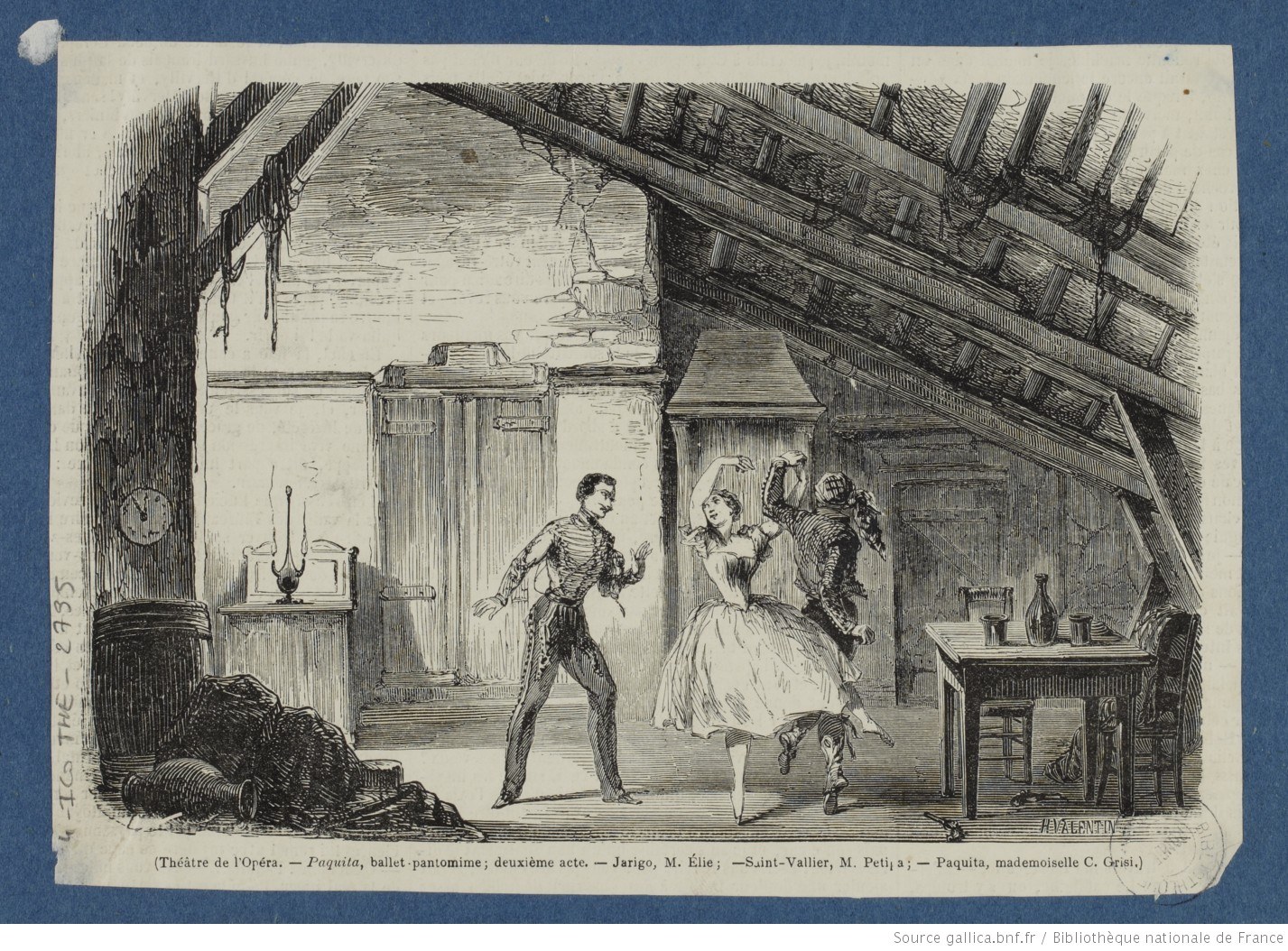
illustration de presse (H. Valentin)
- Medium:
- Oil Painting
- Dance:
- Ballet
- Era:
- Mid 1800s (Polka Era)
- Source:
- Wikimedia Commons
- Rights:
- Public domain — free to use, share and adapt.
- Recorded as:
- Public Domain
The image documents how Romantic ballet was experienced, circulated, and understood in the 1840s—not as abstract movement but as narrative spectacle with dance elements. For historians of dance, costume, and theater, it is evidence of what professionals considered worth recording and what the public was shown. The careful rendering of the dancers' bodies and the interaction between them shows that the artist understood ballet as a dramatic art form in which gesture, positioning, and emotional register mattered as much as steps.
What you are looking at
A scene from the second act of the ballet *Paquita*, rendered as a press illustration. The setting is a rustic interior—a simple dwelling with exposed wooden beams and a peaked roof visible above. A young woman in a voluminous white tulle skirt stands at center, her body in a graceful attitude. To her left, a man in ornate military dress (decorated coat with frogging and tight trousers) gestures expressively toward her. To the right, a second couple—a woman in similar white dress and a man in darker costume—watches or participates in the scene. A small table laden with bottles and glasses sits at the right, suggesting an informal gathering or celebration. The lighting is naturalistic, with what appears to be daylight filtering through an unseen window, and the composition emphasizes the theatrical moment of interaction between the figures rather than a formal pose.
The dancing
The central woman's posture suggests a moment of surprise or pleasure, her weight appearing to rest on one leg while the other extends lightly—a position consistent with classical ballet's emphasis on verticality and control. Her arms are raised and slightly open, neither fully extended nor held close to the body. The man's pose is more animated and declarative, his torso leaning slightly forward in an attitude of appeal or declaration. His arms are spread with palms outward. The composition suggests a narrative moment rather than a static demonstration of technique, with the figures' spatial relationships implying dialogue or interaction. The skirts of the women show the characteristic silhouette of Romantic-era ballet—full, calf-length, and buoyant—though they are rendered more as costume than as the ethereal tutus of later conventions.
The dance depicted
*Paquita* was a romantic ballet first performed in 1846, with choreography by Paul Foucher and music by Ernest Deldevez. The ballet tells the story of a Spanish gypsy woman (Paquita) and her romantic entanglement with a nobleman. This appears to be a scene of flirtation or confession, central to the narrative structure of Romantic ballet, which valued dramatic character interaction and pantomime as much as pure dance vocabulary. The engraving captures the ballet as a theatrical drama with dance elements, typical of how narrative ballets were both performed and documented for press circulation.
How it was made
This is a wood engraving or steel engraving, reproduced as a press illustration. The fine parallel lines (hatching and cross-hatching) that model form, shadow, and drapery are characteristic of mid-19th-century newspaper and magazine reproduction. The technique allowed for sharp, clear printing in large editions, making this an image intended for broad circulation in the French press. The fineness of the line work—particularly visible in the depiction of wood grain and fabric folds—indicates skilled hand-engraving rather than a simple woodcut, suggesting this was created from a drawing made from performance or a studio study, then transferred to the plate by a professional engraver.
About this work
This is a mid-19th-century press illustration documenting a scene from Paul Foucher's *Paquita*, one of the enduring ballets of the Romantic era. It captures not the abstract beauty of technical virtuosity but the theatrical narrative moment—the interaction of characters, the play of emotion, the intersection of costume and gesture that made Romantic ballet a dramatic form. The image is valuable precisely because it shows how the ballet was understood by its contemporary audience: as theater, not as a vehicle for pure dance. The engraving's circulation in the press made the ballet visible to people who could not attend the theater, and its composition and detail suggest what contemporary reviewers valued in the performance.
How to look at it
Attend first to the composition and the narrative gesture rather than the technical display. The artist has chosen a moment of social interaction—a declaration, a response, a moment of tension or pleasure—rather than a moment of virtuosic display. Look at the position of the woman's body: she is not in a pose of extreme extension or contortion, but in an attitude of graceful openness, her weight clearly supported, her line refined but not exaggerated. This is the aesthetic of Romantic ballet: legibility, grace, and emotional expressiveness rather than the spectacular difficulty that would become valued later in the century. Notice also the dress—the full white skirt, the slippers barely visible at the hem, the fitted bodice—which defines the visual aesthetic of the period and makes clear the distinction between Romantic and later Classical or Modern ballet.
The artist
H. Valentin (artist credited on the plate) was a professional press illustrator working in Paris during the 1840s. Nothing certain is known of his individual biography, but the quality of his work places him within the circle of skilled commercial engravers who supplied illustrations to the daily and weekly press. Press illustrators of this period worked from sketches made at performances, studio studies by dancers, or descriptions provided by editors. Valentin's rendering of *Paquita* is typical of the theatrical press illustration of the period—documentary in intention, dramatic in composition, and technically accomplished in its use of engraving to convey texture, light, and narrative moment.
The period
The 1840s were the apex of Romantic ballet in Paris. Marie Taglioni, Carlotta Grisi, Fanny Elssler, and Fanny Cerrito dominated the stage, and the ballet d'action—the narrative ballet with dramatic pantomime—was the dominant form. The period saw the creation of works that remain in the repertory: *La Sylphide* (1832), *Giselle* (1841), *La Peri* (1843), *Paquita* (1846). The press played a crucial role in making these spectacles visible to a wider public through illustration, and the quality of press illustrations like this reflects the cultural importance of ballet in Parisian life. Simultaneously, the development of lithography and improved engraving techniques made theatrical illustration more sophisticated and more widely distributed than ever before.
Where it lives
This is a press illustration, originally published in a French newspaper or periodical; the source record indicates it is now held in the Bibliothèque Nationale de France. The archival reference number (IFN-2735) places it within the BnF's collections of printed press ephemera. It is the kind of object that circulated widely when first published but has surviving value primarily as documentary evidence of theatrical history.
Dance in this work
Questions about this work
Is this a painting or a print?
This is an engraving—a metal plate image printed from multiple impressions. The fine parallel lines that create shadow and texture are the characteristic mark of the engraving technique, used for press illustration throughout the 19th century. It was never intended as a unique work but as a reproducible image for newspapers and magazines.
Can I tell how the ballet was actually danced from this image?
Yes, with caution. You can see the aesthetic ideals—the elegant verticality, the lightness of the limbs, the expressiveness of the arms—and the costume that defined Romantic ballet. You cannot see the specific vocabulary of steps or the exact timing of movement. What the engraver chose to freeze was the moment of maximum dramatic clarity, not necessarily the moment of greatest technical difficulty.
Why was this published?
*Paquita* was a successful ballet that attracted a paying public. Press illustrations like this were advertisements and also cultural documentation. They let people who had seen the ballet relive the experience, and let people who could not attend know what they were missing.
What does the setting tell us about the ballet's story?
The rustic interior—the simple cottage, the rough wood—suggests a scene away from court. *Paquita* is set partly in Spain and involves a gypsy heroine, so this modest setting fits the narrative. Romantic ballets often contrasted aristocratic court scenes with exotic or rustic locations to heighten dramatic effect.
More Ballet artwork