49 works in this view — arrow keys or swipe to move between them.
Dance in Art · 2023
Inquino
Italo somma
- Medium:
- Oil Painting
- Dance:
- Ballet
- Source:
- Wikimedia Commons
- Rights:
- Public domain — free to use, share and adapt.
- Recorded as:
- CC0
The work raises crucial questions about what remains of ballet when a painter strips away anatomical plausibility and muscularity in favor of abstract form. It suggests that the essence of ballet training—discipline, verticality, the raised arch, the pointe shoe—persists even when the body becomes sculpture. For dancers and historians, it offers a window into how contemporary visual artists engage with ballet not as lived practice but as a formal system.
What you are looking at
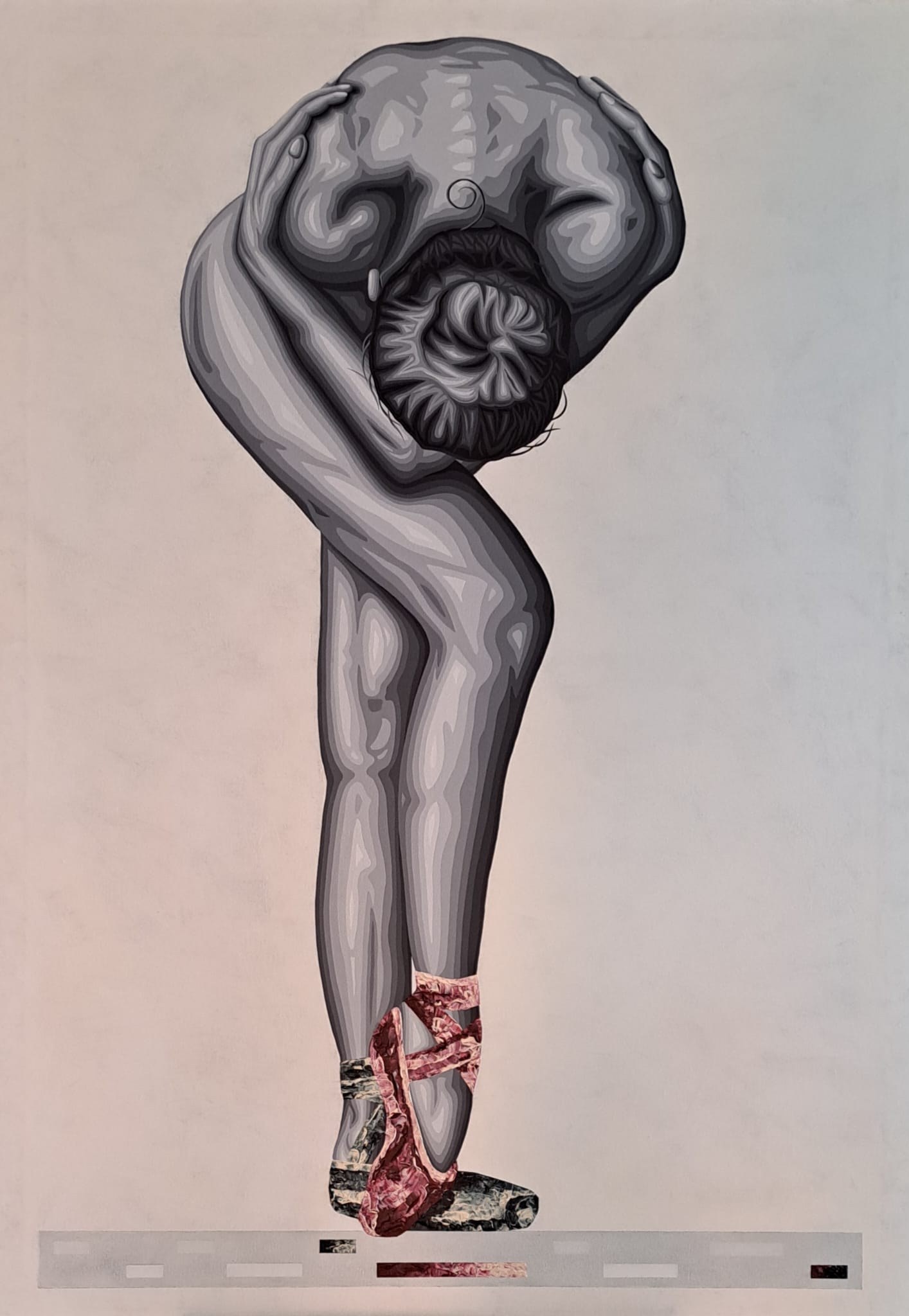
A sculptural figure in grayscale dominates the composition: an elongated, stylized human form bearing an exaggerated bearded head with curled hair rendered in elaborate classical detail. The body is abstracted into a single attenuated column, as if the dancer's torso has been stretched and simplified to the point of abstraction. At the base, vivid crimson-red pointe shoes—rendered in sharp chromatic contrast to the monochromatic body above—anchor the figure to a gray platform. The shoes are positioned en pointe, their ribbons visible. The pose suggests extreme backward lean or contortion, with the head tilted so far back that it nearly reverses onto itself, creating an impossible, dreamlike arabesque or port de bras. The juxtaposition of classical sculptural finish on the head and body with the realistic detail of the ballet footwear creates a surreal hybrid: part classical statue, part contemporary dancer.
The dancing
A single figure, rendered as a continuous abstracted form from head to heels, demonstrates an extreme port de bras with the head thrown far back and the body elongated vertically. The neck is extended almost impossibly; the torso reads as a single unified column rather than distinct chest and waist. The feet are positioned in a classical ballet stance, en pointe, suggesting training and technique despite the formal distortion of everything above. The overall frame is unstable and surreal—the weight appears to rest entirely on the balls of the feet in an exaggerated relevé, with the upper body committed to a backward port de bras that violates anatomical expectation.
The dance depicted
This work depicts ballet, specifically a hyperextended port de bras or arabesque moment pushed into formal and surreal territory. The pointe shoes and their precise ribbon work confirm balletic training; the backward tilt of the head and extension of the neck suggest extreme flexibility work or a romantic-era dramatic pose. However, the artist has subordinated anatomical plausibility to formal abstraction, making the work less a documentation of actual technique than a formal exploration of the body in ballet. The image asks whether ballet—a discipline of precise, trained movement—can be stretched into pure sculptural form.
How it was made
Executed in oil paint, the work demonstrates disciplined tonal modeling in grays and blacks across the body and head, creating the effect of carved stone or plaster sculpture. The artist has reserved vivid color exclusively for the pointe shoes, a deliberate choice that anchors the balletic reality to an otherwise abstracted form. The shift from monochromatic sculptural rendering to detailed naturalism in the footwear is technically controlled and conceptually important: it grounds the surreal upper body in the concrete fact of trained ballet technique. The painting's finish is smooth and controlled, appropriate to the classical and sculptural references.
About this work
*Inquino* by Italo Somma (2023) is a contemporary oil painting that fuses classical sculpture with ballet iconography. A single elongated figure, rendered in grayscale as though carved from stone, displays an extreme and impossible port de bras—the head thrown backward, the neck extended, the body abstracted to a columnar form. Only the feet ground the figure in recognizable ballet technique: pointe shoes, rendered in vivid red with detailed ribbonwork, position the dancer en pointe on a gray platform. The work belongs to a series the artist describes as painted using *Código Somma*, a methodology the artist has applied across their dance painting series. This is contemporary art that uses ballet as a formal and conceptual language rather than documentary subject.
How to look at it
Attend first to the precise moment of the port de bras—notice how far backward the head tilts and how the neck elongates impossibly. Observe how the artist has modeled the classical head and beard with sculptural care, as though it were stone. Then drop your eye to the feet: the shift from grayscale abstraction to vivid red and detailed ribbonwork is not incidental. The artist is saying something deliberate about where ballet's reality lives—in the trained foot, the pointe, the evidence of technique. The backward arc of the body, if completed, would tip the figure off balance; the pointe shoes alone keep it upright.
The artist
Italo Somma is an Italian contemporary artist whose practice centers on representations of dance, particularly ballet. The work is part of a series to which Somma applies *Código Somma*, a technical methodology governing how he approaches the figure and movement in paint. His work sits at the intersection of contemporary abstraction and dance documentation, treating the body as both form and concept.
The period
Created in 2023, *Inquino* emerges in a moment when contemporary visual art increasingly treats dance not as subject for narrative painting but as a formal language. This work reflects broader 21st-century artistic practice of abstracting and estranging the human figure while maintaining references to disciplined bodily practice. It engages with the long history of ballet representation in visual art while deliberately departing from realism.
Where it lives
The work is catalogued as an oil painting from 2023 and is held in the Wikimedia Commons. No collection location or accession information is currently recorded.
Dance in this work
Questions about this work
Is this an actual ballet pose?
No. While the port de bras and the pointe work reference real ballet training, the extreme backward angle of the head and the impossibly extended neck are formal exaggerations. The artist has pushed a recognizable balletic gesture into abstraction and surrealism to explore what remains of ballet when anatomical possibility is removed.
What is 'Código Somma'?
According to the artist's statement, Código Somma is a technical methodology Somma applies to his dance painting series. The catalogue record does not elaborate further, but it appears to be a systematic approach governing how he renders the figure and movement. The precise principles remain to be documented in available sources.
Why are only the shoes in color?
The deliberate use of vivid red for the pointe shoes and gray for everything else anchors the work's surreal abstraction in a concrete balletic reality. The shoes—with their ribbons and precise en pointe positioning—are the evidence that this is a dancer, not merely a sculptural form. Color isolates them as the work's grounding point.
More Ballet artwork