49 works in this view — arrow keys or swipe to move between them.
Dance in Art · 1950
José Clemente Orozco, Ballet y máscaras
José Clemente Orozco
- Medium:
- Oil Painting
- Dance:
- Ballet
- Era:
- 1920-1950 (Swing Era)
- Source:
- Wikimedia Commons
- Rights:
- Public domain — free to use, share and adapt.
- Recorded as:
- Public Domain
This work documents a crucial moment in twentieth-century dance history when ballet began to be absorbed into expressionist and avant-garde visual vocabularies. For dancers and dance historians, it shows how the language of ballet—extension, elevation, turnout—could be reclaimed for purposes other than classical narrative or formal purity. For art historians and visual culture scholars, it reveals Orozco's sustained interest in the dancing body as a metaphor for psychic and social transformation.
What you are looking at
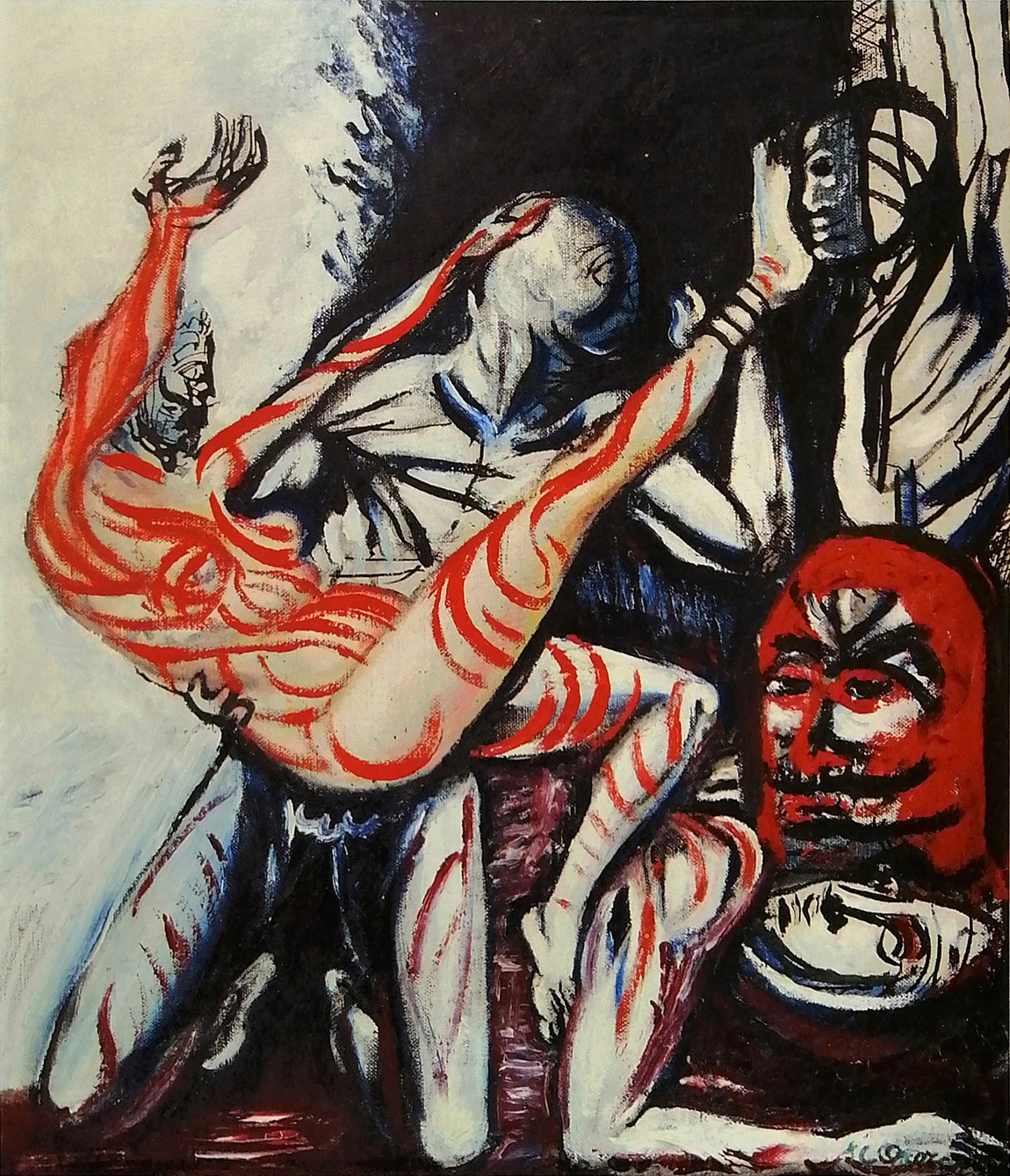
A theatrical scene bursts with expressionist energy and symbolic masks. A central male figure in dark trousers and pale torso dominates the composition, arms raised in an arabesque or attitude, his body arching dynamically. He wears a white mask with dark features. Around him swirl billowing red fabrics—scarves or drapery—that create violent diagonal lines across the canvas. To the right stands a female figure in profile, also masked, her posture more contained. Above and behind float two additional masked faces—one rendered as a pale profile, another a striking red theatrical mask with white details and a grimacing expression. The background is divided: pale cream on the left, deep black on the right, with geometric linework suggesting architectural or mechanical elements—possibly stage machinery or scaffolding. The entire composition radiates psychological tension and carnival grotesquerie rather than classical grace.
The dancing
The principal dancer occupies the center with an extended balletic port de bras—one arm lifted high, the other swept outward—and a pronounced spinal arch. His weight appears lifted rather than grounded, suggesting a moment of suspension or elevation. The pose is individually expressive rather than symmetrical or aligned in any classical formation. The secondary figure maintains a more earthbound stance. All figures are masked, depersonalized, which distances them from naturalistic human interaction. The work shows understanding of balletic vocabulary—turnout, arm carriage, extension—but deploys it expressively rather than formally.
The dance depicted
This is unmistakably ballet, recognizable from the pose vocabulary, the lifted carriage, and the implied theatrical spectacle. However, this is not classical or romantic ballet. The title *Ballet y máscaras* (Ballet and Masks) declares the subject, and the expressionist treatment—the angular distortions, the psychological masks, the violent color and gesture—suggests either a modernist or avant-garde ballet of the early-to-mid twentieth century. The work reflects the influence of mask-based performance traditions (commedia dell'arte, carnival) on European theatrical dance. The dance appears to be an interior psychological or symbolic event rather than narrative ballet.
How it was made
This is oil painting on canvas. The technique is expressionist and loosely handled: areas of intense color (particularly the screaming reds) are applied with visible brushwork, while other areas—the white mask, the geometric forms—use sharper edges and flatter application. The artist has deliberately avoided atmospheric perspective or volumetric modeling in favor of symbolic form and emotional intensity. This approach prioritizes expressive content over illusionistic representation, making the work legible as a statement about the psychological or spiritual meaning of the dance rather than a documentary record of a performance.
About this work
José Clemente Orozco (1883–1949) was a Mexican muralist and painter central to the post-revolutionary Mexican art movement. This work dates to 1950, near the end of his life, and represents his engagement with theatrical and bodily expression as vehicles for psychological and social meaning. Orozco's career spanned from the Mexican Revolution through the mid-twentieth century, and his public murals addressed themes of labor, suffering, indigenous identity, and the human cost of political upheaval. This painting brings that sensibility into the balletic body: the dancer is not an idealized form but a vehicle for interior states—anxiety, ecstasy, alienation. The masks and distortions transform ballet from a European courtly tradition into a site of modernist experimentation and psychological investigation.
How to look at it
Attend first to the arabesque or attitude pose at the painting's center: the lifted arm and extended line are classically balletic, but the distorted musculature, the aggressive color, and the mask drain the pose of its conventional elegance. The red fabrics—are they part of the costume, or are they emotional registers made visible?—pull the eye in violent diagonals that contradict the stillness of the pose. The masks are crucial: they invite comparison with commedia dell'arte and carnival traditions, which influenced early modernist dance (think of the Ballets Russes). The geometric stage machinery in the background insists that this is theater, a constructed event, not nature. Finally, notice the isolation of the dancer despite the surrounding figures: even in a scene crowded with bodies and faces, the central figure appears psychologically alone.
The artist
José Clemente Orozco (1883–1949) was one of the three great muralists of the Mexican Renaissance, alongside Diego Rivera and David Alfaro Siqueiros. His work was characterized by expressionistic distortion, bold social messaging, and formal innovation. Though he is best known for large-scale public murals—on walls in Mexico, the United States, and Latin America—he also produced smaller paintings, drawings, and lithographs exploring similar themes. His late work, including this painting, grew increasingly abstract and psychological, moving away from literal representation toward symbolic and interior states. Orozco's engagement with the human figure remained constant throughout his career; the body for him was always a site of political and emotional meaning.
The period
In 1950, European and American ballet was undergoing profound transformation. George Balanchine and the New York City Ballet had begun abstracting classical ballet away from narrative and character, emphasizing pure movement and music. Simultaneously, Martha Graham and the American modern dance movement were exploring psychological depth, emotional authenticity, and the expressive distortion of the human body. In Europe, the post-war avant-garde—including experimental theater, expressionist art, and surrealism—was wrestling with trauma, alienation, and the search for authentic human expression. Orozco's painting sits within this international ferment: it belongs neither to classical ballet nor to straight modern dance, but to the broader moment in which all theatrical movement was being reexamined through expressionist and psychological lenses.
Where it lives
The work is recorded as an oil painting dated 1950, attributed to José Clemente Orozco. No holding collection is specified in the catalogue record; the image source is listed as Wikimedia Commons.
Dance in this work
Questions about this work
Is this a real ballet or a made-up one?
The painting is titled *Ballet y máscaras* and depicts a recognizable balletic pose, but it does not document a specific, named ballet. The artist has instead created an expressionist interpretation of what ballet—or what it might mean—could be. The title tells us the subject is 'ballet and masks,' not a particular performance. The work belongs to a broader early-twentieth-century conversation about how mask-based and ritualistic traditions might infuse or transform classical ballet.
What do the masks mean?
The masks carry multiple associations: commedia dell'arte (the theatrical tradition of masked comedy and character types), carnival and festival, the erasure of individual identity, and psychological or spiritual doubling. By masking all the figures, Orozco distances them from naturalistic portrayal and invites a reading in terms of types, archetypes, or interior states. The masks transform the ballet from a display of individual skill or beauty into a symbolic or ritualistic event.
Who danced this?
This is not a record of a specific performance or dancer. It is a visual meditation by a painter on the potential meanings of ballet. However, the work reflects Orozco's knowledge of modern and experimental dance, and its expressionist style aligns with the work of experimental choreographers of the 1930s–1950s who were also engaged in transforming classical ballet through psychological and symbolic content.
Why is the painting so distorted and expressionistic?
Orozco was working in the expressionist tradition, which prioritized emotional and psychological truth over illusionistic representation. For him, the dance was not a subject to be accurately depicted but a vehicle for exploring interior states—anxiety, ecstasy, spiritual seeking. The distortion, the violent reds, the fragmentation of the composition, and the surrounding masks all serve to convey a sense of psychological urgency rather than balletic perfection.
More Ballet artwork