49 works in this view — arrow keys or swipe to move between them.
Dance in Art · 1844
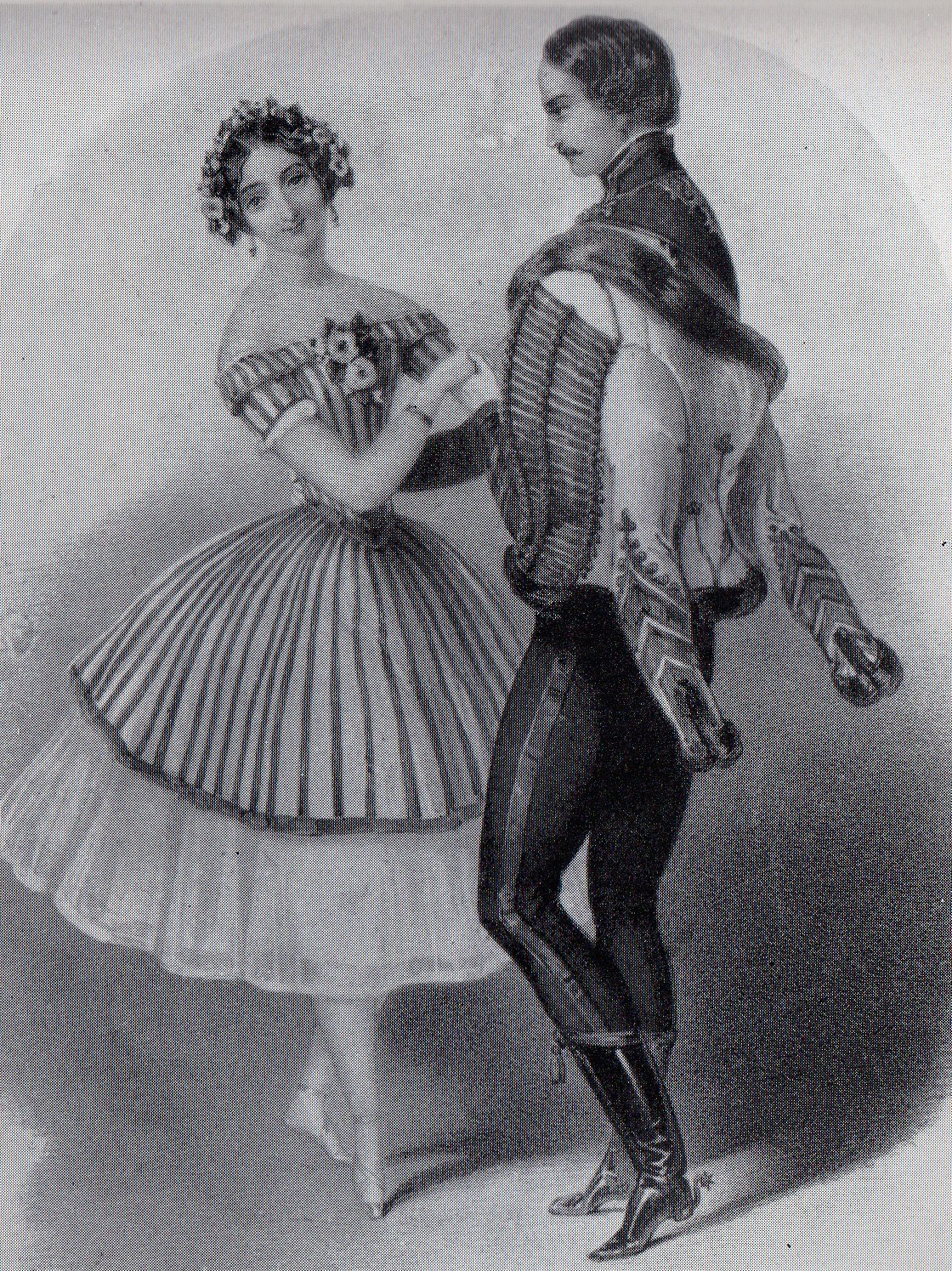
Paquita -Carlotta Grisi as Paquita & Lucien Petipa as Lucien -1844
Unknown artist
- Medium:
- Oil Painting
- Dance:
- Ballet
- Era:
- Mid 1800s (Polka Era)
- Source:
- Wikimedia Commons
- Rights:
- Public domain — free to use, share and adapt.
- Recorded as:
- Public Domain
This image documents one of the most celebrated ballets of the Romantic era and preserves a record of how Carlotta Grisi, one of the period's greatest dancers, was dressed and presented in a leading role. For historians and dancers, it provides concrete visual evidence of Romantic-era costume, posture, and theatrical representation at a moment when ballet was establishing itself as a major European art form.
What you are looking at
A man and woman in early 19th-century dress are shown in a moment of courtship or social interaction. The woman, positioned on the left, wears a voluminous white ball gown with a fitted bodice and dramatically pleated skirt that extends to the floor; her dark hair is arranged in ringlets adorned with flowers. The man, shown in profile on the right, wears a dark military-style coat with ornate braiding and epaulettes, fitted dark trousers, and polished boots. The two figures occupy a neutral, plain background that emphasizes their costumes and posture. The woman looks toward the viewer with a composed expression while the man gazes downward or away, creating a formal, staged quality typical of theatrical portraiture. The composition suggests a moment from a ballet narrative—likely a scene of introduction or flirtation between characters.
The dancing
Both figures stand in upright, formal posture characteristic of classical ballet of the period. The woman's weight appears centered, her frame open and presented to the viewer; her arms hang naturally at her sides, one hand possibly holding her skirt. The man stands beside her in a slightly turned position, his posture respectful and formal, with his arms also held naturally. Neither figure appears to be in motion or executing a visible step; instead, they are posed as if frozen in a moment of interaction. The spatial relationship between them—close but not touching—suggests social propriety and the conventions of courtship display.
The dance depicted
This is a portrait of a scene from *Paquita*, a three-act ballet that premiered at the Paris Opéra in 1846. The ballet tells the story of Paquita, a Spanish gypsy dancer, and her romance with Lucien, a French officer. The inscription identifies the figures as Carlotta Grisi, the Italian prima ballerina who created the role of Paquita, and Lucien Petipa (brother of the choreographer Marius Petipa), who danced the male lead. The image captures a moment of dramatic encounter rather than an active dance phrase, showing the ballet's romantic plot through costume and character portraiture rather than through visible steps. *Paquita* was one of the major works of the Romantic ballet era and showcased Grisi's fame across Europe.
How it was made
This is a lithograph, a printing process well-suited to theatrical promotion and circulation. The fine hatching visible in the rendering of fabric textures, the subtle gradations of gray tone, and the ability to capture both delicate detail and bold contrast are characteristic of lithographic technique. As a printed work, this image would have circulated widely among the Paris theater-going public and across Europe, serving as both a record of the production and publicity for the dancers. The medium allowed for relatively rapid production and distribution compared to oil painting, making it the standard format for theatrical and operatic portraiture of the 1840s.
About this work
This is a lithographic portrait of two dancers in character from *Paquita*, the 1846 Paris Opéra ballet created for the Italian prima ballerina Carlotta Grisi. The work documents the appearance and costumes of a major Romantic-era ballet, capturing both the visual splendor of early 19th-century dance spectacle and the theatrical conventions of character portrayal. The image belongs in a dance gallery both as a record of how a celebrated work looked on stage and as evidence of how Romantic ballet dancers were marketed and remembered through printed imagery.
How to look at it
This is not an action image: it freezes a moment of stillness or encounter rather than capturing a leap, turn, or rapid movement. Look at how the artist has used costume and posture to convey character and drama—the woman's commanding presence and direct gaze, the man's deference and formality. The extremely full skirt and the fitted military coat both signal the technical demands of the period: the skirt required control of line and balance, while the male costume emphasized the dancer's body beneath ornament. The composed, almost portrait-like quality reflects the Romantic ballet's narrative structure, where such moments of encounter between characters drove the plot.
The artist
Not recorded in the catalogue. However, the lithograph's style and circulation context suggest it was produced by a commercial theatrical print shop in Paris, likely in the immediate aftermath of the ballet's 1846 premiere. Such portraits were a standard product of Parisian theaters and opera houses, created to meet public demand for images of celebrated performers.
The period
The 1840s were the height of the Romantic ballet era. Carlotta Grisi had recently triumphed in *Giselle* (1841) and was among the most celebrated dancers in Europe. *Paquita* premiered in 1846 as a vehicle for her talents, combining Spanish-inflected exoticism (popular with Romantic audiences) with the technical display and emotional narrative expected of major works. This period saw intensive circulation of theatrical imagery in print form—lithographs, engravings, and woodcuts—as a way to extend the fame of performers beyond the theater and to build anticipation for productions. The dance world was intensely visual and image-conscious, and printed portraits served as both souvenirs and publicity.
Where it lives
Sourced from Wikimedia Commons. The specific holding collection is not recorded in the catalogue. This is a commercial theatrical print, the kind produced and sold in Paris during the 1846 season and subsequently.
Dance in this work
Questions about this work
Who was Carlotta Grisi?
Carlotta Grisi (1819–1899) was an Italian prima ballerina who became one of the most celebrated dancers of the Romantic era. She is best known for creating the role of Giselle in the 1841 ballet of the same name. She danced across Europe and was a favorite of Parisian audiences, who saw her as embodying the grace, technical mastery, and emotional depth that defined Romantic ballet.
What was Paquita about?
*Paquita* is a three-act ballet about a Spanish gypsy dancer (Paquita) and her love story with a French officer (Lucien). It combined Spanish and exotic themes popular with Romantic audiences with classical ballet technique and narrative spectacle. The work has survived in modified forms and is occasionally performed today, though usually as a one-act work or in versions substantially altered from the original.
Why were these prints made?
Theatrical prints served multiple purposes: they were souvenirs for audience members to take home, publicity to build interest in current and future productions, and a way to extend a dancer's fame beyond the theater. In an era before photography, printed images were the primary way a dancer's appearance and costume reached a wide public. These prints circulated in Paris and were exported to other European cities where the same dancers performed.
How do I read the costumes?
The woman's white gown with its dramatically full skirt signals her role as the romantic heroine and shows off the technical control required of a Romantic-era prima ballerina. The man's military coat with ornate braiding identifies him as a nobleman or officer and emphasizes his role as lover and social superior. Both costumes reflect the period's taste for elaborate, colorful stage dress and the importance of visual spectacle in Romantic ballet.
More Ballet artwork