49 works in this view — arrow keys or swipe to move between them.
Dance in Art · 1915
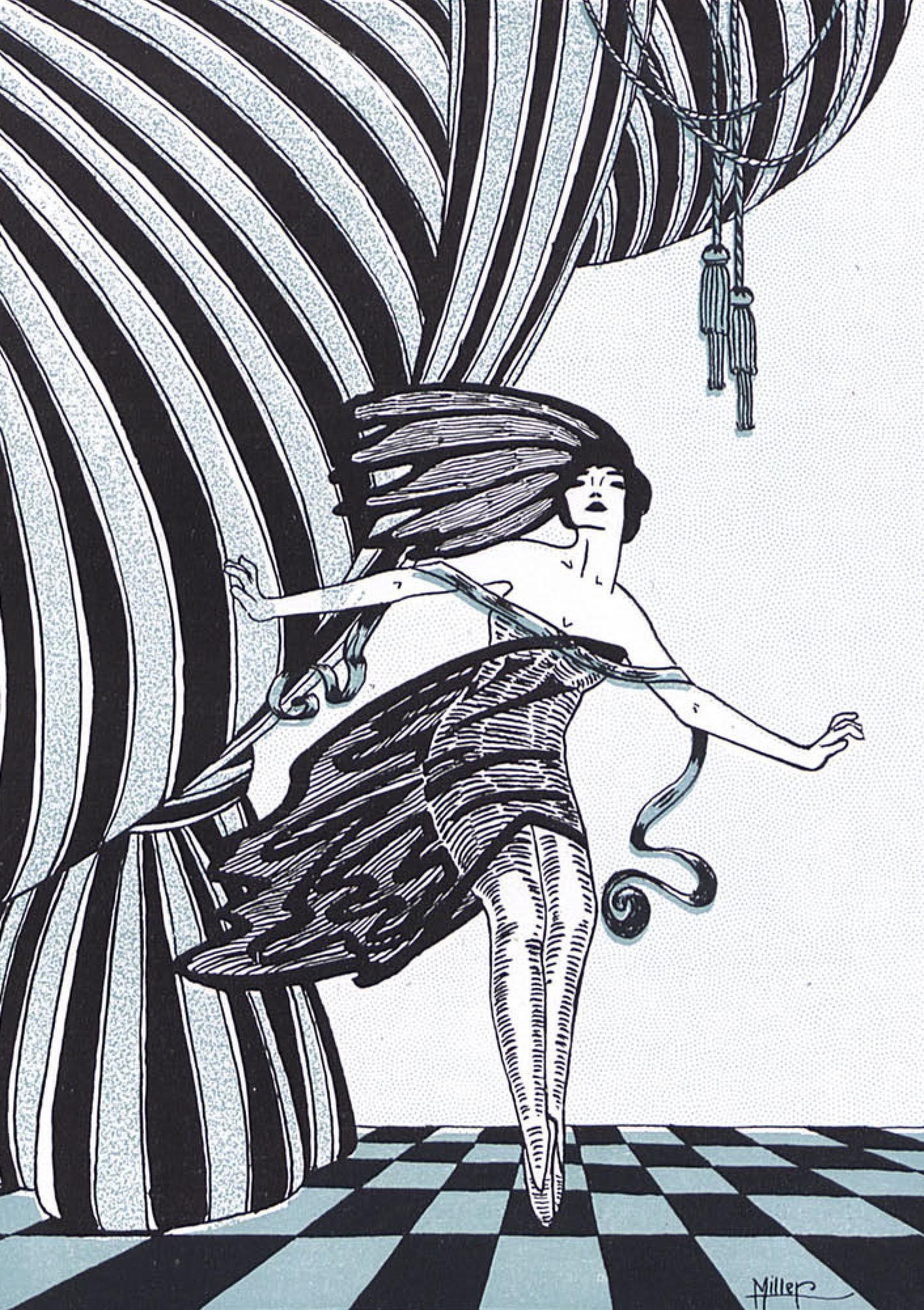
"Dramatics" page dancing art, Cap and Gown 1915 University of Chicago yearbook (page 173 crop)
University of Chicago
- Medium:
- Oil Painting
- Era:
- 1900-1920 (Ragtime/Early Jazz)
- Source:
- Wikimedia Commons
- Rights:
- Public domain — free to use, share and adapt.
- Recorded as:
- Public Domain
This image documents the presence of modernist, emotionally expressive theatrical dance in American university culture before Denishawn and Ruth St. Denis had reached broad institutional influence. It shows how the visual language of dance in this period was already experimental and art-directed, not merely documentary. The art deco graphic treatment itself is historically significant—how the dance is drawn reveals as much about 1910s artistic values as what the dance itself expresses.
What you are looking at
A single female figure dominates this art deco illustration, posed in dramatic movement against an architectural backdrop of radiating curved lines that suggest either drapery or a fantastical interior space. The dancer's body is rendered in an elegant linear style with fine cross-hatching for shading on her legs and torso. She wears a short, dark geometric costume with angular wings or fin-like extensions that emphasize the silhouette. Her head is tilted back, eyes closed or nearly closed, her dark hair swept dramatically across her face. One arm extends outward in an open gesture while the other curves gracefully; her body leans into a pronounced asymmetrical pose. The lower half of the composition features a striking checkered floor in light blue and dark tones, adding spatial depth. The upper portion is dominated by the sweeping radiating lines—alternating white, gray, and black—that create a sense of explosive movement or theatrical grandeur. A tassel or ornamental detail hangs in the upper right. The overall composition conveys motion, elegance, and a theatrical sensibility characteristic of 1910s modernist design.
The dancing
A single dancer in profile-facing-right, weight shifted onto one leg in a lunging or extended stepping position. The torso twists with the back slightly arched, the head thrown back in apparent abandon or ecstatic release. The arms are open, one extended outward to the side, creating an expansive frame around the body. The geometric costume with wing-like extensions emphasizes the verticality and drama of the pose. The dancer's posture suggests movement through space—a lunge, a spiral, or a traveling movement rather than a static position.
The dance depicted
This image depicts theatrical or concert dance of the early 20th century, likely interpretive or art dance influenced by modernist aesthetics rather than classical ballet technique. The exaggerated, emotionally expressive pose—the thrown-back head, the open arms, the asymmetrical weight shift—echoes the gestural language of early modern dance or Duncan-influenced interpretive movement popular in the 1910s. The costume is entirely modern: the geometric cut, the architectural wings, and the art deco styling place it firmly in experimental theater rather than classical ballet or folk tradition. This is a soloist performing an abstract or allegorical piece, the kind of avant-garde theatrical work that would have been featured in university theatrical productions.
How it was made
This is a line drawing with cross-hatching and some color wash, most likely a reproduction technique such as engraving or lithography rather than oil painting as the record states. The crisp black outlines, the deliberate use of parallel lines for shading, the selective use of color (the blue-gray in the radiating drapery and floor), and the way the image is composed all suggest a print medium designed for reproduction in a yearbook or periodical. The technique allowed the artist to create dramatic contrast and graphic clarity—essential for a small-scale illustration in a university publication. The style shows awareness of art deco and modernist graphic design conventions of the period.
About this work
This illustration appears in the 1915 University of Chicago yearbook as an artwork demonstrating avant-garde theatrical dance of the 1910s. The image captures a soloist in an interpretive or modern dance idiom, executing an emotionally charged, open-armed movement against an abstract, decorative architectural setting. The drawing itself employs modernist graphic principles—strong linear composition, geometric costume design, and dramatic use of negative space—to render the dancer as both subject and artistic statement. This is not a representation of a conventional social dance or classical technique, but rather a visualization of theatrical experimentation and the emerging modern dance movement.
The work belongs in the Gallery of Dance in Art as evidence of how university theatrical productions engaged with avant-garde aesthetics in the 1910s, and how dance was visualized in the modernist idiom of the period. It demonstrates the cultural moment when dance became a vehicle for artistic expression and abstract feeling rather than merely social or athletic display.
How to look at it
Attend first to the moment of movement the artist has chosen: not a finished position but a dynamic lunging or spiraling action, with the body caught mid-phrase. The thrown-back head and open arms suggest ecstasy or release rather than control or technique. Notice how the radiating lines of the background are not merely decorative but compositionally mirror and amplify the energy of the dancer's body—they create a halo or explosion around the figure. The geometric costume elements (the wings, the angular cut) are as much about modernist visual design as about function; they make the body itself into an abstract form. The checkered floor grounds the figure spatially while the explosive background lifts it toward the spiritual or emotional realm.
The artist
Signed 'Miller' in the lower right. The artist is unknown beyond this signature; no attribution can be made with confidence. The work is likely by a student artist or a local illustrator commissioned to create artwork for the yearbook. The style is consistent with early 20th-century American art deco and modernist graphic design, showing competence in figure drawing and compositional clarity.
The period
The 1910s saw the emergence of modern dance as a serious theatrical art form in America. Isadora Duncan's influence—the emphasis on natural movement, emotional expression, and rejection of ballet corsetry—was reshaping how artists thought about the body on stage. University theatrical productions, including those at major institutions like the University of Chicago, began to feature experimental dance works that engaged with modernist aesthetics. Simultaneously, visual artists were adopting art deco and early modernist graphic styles, with their emphasis on geometric form, strong linear composition, and decorative abstraction. The intersection of these two movements appears in this yearbook illustration, where dance becomes a vehicle for visual modernism.
Where it lives
This image is a crop of page 173 from the Cap and Gown yearbook of the University of Chicago, 1915, as reproduced on Wikimedia Commons. It is a student publication showcasing student theatrical work and artistic production of that year. The yearbook itself is a documentary record of university culture and theatrical practice.
Dance in this work
Questions about this work
Is this classical ballet?
No. This is interpretive or modern dance, likely influenced by Isadora Duncan and the emerging modern dance movement. Classical ballet would feature turned-out positions, pointe shoes, and a different body relationship to space. The thrown-back head, open arms, and asymmetrical weight shift are characteristic of early 20th-century interpretive dance, not ballet technique.
What does the costume mean?
The geometric wings and angular cut are typical of avant-garde theatrical costumes in the 1910s. They are not naturalistic but rather sculptural and decorative—they transform the body into an abstract form aligned with art deco visual principles. This was how modernist theater designers approached the clothed body.
Why is the head thrown back?
The pose conveys emotional abandon and ecstatic release—key values in early modern dance. Rather than the controlled, upright carriage of classical ballet, this dancer expresses feeling through the body, allowing it to arch, spiral, and open. The head thrown back is both a gesture of emotion and a visual statement about freedom from academic restraint.
What can we learn from seeing this in a yearbook?
Yearbooks document what institutions valued and displayed. The inclusion of this avant-garde theatrical image shows that the University of Chicago, by 1915, was showcasing experimental dance alongside traditional student activities. This tells us that modern dance had entered university culture and was considered art worthy of visual commemoration.
More dance artwork