49 works in this view — arrow keys or swipe to move between them.
Dance in Art · 1542
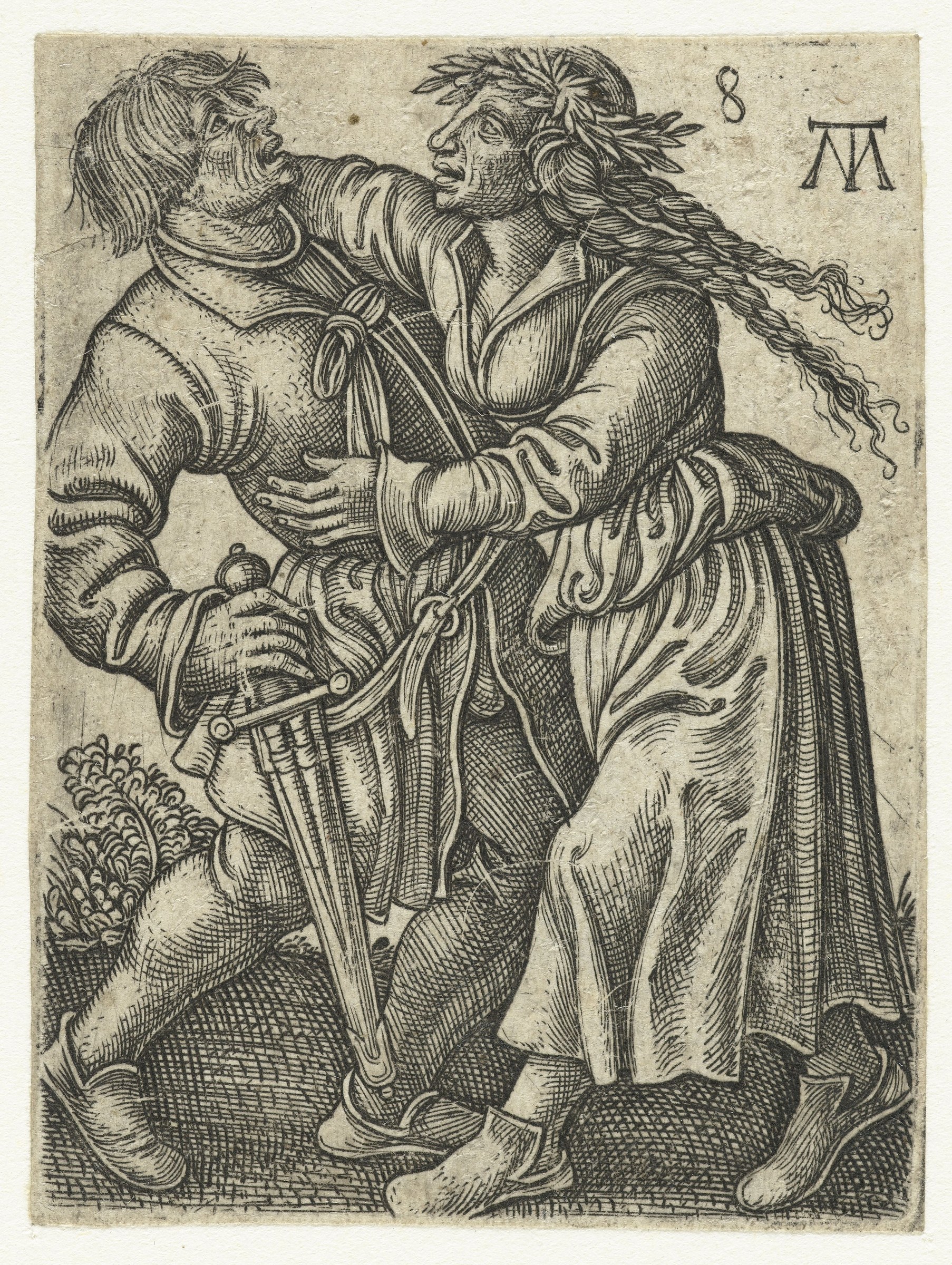
Dansend boerenpaar Dansende boeren (serietitel), RP-P-1913-858
Unknown (Rijksmuseum collection)
- Medium:
- Ink
- Era:
- Pre-1700 (Renaissance/Baroque)
- Source:
- Wikimedia Commons
- Rights:
- Public domain — free to use, share and adapt.
- Recorded as:
- CC0
This is visual evidence of how people actually danced in the 16th century outside the court, when dance history is often told only through courtly manuals and elite imagery. The series format and the detail of costume, gesture, and physical contact offer rare, specific information about vernacular dance practice that written records rarely preserve. For historians of dance and social custom, these prints are primary documents of considerable value.
What you are looking at
A man and woman dance together in profile against a plain background, their bodies angled toward each other in a vigorous embrace. The man, bearded and muscular, wears a belted tunic and has his left hand grasping the woman's shoulder or upper back while his right hand rests on his sword hilt—a gesture that signals both martial readiness and social status. The woman, her hair braided and crowned with a wreath or chaplet, wears a long simple dress with full sleeves. Both figures lean into the dance with considerable physical energy; their legs are extended in active strides suggesting rapid movement. The composition captures them mid-motion, with the woman's body slightly reclined against the man's support. A flowering shrub or plant detail appears in the lower left, grounding the scene in a rural setting. This is the eighth print in a numbered series of dancing peasant couples, as indicated by the numeral 8 and the artist's mark in the upper right.
The dancing
The pair are in a close, asymmetrical embrace typical of northern European folk dancing. The man's frame is upright and dominant, his sword hand emphasizing masculine authority; the woman leans back into his support, her weight partly transferred to him. Both figures' legs are in active extension—neither is in a closed ballroom frame, but rather in a more robust, open stance with considerable forward momentum. The hand placement and body angle suggest a turning or swaying motion rather than stepping in strict formation. This is dance of physical vigor and social familiarity rather than courtly restraint.
The dance depicted
This depicts a peasant or country dance of the 16th-century Germanic or Low Countries tradition—the kind of vigorous, social dancing that took place at village celebrations and fairs. The engraving identifies it explicitly as a 'boerenpaar' (peasant couple) dance. The man's hand on his sword and the woman's braided hair with wreath are costume markers of rural, non-courtly status. The style of movement—close contact, leaning, turning momentum—is consistent with early modern folk dances like the Allemande or Branle, dances that required physical confidence and bodily contact between partners. The series format suggests these prints circulated as instruction or documentation of the social dances actually performed by common people, distinguishing them from the formal court dances of the period.
How it was made
This is an engraving—a print made by incising lines into a metal plate (almost certainly copper), which was then inked and printed onto paper. The technique is evident in the controlled parallel lines used for shading (hatching and cross-hatching), the fine detail in the hair and drapery, and the crisp, uniform black line. Engraving allowed for wide circulation at relatively low cost; this print would have been affordable to a broad urban audience and could be bound into instructional or satirical series. The formal quality of the print—its careful composition and fine detail—suggests it was made for an educated, literate audience, not a casual broadside market. The series numbering and collector's mark (verso) indicate it was preserved as part of a systematic collection, likely of satirical or documentary prints about social customs.
About this work
This is one of a numbered series of engravings documenting the social dances of peasant and common people in 16th-century northern Europe. It captures a moment of vigorous, partnered folk dancing in which the man and woman are in close contact, leaning into the movement with physical abandon. The print is both a record of actual dance practice and a commentary on rural life—peasant dances were often subjects of satire and moralizing in Renaissance prints, though this image treats the dancers with reasonable dignity. The engraving's fine detail and circulation as a collected series suggests it served both documentary and entertainment purposes, preserving a glimpse of how ordinary people actually moved and celebrated together.
The work belongs in a dance history because it is one of the earliest surviving images to document vernacular, social dancing rather than courtly or theatrical performance. It shows how people outside the aristocratic circle moved, what their dress signaled, and what kinds of contact and physical engagement characterized their celebrations. The series format—multiple couples in similar poses—suggests a systematic attempt to catalogue or teach the regional variations of folk dance.
How to look at it
Observe the hand positions closely: the man's sword hand remains on his hilt even as he dances, a detail that signals how thoroughly martial identity was embedded in male costume and bearing. Notice the woman's recline into the man's frame—this is not a modern ballroom frame, but a more robust, almost wrestling-like engagement that nevertheless conveys partnership and trust. The extended legs and forward lean suggest the couple is in motion, possibly turning; the engraver has caught them not in a posed moment but in the middle of vigorous movement. The wreath on the woman's hair and the rural plant detail are small but crucial markers: these are not town folk or nobility, but people whose lives were tied to the land and its cycles of celebration.
The artist
The print is catalogued as unknown artist within the Rijksmuseum collection. The style, numbering system, and subject matter suggest it is part of a numbered series of satirical or documentary prints on peasant life, possibly produced in the German-speaking lands or Low Countries in the mid-16th century. Without signature or secure attribution, the artist cannot be further identified, though the consistent quality and systematic approach across the series suggests an established printmaker working in the tradition of social or moral satire through costume and custom.
The period
The 16th century saw intense interest in cataloguing and satirizing regional and social differences, including the dances and customs of peasants and common folk. This coincided with the rise of printmaking as a medium for mass circulation of images and ideas. In dance itself, the period was marked by a sharp divide between courtly dances (Pavane, Galliard, Allemande) documented in detailed written manuals, and the vigorous, less-regulated dances of common people, which left few written traces. Prints like this series filled that gap, offering both entertainment (peasant life was often comic to urban audiences) and genuine documentation. The emphasis on the couple form and the physical contact suggests these folk dances were already organized around partnership and social interaction, distinct from the more formal court dances of the same era.
Where it lives
The work is held by the Rijksmuseum, Amsterdam (catalogue number RP-P-1913-858). It is part of a numbered series of nine prints on the theme of dancing peasant couples ('Dansende boeren'). The collector's mark on the verso (Lugt 2228) indicates it was part of a systematic print collection. The engraving is documented in Bartsch's catalogue of old master prints (reference Bartsch 22, vol. IX, p. 73), the standard reference work for 16th- and 17th-century engravings.
Dance in this work
Questions about this work
What does the sword in the man's hand mean?
In 16th-century imagery, the sword was a marker of male status and identity—not necessarily that this man was a soldier, but that masculine identity was inseparable from the capacity and right to bear arms. Even in a dance scene, the sword remains visible and prominent, signaling that the dancer's social identity as a man did not pause for festivity. It also distinguishes these peasants from the unarmed common folk of the lowest ranks.
Why is this a series of nine prints?
Series of this kind served both as instruction and as documentation of regional or social variation. The printmaker may have been recording different dances from different regions, or different figures and steps within the same dance tradition. The series format allowed buyers to collect the complete set and build a comprehensive visual record of peasant dance customs.
Is this dance teaching or entertainment?
Likely both. The fine quality of the engraving and the systematic series numbering suggest these were serious documents for an educated audience. However, peasant life was often treated as comic or satirical by urban printmakers and their customers. The prints could work as both genuine records of custom and as humorous observation of rural behavior.
What dance is this actually showing?
The style—close partnering, leaning, turning momentum—is most consistent with the Allemande or the Branle, both dances that involved couples in close contact and required considerable physical engagement. Without written documentation from this specific region and date, we cannot be certain, but the physical form is characteristic of early modern northern European folk dances.
More dance artwork