49 works in this view — arrow keys or swipe to move between them.
Dance in Art · 1907
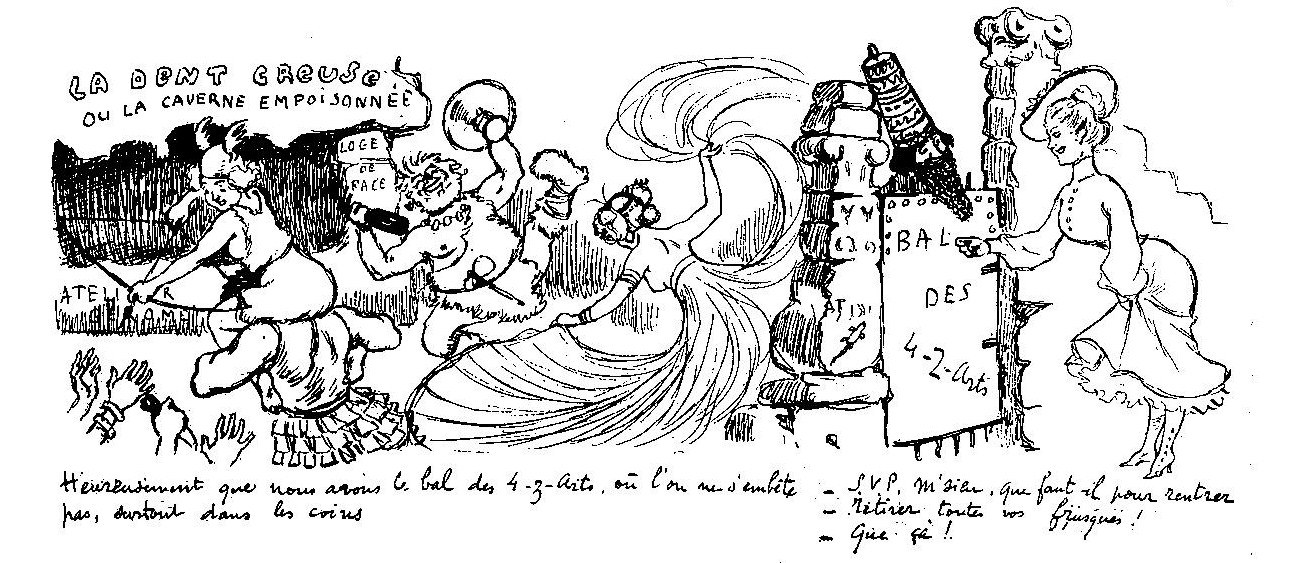
Journal amusant journal illustré (...) bpt6k5500430q 11
Maurice Lefebvre-Lourdet
- Medium:
- Oil Painting
- Era:
- 1900-1920 (Ragtime/Early Jazz)
- Source:
- Wikimedia Commons
- Rights:
- Public domain — free to use, share and adapt.
- Recorded as:
- Public Domain
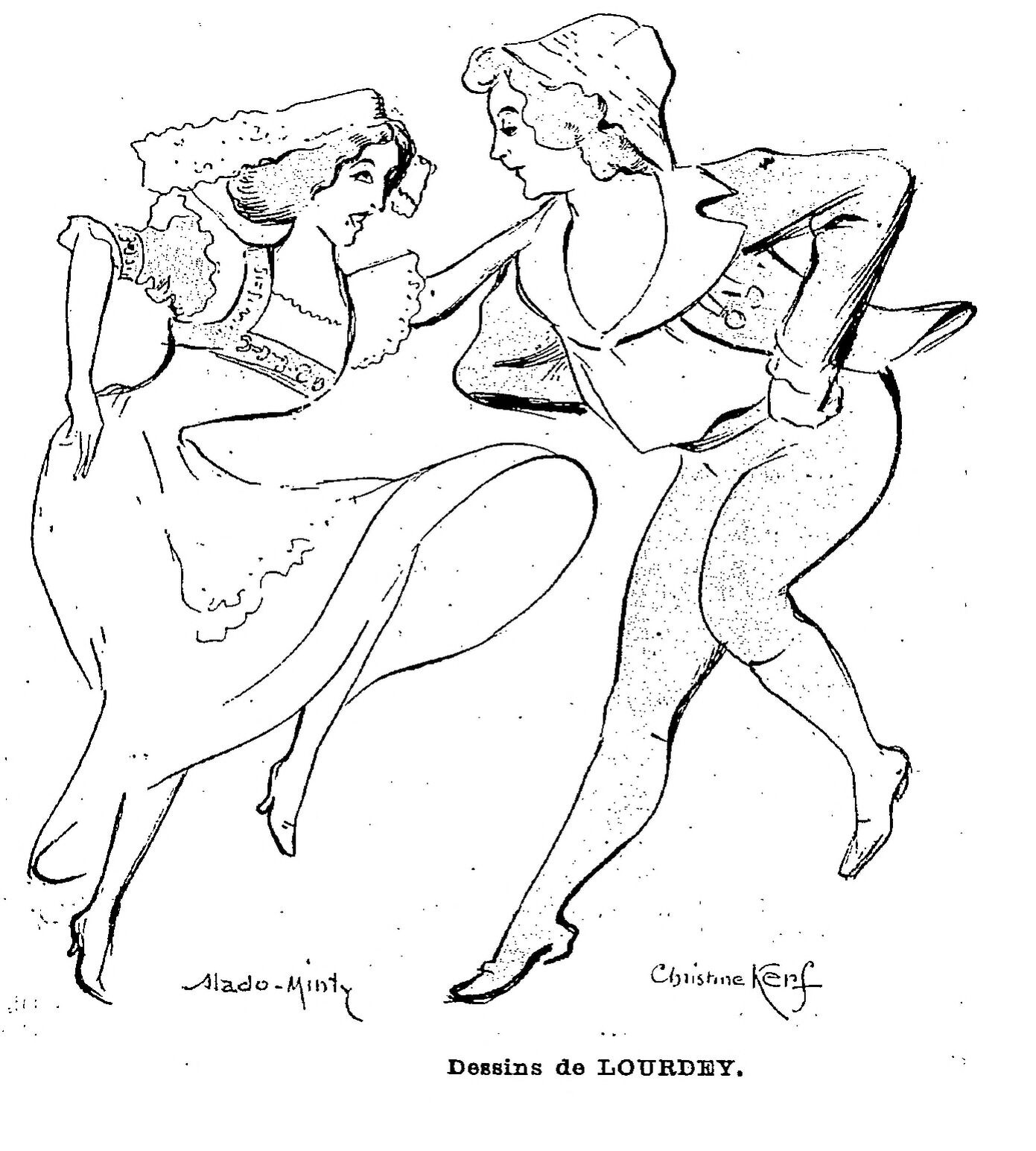
This image documents a crucial transition in social dance history: the moment when European ballroom culture was absorbing faster, more relaxed American dances and when women's participation in active dance was becoming more visible and socially acceptable. The periodical source and named subjects suggest this was not merely artistic invention but a record of actual dancers and the real fashions and movements of the time.
What you are looking at
Two women in fashionable early 1900s dress are captured mid-dance against a plain background. The woman on the left wears a white or light-colored dress with elaborate lace detail and a decorative hat, her body tilted forward in an energetic pose with one leg raised. The woman on the right, dressed in a darker outfit with a broad-brimmed hat and an oversized jacket or coat with pronounced lapels, leans into the frame with similar dynamic energy. Both figures are in motion, their bodies angled sharply toward each other, caught in what appears to be a moment of playful, rapid movement. The line work is loose and energetic, using stippled shading to suggest volume and texture in the fabrics, with particular attention to the pleating and movement of the skirts and the bulk of the jackets. The composition creates a sense of vitality and improvisation.
The dancing
Both dancers are in open positions rather than closed holds. Their bodies are angled forward and laterally, weight shifted onto the balls of their feet in a way that suggests quick, bouncing movement. The raised leg on the left figure and the forward lean of both suggest a springing or hopping action. The arms are relatively free rather than formally positioned, with natural gestures that emphasize the informality and sociability of the moment. The relative heights, angles, and the way they face each other suggest responsive, conversational movement rather than choreographed symmetry.
The dance depicted
This appears to document a fashionable social dance of the Belle Époque period, most likely a one-step, two-step, or similar ragtime-era ballroom dance. The loose, energetic poses and contemporary dress suggest the new American and European social dances that emerged in the early 1900s, which emphasized simpler steps and closer contact than Victorian-era formality. The image captures the transitional moment when dancing was becoming less rigid and more improvisational. The exact style cannot be determined from pose alone, but the overall character—the lack of rigid frame, the upright but flexible posture, the sense of buoyancy—aligns with the social dances of the 1900s–1920s rather than classical forms.
How it was made
This is a line drawing with stippled or dotted shading, likely a pen-and-ink illustration or engraving. The technique allows for economy of means while suggesting fabric texture through density of mark-making; the skirts are rendered with fluid, curved lines that follow the movement, while the jackets and hats are built from more angular hatching. The style is characteristic of early 20th-century magazine illustration and editorial art. The technique was well-suited to reproduction in periodicals and allowed the artist to capture movement through exaggerated line and distortion without requiring the rendering time or materials of a finished oil painting.
About this work
This is a caricatural magazine illustration documenting fashionable social dancing in Belle Époque Paris, likely from the journal *Journal amusant*, a French publication that specialized in satirical social commentary through art. The work captures a specific moment in dance history when new American ragtime dances were being enthusiastically adopted by European society, and when women's dress—though still constrained by corsetry—was becoming more practical and active. The illustration names two dancers, Mado Minty and Christine Kerf, suggesting these may have been known performers or socialites of the period. The work belongs to the visual culture of early modernism, where dance became a subject of fascination for artists documenting contemporary leisure and the new informality of modern life.
How to look at it
Note the diagonal thrust of both bodies—the artist has chosen not a moment of stillness or formal frame, but a moment of propulsion and mutual response. The raised leg and forward lean suggest quick, bouncing steps rather than the gliding motion of a waltz. Observe how the clothing is rendered: the artist emphasizes the movement of the skirts and the bulk of the jackets, showing fabric in motion rather than repose. The exaggeration of proportion and the loose, energetic line style are characteristic of satirical illustration, suggesting the artist is capturing the spirit and social novelty of the moment as much as the literal choreography.
The artist
The signatures on the drawing read 'Mado-Minty' (lower left) and 'Christine Kerf' (lower right), which appear to be the names of the dancers depicted rather than the artist. The artist is not identified in the record, but the style is consistent with early 20th-century French magazine illustration. The drawing style suggests a professional illustrator trained in the conventions of editorial cartooning and social satire. Without further documentation, the artist's identity cannot be established.
The period
This work dates to 1907, a moment of significant cultural ferment in dance and visual art. The ragtime dances imported from America—one-steps, two-steps, and their variants—were controversial, exciting, and widely caricatured in European periodicals as vulgar but irresistible. Women's fashion was in transition; the S-bend corset was beginning to relax, allowing more active movement, though women were still heavily clothed. In visual art, Cubism and other modernisms were beginning to fragment traditional representation, and in illustration and caricature, exaggerated line and distortion were becoming the standard language for capturing contemporary life and social change.
Where it lives
This drawing comes from *Journal amusant*, a French periodical devoted to humorous and satirical illustration and commentary. It appeared in the issue of 14 September 1907. The work is reproduced in the public record via Wikimedia Commons.
Dance in this work
Questions about this work
Who were Mado Minty and Christine Kerf?
The available record does not identify them beyond their appearance in this 1907 illustration. They may have been professional dancers, music-hall performers, or notable socialites of the Belle Époque period in Paris. The fact that they are named suggests they were recognizable to readers of *Journal amusant*, but no further documentation is available.
What dance are they doing?
The pose and movement suggest one of the new social dances popularized in the early 1900s, most likely a one-step, two-step, or similar ragtime-era ballroom dance. The exact style cannot be determined from the illustration alone, but the energetic, bouncing quality and open position indicate the faster, less formal social dances that were replacing the Victorian waltz and quadrille.
Why is the drawing style so exaggerated?
This is a work of social satire from a humorous periodical. The exaggeration—in the poses, the proportions, the rendering of fabric and movement—is deliberate, designed to capture the comic, shocking, or novel aspects of the scene for readers. The style was also suited to reproduction in print and to the rapid execution required by magazine deadlines.
What does this tell us about women's fashion and dance in 1907?
The drawing shows women wearing relatively fashionable, well-fitted clothing (hats, jackets, fitted waists) while actively dancing. This reflects a real shift in women's dress and behavior: corsetry was beginning to ease, and women's participation in active social dancing was becoming more accepted and visible, though still constrained by convention.
More dance artwork