41 works in this view — arrow keys or swipe to move between them.
Dance in Art · 1920
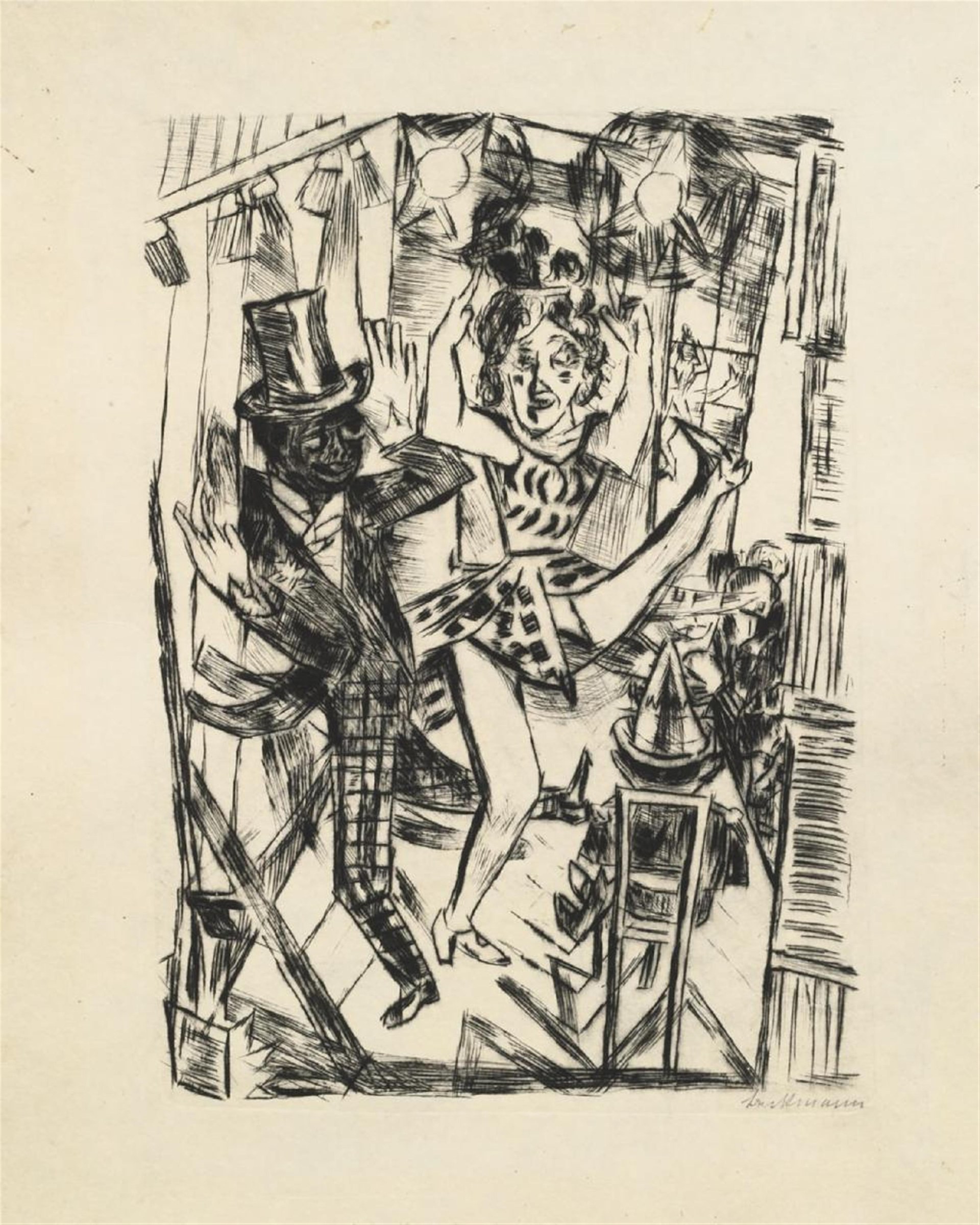
Max Beckmann Tauentzienpalast
Max Beckmann
- Medium:
- Oil Painting
- Era:
- 1920-1950 (Swing Era)
- Source:
- Wikimedia Commons
- Rights:
- Public domain — free to use, share and adapt.
- Recorded as:
- Public Domain
This work documents an otherwise ephemeral performance culture—the cabaret and revue of 1920s Berlin—through the lens of a major modernist artist. It shows how social dance and theatrical entertainment registered in the visual imagination of Expressionism, and it is a primary visual record of what Weimar cabaret looked like and how it moved. For dance historians, it is evidence of the aesthetic and social context of 1920s performance outside the classical ballet tradition.
What you are looking at
A cabaret or revue scene rendered in expressionist line work, capturing a moment of performance energy in what appears to be a Berlin nightclub or theatre. At center, a female dancer in a patterned dress with horizontal striping and a boldly drawn face strikes an animated pose, her body energized and her expression sharp and direct. To her left stands a figure in formal dress and top hat, frozen in an attitude of engagement or courtship. The space around them is crowded with hanging theatrical fixtures—bare bulbs suspended from above, flags or decorative elements strung across the composition—and the gestural, quick-sketch quality of the line work conveys movement and theatrical excitement. The setting is rendered with emphatic hatching and cross-hatching that suggests the interior of a cabaret, with architectural elements and other figures visible in the compressed, bustling composition. The energy is one of modern urban nightlife: brash, direct, slightly satirical in tone.
The dancing
The central female dancer stands with weight shifted, torso animated and arms raised in a gesture of performance or exuberance rather than technical dance form. Her pose is frontal and presentational, characteristic of revue or cabaret performance rather than classical training. The male figure beside her leans slightly toward her in an attitude of courtship or spectatorship. The drawing style emphasizes attitude and moment over anatomical precision; bodies are simplified into expressive gestures. Other figures are sketched in the background with less definition, creating a sense of a crowded venue.
The dance depicted
This is most likely a Berlin cabaret or revue scene, possibly from the Weimar era or shortly after. The Tauentzienpalast was a real Berlin entertainment venue, and the work appears to document the character of such spaces: fast-paced, mixed-gender, theatrical performance blending dance, comedy, and social encounter. The dance itself does not read as any classical or codified style—it is vernacular cabaret performance, the social dancing and theatrical entertainment of Weimar-era Berlin nightlife. The female figure's pose and presentation suggest an entertainer or performer rather than a trained dancer in a formal tradition.
How it was made
This is an intaglio print—likely a drypoint or cold-needle etching as the catalogue record suggests—executed in black line on a yellowish paper (Japan or wove). The technique of drypoint allows for a loose, gestural, almost sketch-like quality while maintaining definition; the artist has used varied line weight, cross-hatching, and open areas to create depth and texture. This printmaking method was favored by Expressionist artists for its capacity to capture immediacy and emotional intensity. The print would have been published and distributed through a commercial press (Karl Lang, Darmstadt, per the record), making it a work for a educated urban audience interested in modern art and culture.
About this work
This is an Expressionist print depicting a moment of cabaret performance in 1920s Berlin, specifically the Tauentzienpalast, a celebrated entertainment venue of the era. The work captures not choreography but the social and theatrical energy of modern urban nightlife—the interaction of performer and spectator, the costume and attitude of cabaret dance, the crowded, electric atmosphere of a Berlin venue in the early Weimar period. As a drypoint or etching, it is both a document of performance and a work of graphic modernism, using Expressionist technique to convey the visual and emotional intensity of the moment.
How to look at it
Attend to the artist's choice of the moment of interaction between performer and spectator, frozen mid-gesture rather than mid-step. The loose, emphatic line work and the compressed, crowded composition create a sense of immediacy and visual energy; the eye moves among the figures rather than settling on a single focal point. Notice how the female dancer's frontal pose and bold facial expression convey confidence and presence rather than physical technique. The architectural and decorative elements (hanging lights, flags) are rendered with the same expressive intensity as the figures, making the venue itself part of the subject.
The artist
Max Beckmann (1884–1950) was a leading German Expressionist painter, printmaker, and draftsman. He worked extensively in prints—woodcuts, lithographs, etchings, and drypoints—throughout his career, often depicting urban life, theater, and contemporary society. Beckmann was fascinated by the energy and artifice of urban entertainment and performance; the nightclub, the circus, the stage were recurring subjects in his work. His graphic work was published by commercial presses and circulated among educated audiences. He left Germany in 1937 under Nazi pressure and worked in Amsterdam and later the United States. The Tauentzienpalast print is characteristic of his engagement with the visual and social texture of modern life.
The period
This print dates to 1920, a moment of extraordinary energy and experimentation in German art and culture in the aftermath of World War I and the revolution of 1918–19. The Weimar Republic, though politically unstable, was marked by a flowering of modernist art, theater, music, and nightlife culture. Berlin became a center of avant-garde activity and also of mass entertainment: cabarets, revue theaters, and dance halls flourished and attracted artists and intellectuals as subjects and audience. Expressionist artists were intensely engaged with urban life and performance culture. At the same time, early-twentieth-century cabaret and revue represented a distinctly modern, often sexually liberated form of entertainment, sometimes socially transgressive, that appealed to modernist artists as a subject of both fascination and social critique.
Where it lives
This is a published print from the Verlag Karl Lang in Darmstadt, part of what appears to be a commercial edition. It is catalogued according to the Hofmaier catalogue (WVZ Hofmaier 159 B/a), the standard reference for Beckmann's graphic work. The source is Wikimedia Commons; the holding collection is not recorded.
Dance in this work
Questions about this work
What is the Tauentzienpalast?
The Tauentzienpalast was a major entertainment venue in Berlin, located on Tauentzienstrasse. It operated as a revue theater and nightclub in the 1920s and was a center of Weimar cabaret culture. The building survived World War II and operated in various forms into the postwar period. It was a gathering place for performers, artists, and audiences interested in modern entertainment.
Is this a painting or a print?
This is a print made using an intaglio technique, most likely drypoint or cold-needle etching. The catalogue record identifies it as an original drypoint on Japan paper. It was published by a commercial press (Karl Lang, Darmstadt) and would have been distributed as a published work, not as a unique object.
What kind of dance is being shown?
This is not a formal, codified dance style but rather a representation of cabaret performance and social entertainment as practiced in 1920s Berlin nightclubs. Cabaret dance was a form of theatrical entertainment, often performed by women, that combined elements of revue, comedy, and social dancing. It was improvisatory, direct, and oriented toward audience engagement rather than technical virtuosity in the classical sense.
Why did Beckmann choose this subject?
Beckmann, like many Expressionist artists, was drawn to urban life, entertainment, and performance as subjects that captured the energy and moral complexity of modern society. The cabaret represented a distinctly modern, liberated form of entertainment that appealed to avant-garde artists. Depicting such venues allowed Beckmann to explore themes of theatricality, desire, social interaction, and the aesthetics of urban modernity.
More dance artwork