49 works in this view — arrow keys or swipe to move between them.
Dance in Art · 1912
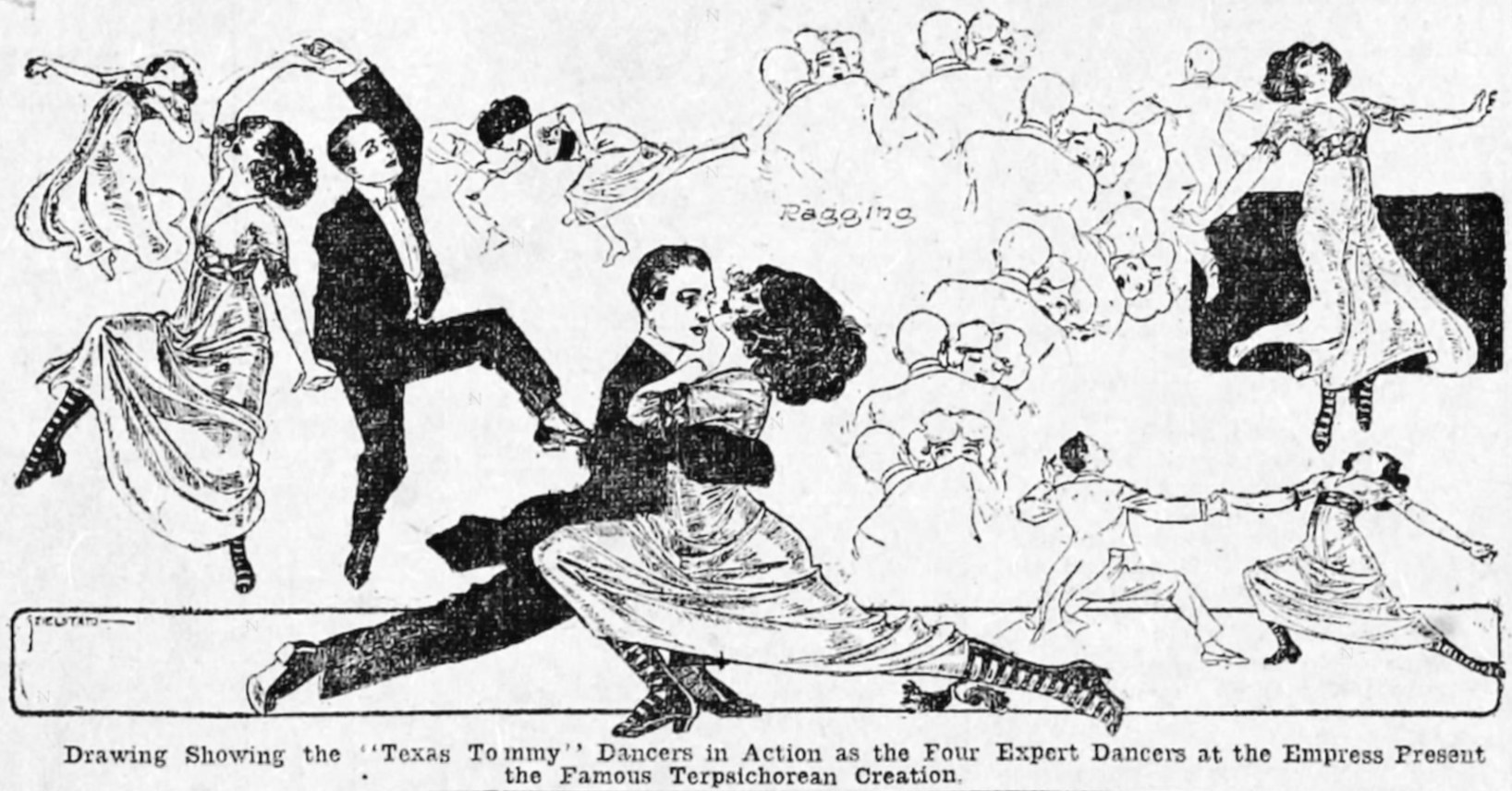
Texas Tommy dancers in Action - 1912
undetermined, published in The Salk Lake Tribune (Feb 25th, 1912)
- Medium:
- Drawing
- Era:
- 1900-1920 (Ragtime/Early Jazz)
- Source:
- Wikimedia Commons
- Rights:
- Public domain — free to use, share and adapt.
- Recorded as:
- Public Domain
The Texas Tommy represents a crucial turning point in American dance history: the moment when African-American vernacular dance moved into mainstream white ballrooms and became a subject of public debate, regulation, and reportage. This illustration, published in a major regional newspaper, is evidence of how seriously the dance was taken—not as a curiosity, but as a significant social phenomenon worthy of documentation. For anyone studying the origins of modern ballroom dance, the emergence of African-American dance forms in the early 20th century, or the role of the press in mediating and shaping public understanding of dance, this image is primary source material.
What you are looking at
This is a newspaper illustration depicting the Texas Tommy, a ragtime-era social dance that swept through American ballrooms in the early 1910s. The composition is divided into two registers: the lower section shows four couples dancing in close embrace, their bodies angled dynamically across the frame; the upper section shows a chaotic proliferation of smaller figures—perhaps two dozen cherub-like dancers in various stages of movement, their forms becoming progressively more schematic and caricatured toward the edges. The setting is urban and public; the dancers wear contemporary street dress—high-collared jackets, long skirts, boots—suggesting a dance hall or ballroom rather than a theatrical stage. The energy is frenetic: bodies lean, twist, and spiral; skirts flare; arms extend at sharp angles. The line work is rapid and energetic, with heavy blacks used to define the nearer, larger figures and to create silhouettes that read instantly from newsprint.
The dancing
The principal couples hold each other in a close ballroom embrace, but the position is unstable and dynamic—weight is thrown forward and to the side rather than held vertical. The women's long skirts are caught mid-flare, indicating rapid turning or swinging motion; the men's frames are slightly bent, suggesting weight transfer through the legs rather than a held posture. The smaller figures above show extreme positions: legs kicking high, bodies tilted at acute angles, one dancer appearing nearly horizontal. The multiplicity of small figures conveys not precision but abandon—the sense of a dance that prioritized improvisation, social enjoyment, and close physical contact between partners over formal alignment.
The dance depicted
The Texas Tommy was a couple dance that emerged in African-American communities in San Francisco around 1910 and spread rapidly to white ballrooms by 1911–12, becoming briefly notorious for its perceived indecency. Contemporary accounts emphasize the close contact between partners, rapid hip movement, and the freedom dancers had to improvise steps while maintaining the embrace. This image confirms those accounts: the dancers are bound together at hip and torso, and the extreme positions of the limbs suggest vigorous, swinging action rather than the restrained posture of contemporary ballroom dances like the waltz or foxtrot. The inscription 'Ragoine' (possibly 'Ragoïne' or a variant spelling) and the caption's reference to 'the Four Expert Dancers' and a 'Terpischorean Creation' suggests this depicts a public performance or demonstration, probably at a hotel or theatre venue—the 'Empress' is mentioned in the caption.
How it was made
This is a line drawing, likely made from a photographic source or sketched from life, and reproduced via halftone or direct photo-engraving for newspaper publication. The technique allows for rapid tonal shifts from pure black to white, with minimal gray; this economical approach suits the urgency of newspaper production and the need for images to read clearly in poor-quality newsprint. The artist has used weight variation in the line itself—heavier, more deliberate strokes for the foreground figures; lighter, sketchier marks for the background—to create depth and to suggest movement through variation in finish. The style is caricatural without being hostile; the exaggeration serves to amplify the energy and novelty of the dance rather than to mock the dancers.
About this work
This is a newspaper illustration documenting a moment when a new social dance—one that originated in African-American communities and carried associations with sexual transgression—had become fashionable enough to be demonstrated in respectable venues and reported on in the mainstream press. The Texas Tommy was not a theatrical dance; it belonged to the social sphere, to dance halls, cabarets, and hotel ballrooms where couples paid to dance together. By including it in the newspaper, the artist and editor were acknowledging its cultural significance, even as the caption's references to 'expert dancers' and formal venues suggest an attempt to normalize and legitimize a dance that many Americans found shocking. The image is a snapshot of a moment of cultural anxiety and change, frozen in the technology of the newspaper page.
How to look at it
Look first at the contrast between the four foreground couples and the swarm of background figures. The foreground dancers are depicted in sufficient detail to show the actual mechanics of the dance—the embrace, the angle of the bodies, the position of the limbs—while the background becomes increasingly abstract and playful, almost dream-like. This is a compositional choice that suggests two things: first, the artist's primary interest in showing how the Texas Tommy was actually danced, and second, the infectious, almost contagious nature of the dance—it spreads, multiplies, and becomes generalized. The weight of the line in the foreground figures is also significant: the artist has taken care to show that the dance involves not a vertical, held posture but an active, forward-leaning embrace in which both partners are contributing momentum. The flaring skirts and extended limbs in the background convey speed and liberation rather than restraint.
The period
The Texas Tommy appeared at a moment of significant social change in American dance. The early 1910s saw the rapid proliferation of new ragtime and jazz-influenced social dances—the Bunny Hug, the Grizzly Bear, the One-Step, the Turkey Trot—that broke with Victorian ballroom conventions by permitting close contact, improvisation, and visible hip motion. These dances emerged from African-American communities in port cities and quickly became fashionable in white urban ballrooms, generating moral panic among conservatives who saw them as signs of social decay. Newspaper editors, meanwhile, were discovering that images of novel dances sold papers; by 1911–12, illustrated reports of new dance crazes had become a standard feature of the society pages. This particular image, from the Salt Lake Tribune, testifies to the national reach of the craze and the intense interest in documenting and understanding what these new dances looked like and how they were performed.
Where it lives
This illustration was published in the Salt Lake Tribune on February 25, 1912, as part of the newspaper's coverage of social and entertainment news. It is presented here as reproduced on Wikimedia Commons; no holding collection or accession number is currently recorded.
Dance in this work
Questions about this work
Was the Texas Tommy really considered scandalous?
Yes. Contemporary accounts and newspaper editorials frequently criticized it for permitting too much physical contact and visible hip motion. Some cities and venues attempted to ban it. By 1913–14, it had fallen somewhat out of fashion as other dances took its place, but it remains significant as the first major wave of African-American vernacular dance to break into mainstream white ballrooms and as a flashpoint for debates about race, sexuality, and modernity in dance.
Who danced the Texas Tommy?
It began as a social dance in African-American communities in San Francisco and Oakland around 1910. By 1911–12, it had spread to white ballrooms in major cities. The caption mentions 'four expert dancers' performing at the 'Empress,' suggesting this image documents a public performance or demonstration rather than an everyday social dance.
How was this image made and circulated?
This is a line drawing, likely based on a photograph or sketch, reproduced for newspaper publication via halftone or photo-engraving. Newspaper illustrations were a primary source of visual information for the public in the pre-photographic era and were distributed to thousands of readers daily. This particular image would have appeared on the society or entertainment page of the Tribune and would have been visible to the entire reading public of Salt Lake City.
Why is this in a gallery about dance?
Because it documents a historically significant moment when a new dance form—one that originated in African-American communities—entered mainstream culture and became a subject of public discourse and regulation. The image is evidence of how dance was reported, understood, and debated in the early 20th century, and it provides visual documentation of how the Texas Tommy was actually danced.
More dance artwork