49 works in this view — arrow keys or swipe to move between them.
Dance in Art · 1912
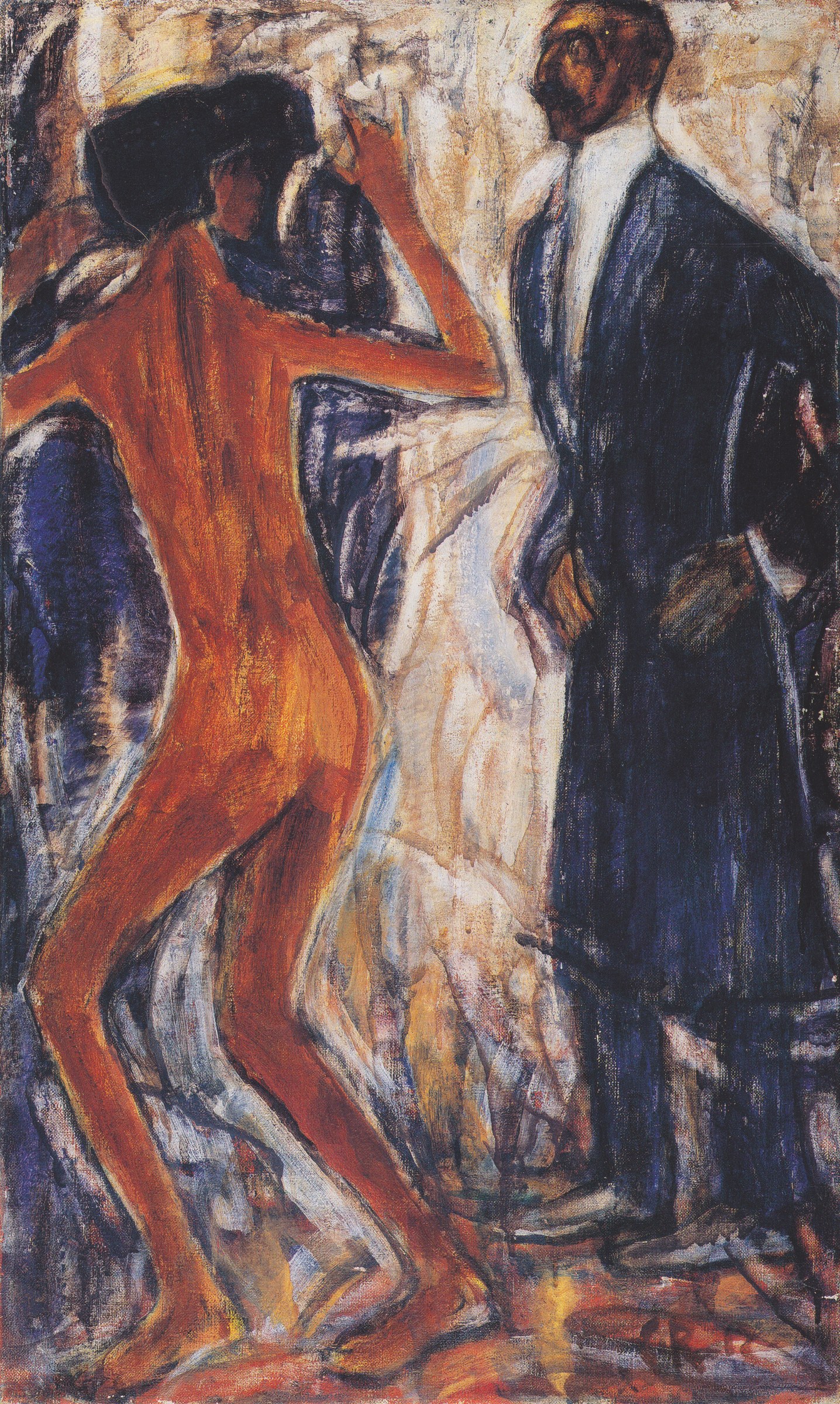
Christian Rohlfs - Herr im Frack und kreolische Tänzerin
Christian Rohlfs
- Medium:
- Oil Painting
- Era:
- 1900-1920 (Ragtime/Early Jazz)
- Source:
- Wikimedia Commons
- Rights:
- Public domain — free to use, share and adapt.
- Recorded as:
- Public Domain
This work documents the aestheticization of racialized 'exotic' dance in early modernism, when European artists were fascinated by and appropriating performance forms associated with colonized or marginalized peoples. It is a rare surviving artwork that captures both the formal ballroom idiom and the contemporary fascination with 'primitive' or 'primitive-inflected' dance. For historians of dance and of modern art, it exemplifies how dance became a vehicle for both erotic fantasy and artistic innovation in the early twentieth century.
What you are looking at
A man in formal evening dress—tailcoat, white shirt, dark trousers—stands at right, watching intently as a woman in a vibrant red-orange wrap or shawl executes a dynamic turn or pivot at center-left. The woman's body twists sharply, her weight shifting, one arm raised; the red fabric swirls around her in an arc. A third figure, partially obscured, appears in the background at upper left. The setting is spare and tonally warm—ochre, cream, and rust tones dominate—with no clear interior or exterior markers. The composition is intimate and theatrical, capturing a moment of performance or demonstration rather than a ballroom or social gathering. The artist's expressionist handling emphasizes movement and emotion over anatomical precision.
The dancing
The male figure stands upright, formal, in a classic ballroom spectator pose. The dancing woman's frame is open and unpartnered; her weight is visibly shifted, her torso twisted, suggesting a turn in progress. The red fabric emphasizes the rotational energy of her movement. Her right arm extends or lifts; her head turns with the torso. The hold and relationship suggest instruction, performance, or formal dance rather than social partnership.
The dance depicted
The title names the woman a 'kreolische Tänzerin' (Creole dancer), and her dynamic, twisting movement in the open frame is consistent with early twentieth-century performance dance, possibly a stylized stage interpretation of Caribbean or mixed-heritage dance idioms then fashionable in European art and cabaret. The formal male spectator and the isolated, theatrical framing suggest this is a performance moment rather than social dance. The unpartnered, rotational quality and the expressive use of fabric do not align with ballroom technique of the period.
How it was made
Oil painting on canvas. The expressionist handling—loose, gestural brushwork; distorted proportions; heightened color—subordinates anatomical accuracy to emotional and kinetic effect. The artist has used warm, earthy ochres and bold reds to convey both the sensuality and the exertion of the moment. This technique allows for immediacy and psychological intensity that a more naturalistic approach would not achieve.
About this work
This is a theatrical dance scene painted by Christian Rohlfs in 1912, capturing a moment between a formally dressed European man and a woman identified as a Creole dancer. The work sits at the intersection of modernist art practice and the early twentieth-century fascination with 'exotic' or colonial performance. The man's formal dress and attentive posture, and the woman's dynamic, unpartnered movement, suggest a power dynamic rooted in the colonial gaze—the woman as performer or object of desire, the man as spectator and arbiter. The painting is expressionist in technique, using distortion, loose brushwork, and saturated color to convey psychological and kinetic energy rather than documentary precision.
How to look at it
Watch the woman's torso and the arc of the red fabric. The artist has frozen a moment mid-rotation, where energy and strain are visible in the twisted spine and lifted arm. The man's stillness and formal dress throw the woman's movement into relief. Notice too the expressionist distortion—the bodies are not naturalistic, but emotionally heightened. The warm, saturated palette conveys both intimacy and intensity. The composition isolates the two figures, erasing the social context that would surround such a moment in reality; this intensifies the psychological charge.
The artist
Christian Rohlfs (1849–1938) was a German modernist painter who began as a realist and evolved toward Expressionism in the early twentieth century. He was associated with Die Brücke and other avant-garde movements and worked across landscapes, still lifes, and figural subjects with increasing abstraction and emotional intensity. His interest in non-European subjects and forms reflects the broader early-twentieth-century avant-garde engagement with colonial and ethnographic material.
The period
In 1912, European modernism was in ferment. Picasso and Matisse had recently encountered African sculpture; the Ballets Russes, founded in 1909, was revolutionizing theatrical dance and blending European, Oriental, and primitive aesthetics. Simultaneously, colonialism was at its height, and 'exotic' dance—often performed by women of African, Caribbean, or mixed heritage—was a fixture of cabarets, music halls, and avant-garde salons in Paris and Berlin. The formal ballroom and the 'primitive' dancer were both present in European culture, but coded as opposite: the ballroom as civilization and order, the exotic dancer as sensuality and nature. Rohlfs's painting captures this collision.
Where it lives
The work is recorded as an oil painting dated 1912 and was sourced from Wikimedia Commons. No holding collection or accession information is currently recorded.
Dance in this work
Questions about this work
What is a 'kreolische Tänzerin'?
The title indicates a woman of Creole heritage—a term used in colonial contexts to denote a person of mixed European and African descent, or of European descent born in the colonies. In early twentieth-century European performance, 'Creole dancer' was a category of exotic performer, often associated with Caribbean dance idioms and presented in cabarets and music halls. The term itself reflects the racial and colonial frameworks of the period.
Is this a ballroom dance?
No. The woman's frame is open and unpartnered, and her movement is too dynamic and rotational for formal ballroom technique. The theatrical framing and the formal male spectator suggest this is a staged performance or demonstration, not a ballroom. The dance itself appears to be a stylized interpretation of a performance idiom associated with the Caribbean or colonial contexts.
Why does the artist distort the bodies?
Rohlfs was an Expressionist painter, and distortion was a deliberate technique to convey emotion, energy, and psychological intensity rather than literal representation. The twisted spine, the loose brushwork, and the exaggerated color all heighten the tension and sensuality of the moment.
What does the red fabric represent?
The red-orange wrap or shawl is both costume and kinetic element. Its arc and flow emphasize the woman's rotational movement and sensuality. The bold color also signals the 'exotic' or 'primitive' associations the work trades in: red as heat, passion, and otherness.
More dance artwork