49 works in this view — arrow keys or swipe to move between them.
Dance in Art
Ingres - MI.867.484, Groupe de la danse
Jean-Auguste-Dominique Ingres
- Medium:
- Oil Painting
- Source:
- Wikimedia Commons
- Rights:
- Public domain — free to use, share and adapt.
- Recorded as:
- Public Domain
For historians of dance, this sheet offers a rare glimpse of how a major visual artist of the early 19th century understood and studied movement. The work shows that even painters primarily engaged with history and portraiture paid close attention to choreography, ensemble work, and the grammar of the moving body—suggesting that dance was a living presence in the visual culture of the period. The sketch also documents a moment when neoclassical aesthetics were giving way to Romantic sensibility; the ease and variety of the poses, and the theatrical reference, hint at shifting attitudes toward both art and the body.
What you are looking at
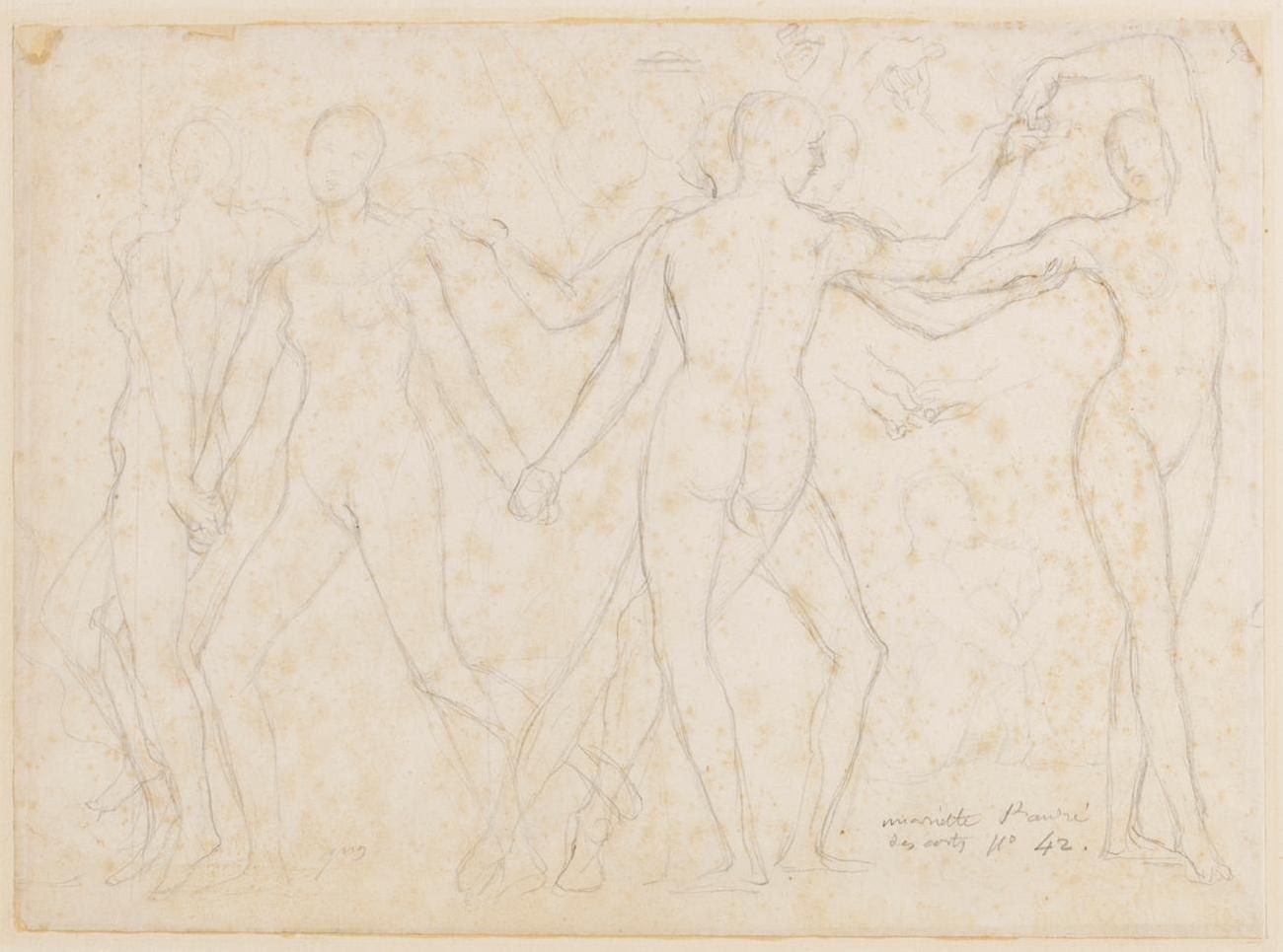
A pencil sketch shows approximately eight nude or lightly draped figures arranged in a loose group, apparently dancing or in choreographed motion. The figures are rendered in light, gestural line work with minimal shading. They occupy most of the composition, which appears to be a study sheet or preparatory drawing. The bodies are positioned at varying heights and angles—some standing upright, others leaning or turning—suggesting continuous movement around a shared space. The setting is neutral; there is no background detail, architectural frame, or landscape to anchor the scene to a specific location or narrative. At the bottom right, a handwritten inscription in French reads "Marionette Parisienne / les corfs fit [?]" (the exact final word is unclear). The paper itself shows age: it has a cream tone, scattered foxing marks, and overall the quality of an old master's working study.
The dancing
The dancers display a range of poses suggesting classical training and formal movement vocabulary. Several stand in contrapposto or near-vertical alignment; others bend at the waist or turn through the torso. Arm positions are varied—some raised, some lowered, some extended—with no single uniform frame visible across the group. The weight distribution suggests weight shifts and traveling motion rather than static poses. The sketchy, economical line conveys fluidity and ease of movement; there is no tension or strain in the bodies. The variety of heights and the grouping suggest ensemble choreography where bodies relate to one another without holding fixed formation.
The dance depicted
This appears to be a study of social or theatrical dance, most likely from the late 18th or early 19th century based on the drawing style and the inscription's reference to "Parisian" figures. The loose ensemble arrangement and the casual yet coordinated poses suggest either a ballroom scene or a stage dance, possibly a group number from a theatrical work. The nudity or light drapery is typical of academic and neoclassical preparatory studies, which used the undraped figure to understand anatomy and movement before adding costume. The title reference to "marionettes" (puppets) may indicate this is a study for a theatrical dance scene rather than documentary observation—Ingres often studied figures for history paintings and could have been preparing a work depicting dance as part of a larger narrative.
How it was made
This is a pencil drawing on laid paper, executed with rapid, confident line work typical of an artist's studio study. The medium allows for quick notation of pose and gesture without the commitment of paint or detailed rendering. The lightness of line and economy of mark suggest this was made as a working study—possibly for a painting, a print, or simply to develop choreographic or compositional ideas. The sketch's working nature is confirmed by the handwritten note and the visible pentimenti (corrections) in several figures. For an artist of Ingres's stature, such sheets served as repositories of observed or imagined movement, often consulted later when composing larger works.
About this work
This pencil sketch preserves a moment of artistic inquiry into dance and the moving body. Jean-Auguste-Dominique Ingres, known principally as a history painter and portraitist, here turns his attention to choreographed ensemble movement, studying how bodies arrange themselves and relate to one another in space. The sheet is neither a final work nor a documentary record, but a working study—the kind of private visual note a classically trained artist accumulated as reference and inspiration. The group depicted suggests either a ballroom or theatrical dance, rendered with the anatomical clarity Ingres brought to all figural work. The inscription places the study within a Parisian cultural context and hints at a theatrical or literary connection. As a whole, the drawing testifies to the importance of dance as a subject for visual artists in the neoclassical and romantic periods, and to the cross-pollination between stage, salon, and studio.
How to look at it
Observe how Ingres distributes the weight and energy of each body. Notice that no two poses are identical, yet all are rendered with the same anatomical logic and linear clarity. Look at the variation in arm positions and the subtle shifts in torso angle; these small differences create a sense of choreographic flow even in a static drawing. Attend to the spacing and grouping: the figures are close enough to suggest ensemble unity, yet dispersed enough to avoid crowding. The absence of costume, setting, or narrative detail directs focus entirely to the body itself—this is the neoclassical aesthetic at work, privileging form and line over story or spectacle. Finally, note the handwritten inscription, which anchors the study to a specific cultural moment and hints at an intention or memory attached to these figures.
The artist
Jean-Auguste-Dominique Ingres (1780–1867) was a dominant figure in French academic painting, celebrated for history paintings, portraits, and nudes executed in a neoclassical idiom. He trained under Jacques-Louis David and inherited David's commitment to line, anatomical precision, and narrative gravity. Though known primarily for his monumental works, Ingres maintained a vast practice of drawing—thousands of studies from life, from memory, and from imagination. His notebooks and study sheets reveal a restless visual intelligence that ranged far beyond the subjects of his finished paintings: dancers, musicians, street scenes, and architectural fragments fill the sheets. This drawing is characteristic of that working practice: a rapid notation, executed without pretense to completion, that nonetheless demonstrates supreme facility and a keen eye for pose and proportion.
The period
In the early 19th century, dance occupied a prominent place in European visual culture. The Romantic movement elevated the ballerina to an iconic figure, and theatrical dance—especially pantomime and narrative ballet—became subjects of serious artistic interest. At the same time, academic training in the fine arts still centered on the human figure, and drawing from life remained the foundation of all instruction. For an artist like Ingres, studying dancers would have served multiple purposes: it developed anatomical knowledge, it provided material for potential historical or theatrical compositions, and it engaged with a form of human expression that fascinated Romantic-era aesthetics. The salon and the stage were closely linked in Parisian cultural life, and it was common for painters, sculptors, and printmakers to turn to dance—both as subject matter and as a metaphor for grace, movement, and the ideal body.
Where it lives
The work is recorded as part of an unspecified collection and was sourced for this catalogue from Wikimedia Commons. The catalogue record does not specify a holding institution, accession number, or date, so the full history of the object remains uncertain. It appears to be a working study sheet from Ingres's own hand, the type of material that would typically remain in an artist's studio or pass to an estate collection before entering a public or private holding.
Dance in this work
Questions about this work
Did Ingres dance himself?
There is no evidence that Ingres was a dancer. However, he lived in Paris during a period of intense theatrical and cultural activity, and his attention to the moving body in his drawings and paintings shows that he studied dance as a visual phenomenon with the same care he brought to anatomy, drapery, and expression. His many sketch studies of dancers, musicians, and performers indicate that he frequented theaters and rehearsals or relied on memory and imagination.
Is this drawing for a finished painting?
It is impossible to say with certainty from the image alone. This appears to be a working study rather than a preparatory drawing for a known painting. Such sheets sometimes fed into later works; sometimes they remained studio notes, consulted for reference or technique. The handwritten inscription suggests a memory or intention connected to the figures, but without access to Ingres's other records or a complete catalogue raisonné, we cannot establish a direct link to a finished composition.
Why are the figures nude if this is about dance?
In academic training, the undraped figure was the foundation of all study. Artists learned anatomy, proportion, and movement by drawing from live models and from memory. A neoclassical artist like Ingres would have studied the body in its most essential form, then added costume or drapery when composing a finished work. This sketch preserves the skeletal study; the dancers' actual dress would have been added in a later stage or in a finished painting.
What does the inscription tell us?
The inscription references "Parisian marionettes" or "marionette figures" (possibly in the sense of graceful, puppet-like or staged performers), with a partially legible second line. This suggests the drawing may be connected to theatrical performance—possibly a ballet, a pantomime, or a stage spectacle—or may be Ingres's own playful title for a group of formally posed dancers. The reference to Paris anchors the study to the city's vibrant dance and theater world.
More dance artwork