49 works in this view — arrow keys or swipe to move between them.
Dance in Art · 1895
KANZE Sakon Okina
不明(スキャン:Sat666 (talk))
- Medium:
- Oil Painting
- Era:
- Late 1800s (Victorian Ballroom)
- Source:
- Wikimedia Commons
- Rights:
- Public domain — free to use, share and adapt.
- Recorded as:
- Public Domain
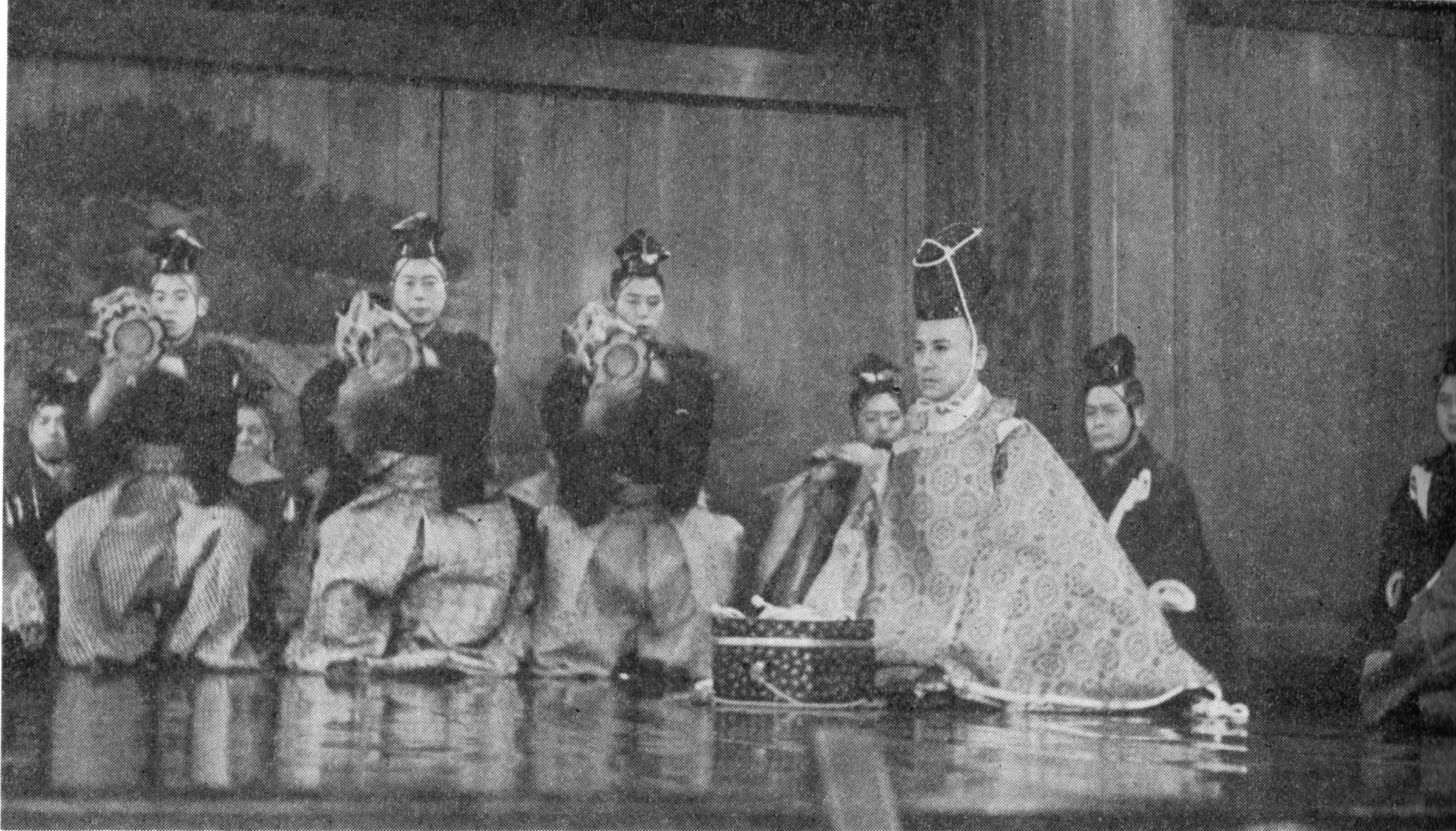
Noh is one of the world's oldest continuously performed theatrical forms, and *Okina* is its most foundational work. This 1895 photograph documents a living performance tradition that had already survived five centuries and continues substantially unchanged today. For anyone studying non-Western performance traditions or the relationship between dance, theatre, and ritual, this image is a rare window into how Noh was actually staged and costumed in the late Meiji period.
What you are looking at
This is a theatrical scene depicting characters in elaborate costumes arranged in a formal, staged composition. At center stands a figure in an ornate cream-colored robe with geometric patterning, wearing a tall formal headdress and holding what appears to be a fan or ritual object. To the left, three figures in dark robes sit in profile, each holding decorated circular fans or mirrors. Additional figures in darker dress occupy the right side of the composition. The setting appears to be an interior theatrical space with plain walls. The photograph is in black and white, grainy, consistent with late 19th-century photographic reproduction of theatrical performance or documentation.
The dancing
The composition is frontal and hierarchical rather than dynamic. The central figure stands upright in a formal pose with elevated stance, while the seated figures on the left maintain composed, profile positions with arms raised to display their hand-held objects. The postures are highly formalized and symmetrical—there is no closed partnering or traveling movement visible. The framing emphasizes stillness and ceremonial arrangement rather than motion through space.
The dance depicted
This appears to be Noh theatre, specifically the play *Okina*, one of the oldest and most ceremonial works in the Noh repertoire. *Okina* is traditionally performed at auspicious occasions and is characterized by slow, deliberate movement, masked performers in formal costume, and symbolic gesture rather than narrative action. The central figure is likely the shite (protagonist) performing the role of the aged man, while the seated figures are likely the waki (supporting actors) and chorus. The circular objects are typical hand properties of Noh performance. This is a performance document rather than a spontaneous record of movement—Noh prioritizes formalized, ritualized gesture over naturalistic choreography.
How it was made
This is a black-and-white photograph, likely a halftone reproduction or photographic print made from a theatrical documentation of a live or staged performance. The grain and tonal range suggest late 19th-century photographic technology. The lighting is frontal and even, typical of theatrical documentation of the period. The photograph has been composed to capture the full stage picture in a single frame, prioritizing composition and costume legibility over capturing movement or the performer's perspective.
About this work
This is a photograph documenting a performance of the Noh play *Okina* from 1895, featuring the actor Kanze Sakon. *Okina* is the most sacred and ceremonial work in the Japanese Noh theatre, performed to bring blessings and prosperity. Rather than depicting narrative or character development, it presents a series of highly formalized movements, chants, and symbolic gestures performed in costume by masked or painted performers. The work sits at the intersection of theatre, ritual, and dance—categories that do not fully separate in Noh tradition. The photograph captures the formal, frontal composition typical of Noh stagecraft, with the central performer elevated in status and the chorus arranged subordinately.
How to look at it
Attend to the absolute formality and stillness of the composition. Unlike Western theatrical photography of the same period, which often captures dramatic gestures or narrative moments, this image shows performers in composed, ceremonial positions. The arrangement is symmetrical and frontal, emphasizing the viewer's gaze along the center line toward the protagonist. Note the precision of costume and the prominence of hand properties—in Noh, small objects and subtle gestural changes carry vast symbolic weight. The photograph is not a moment of action but a record of formal presentation.
The artist
Kanze Sakon (1895–1939) was the heir to the Kanze school, one of the five principal schools of Noh theatre in Japan. The Kanze lineage had been performing Noh continuously since the 14th century. As the designated successor (shite actor) of the school, Sakon would have trained from childhood in the highly codified techniques of Noh performance, which emphasize precise, inherited movement vocabularies passed orally from master to student. This photograph documents him in one of the most important roles in the Noh repertoire.
The period
This photograph was taken during Japan's Meiji Restoration (1868–1912), a period of rapid modernization and Western cultural influence. Despite pressure to embrace Western forms of theatre and entertainment, Noh and other classical Japanese performing arts survived and were increasingly valorized as markers of authentic Japanese cultural heritage. Photography itself was a new technology being used to document theatre for the first time; this image is part of a broader archival impulse to preserve performance traditions through mechanical reproduction. The date of 1895 places this near the end of the Meiji period, when traditional arts were beginning to be systematically photographed and collected.
Where it lives
The image is sourced from Wikimedia Commons. The catalogue information is minimal; the artist is listed as unknown, though the subject is identified as Kanze Sakon performing in *Okina*. The photograph is likely archival documentation rather than a signed artistic work, and its current holding location is not recorded.
Dance in this work
Questions about this work
Is this a dance or a theatrical performance?
In Noh, this distinction does not apply. Noh integrates dance, theatre, music, and ritual into a single formal system. The movement vocabulary includes elements recognizable as dance—formalized steps, spatial patterns, and stylized gesture—alongside spoken and chanted text, music, and symbolic action. Noh performers train in 'Noh dance' (*maimai*) as part of their core technique, so this should be understood as both theatre and dance.
What is the play *Okina* about?
*Okina* tells the story of an aged man who appears at a celebration to offer blessings for prosperity and longevity. It has no plot in the Western sense—instead, it unfolds as a series of ritual movements, chanted prayers, and dances performed to invoke good fortune. The work is so sacred that it is performed only on auspicious occasions and is treated as a spiritual blessing in itself.
What are those circular objects the performers are holding?
They are fans (called *uchiwa* or similar hand properties in Noh). Fans and other small objects are essential properties in Noh performance and carry symbolic meaning. Their movement through space and their positioning relative to the body are part of the gestural vocabulary. In *Okina*, the fans may represent prosperity or ritual authority.
Why are the performers wearing masks or heavy makeup?
In Noh, masks are the principal tool for character representation. Most Noh plays feature masked performers whose faces are hidden; the mask itself conveys age, gender, emotional state, and supernatural status. The formality of the mask reflects Noh's emphasis on archetypal representation rather than individual character psychology. Even unmasked performers use heavy makeup to create a stylized, non-naturalistic appearance.
More dance artwork