49 works in this view — arrow keys or swipe to move between them.
Dance in Art · 1910
MET DP143333
Kōgyo Tsukioka
- Medium:
- Oil Painting
- Era:
- 1900-1920 (Ragtime/Early Jazz)
- Source:
- Wikimedia Commons
- Rights:
- Public domain — free to use, share and adapt.
- Recorded as:
- CC0
For historians of East Asian theatre and dance, this image provides direct evidence of costume, makeup, and headdress conventions in Meiji-period Noh or Kabuki performance. For anyone studying how dance and theatre are documented and circulated—how audiences encountered performance through portraiture and prints rather than through viewing the live event—this work is a window into the visual technologies and celebrity cultures that shaped theatrical knowledge before film.
What you are looking at
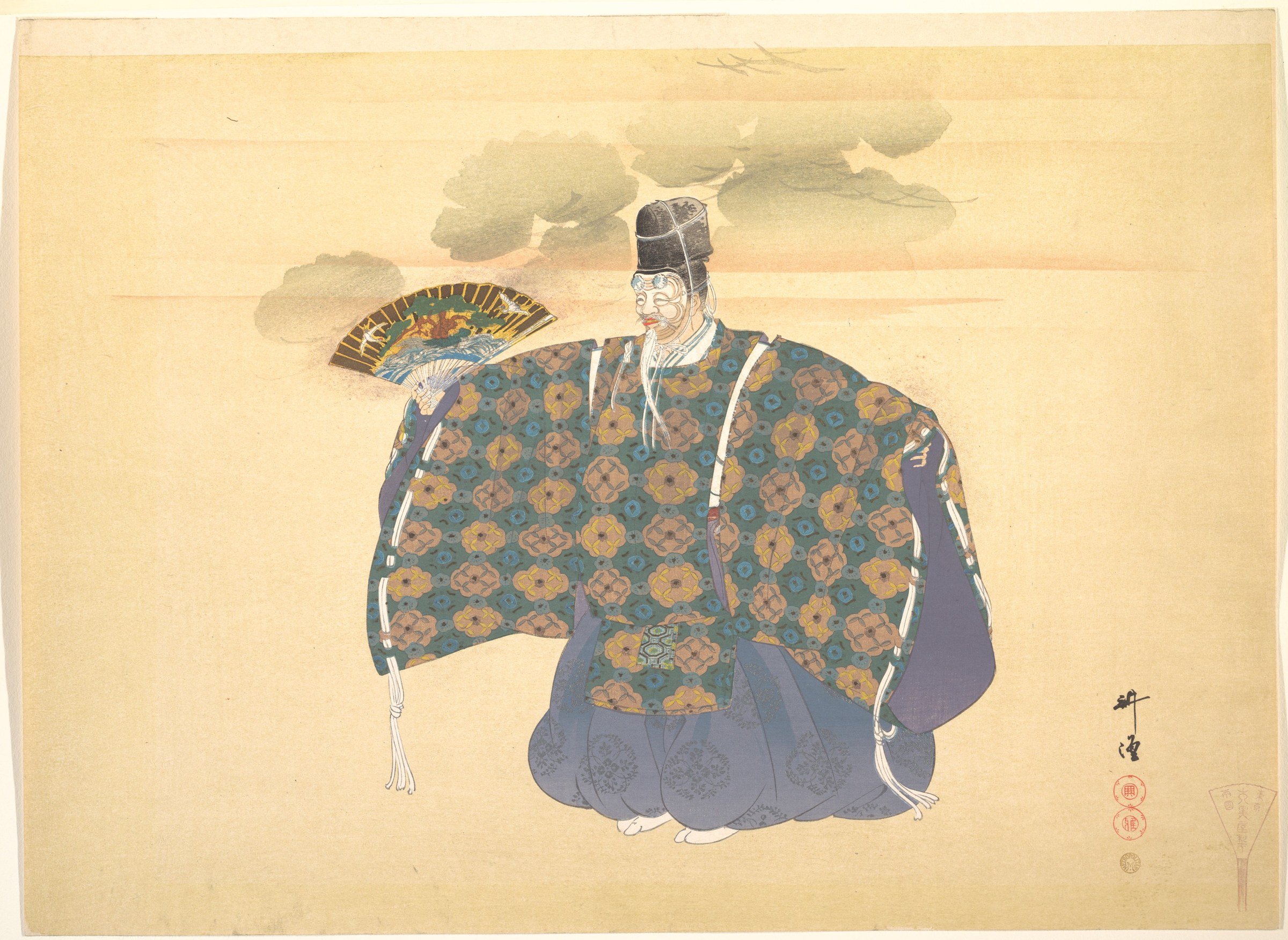
A single standing figure dominates the composition against a pale cream background with minimal setting. The figure wears an elaborate patterned robe in teal-green and ochre with a dense geometric floral design, worn open to reveal a deep blue undershirt. The robe's broad sleeves extend widely, and the figure wears a distinctive tall black headdress with white face makeup. A decorative fan with red and gold detail is held in the left hand, its handle visible with a long tassel. The figure's stance is frontal and stationary, with feet planted apart and the body held upright. Muted clouds appear in the upper background, rendered in pale washes of pigment that suggest an interior or theatrical space rather than an outdoor setting.
The dancing
The single figure stands in a posed, formal stance rather than mid-movement. The weight appears evenly distributed between both feet, planted firmly on the ground. The arms are positioned to frame the body—the right hand rests near the hip, while the left extends outward to present the fan. The torso remains still and dignified, the body entirely frontal. There is no indication of locomotion, turn, or dynamic action. The posture suggests a moment of stasis, presentation, or formal address rather than the execution of choreography.
The dance depicted
This appears to be a portrait of a performer in Noh or Kabuki theatrical dress and makeup, rather than a depiction of dance itself. The figure is costumed and positioned as a performer would appear when presenting themselves to an audience—a moment of stillness before, after, or outside of active performance. The tall headdress, white face makeup, decorative fan, and elaborate patterned robe are characteristic costume elements of Japanese classical theatre, but the stationary pose does not document a specific dance style or technique. The work functions as a character portrait rather than as a record of movement.
How it was made
This is a woodblock print, likely a Meiji-period example using the ukiyo-e tradition, rendered with watercolor or mineral pigments over a printed base. The delicate color work—particularly the subtle gradations in the robe pattern and the pale atmospheric washes in the background—suggests hand-applied pigment. The technique allowed for the fine rendering of costume detail and theatrical makeup, capturing the spectacle of stage dress that would have been the primary visual experience of a theatre-goer viewing the performer from the audience. The print medium and coloring practice made such images accessible and widely distributed, helping establish celebrity and costume knowledge among the theatre-going public.
About this work
This is a theatrical portrait of a Noh or Kabuki performer in full stage dress and makeup, standing in a formal, frontal pose. It belongs in a gallery of dance in art not because it documents choreography, but because it captures the visual culture and costume conventions of Japanese classical theatre—a central context in which formalized movement, music, and gesture were performed and understood. The work shows us what a theatre-goer saw when they attended a performance: not the movement itself, but the spectacular, carefully composed appearance of the performer as a visual entity. The stillness of the pose is itself a convention of such portraiture; the performer's power lay partly in their costume and presence as much as in the movement they executed.
How to look at it
Attend first to the costume and makeup as the primary subject. The artist has lavished care on the patterned robe, rendering each element of the geometric design with precision and color. The tall black headdress, the white face makeup, and the formal fan are as much a portrait as the implied face beneath the makeup. Notice the formal, frontal stance and the symmetry of the composition—this is not a moment of action but of presentation and display. The pale background and muted cloud forms keep attention on the figure. The work asks you to appreciate the theatre itself as a visual spectacle, not to imagine the movement that would accompany this costume.
The artist
Tsukioka Kōgyo (1869–1927) was a master woodblock printmaker specializing in theatrical subjects, particularly Noh and Kabuki. His series of full-length actor and character portraits, executed with refinement and attention to costume detail, are among the most celebrated examples of late Meiji theatrical portraiture. Kōgyo worked in the ukiyo-e tradition but adapted it for contemporary theatre documentation, bringing fine art sensibilities to what had been a more popular commercial practice. His prints were collected by both Japanese and Western audiences and represent a major bridge between traditional woodblock practice and modern theatrical imaging.
The period
This work dates to the early 1910s, a moment when Noh theatre was undergoing significant revival and revaluation in Japan following decades of relative decline in the Edo and early Meiji periods. The Meiji government and intellectual class had begun to frame Noh as a refined classical art form worthy of national cultural pride, in contrast to earlier modernization efforts that had marginalized it. Kabuki, meanwhile, remained a dominant popular theatrical form. Kōgyo's theatrical prints, including this one, were part of a broader movement to document, celebrate, and elevate Japanese classical performance as fine art. In Western art, this period saw intense interest in Japanese aesthetics following the earlier opening of Japan; Kōgyo's work circulated in both contexts.
Where it lives
The work is housed in a public collection and is known to circulate in digital form through Wikimedia Commons, indicating it is in the public domain or held in an open-access collection. The catalogue designation (MET DP143333) suggests a major institutional holding, likely the Metropolitan Museum of Art or similar major collection.
Dance in this work
Questions about this work
Is this actually a dance image?
Not in the sense of documenting choreography or movement. It is a theatrical portrait of a performer in classical Japanese theatre dress. It belongs in a dance gallery as a document of the visual culture and costume conventions within which formalized movement took place, and as evidence of how dance and theatre were circulated and understood through portraiture before film.
What is the headdress and makeup?
The tall black headdress and white face makeup are conventions of either Noh or Kabuki theatrical performance. Specific character types and roles were identified by standardized makeup patterns and costume elements. Without additional inscriptions or context, the exact character cannot be determined from the image alone, but the style clearly indicates Japanese classical theatre.
Who was Tsukioka Kōgyo?
A leading Meiji-period woodblock printmaker (1869–1927) who specialized in theatrical subjects. He was trained in the traditional ukiyo-e technique but brought fine art ambitions to the documentation of Noh and Kabuki performance. His work helped establish theatrical portraiture as a serious art form and circulated widely in both Japan and the West.
Why is the performer standing so still?
This is a portrait, not an action scene. The stillness and formal frontality are conventions of theatrical portraiture—they present the performer as a composed, dignified figure for the viewer's contemplation. The viewer is meant to appreciate the costume and presence rather than imagine active movement.
More dance artwork