49 works in this view — arrow keys or swipe to move between them.
Dance in Art · 1898
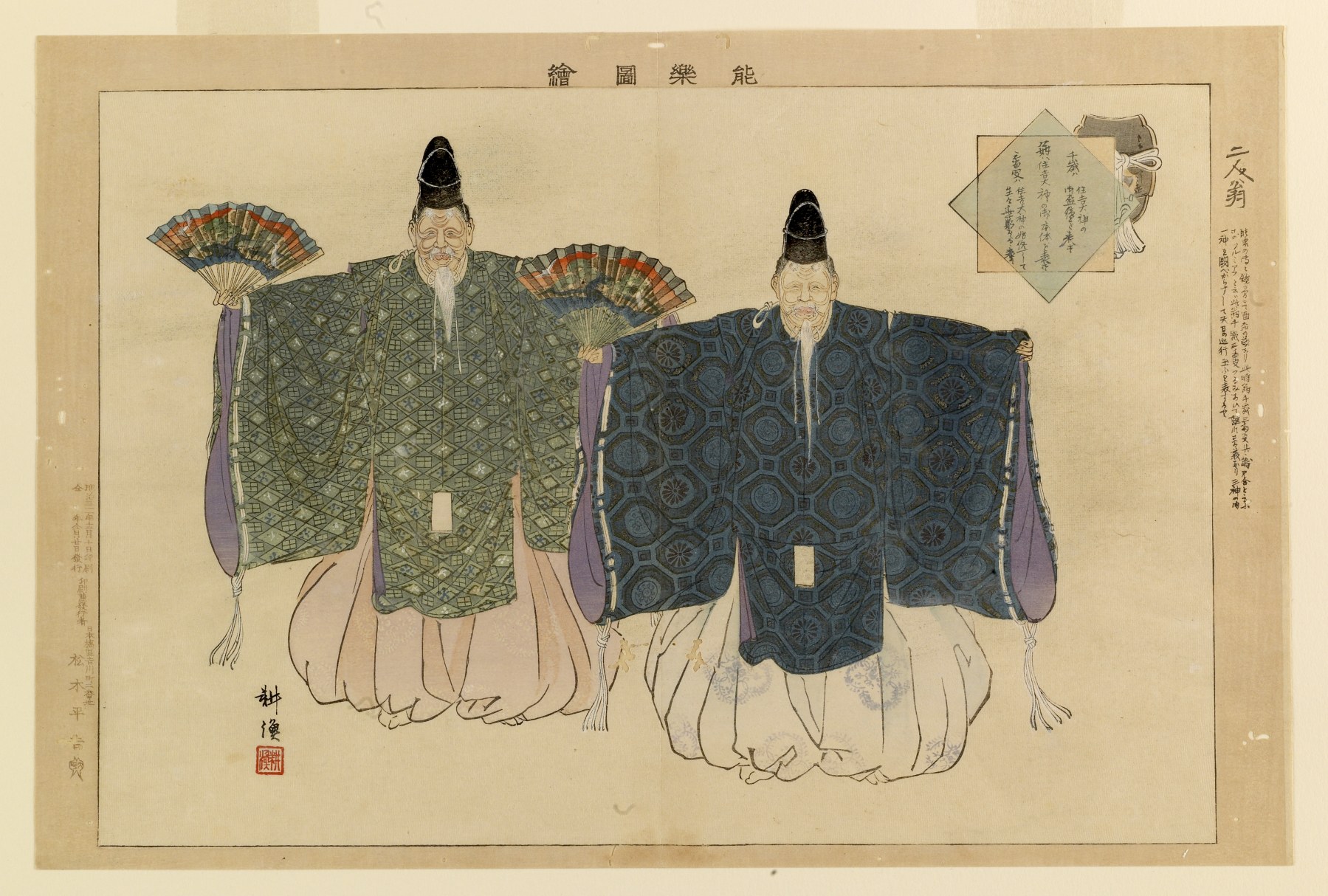
Matsuke Heikichi - Nogaku zue - Walters 95236
Kōgyo Tsukioka
- Medium:
- Oil Painting
- Era:
- Late 1800s (Victorian Ballroom)
- Source:
- Wikimedia Commons
- Rights:
- Public domain — free to use, share and adapt.
- Recorded as:
- Public Domain
Okina is the oldest continuously performed theatrical form in the world and a UNESCO Intangible Cultural Heritage; this image is a rare documentary record of its actual staging and costuming in a specific historical moment. For dance historians, it documents the formal ceremonial aesthetics of noh performance—the primacy of rank, age, and blessing over dramatic action or virtuoso movement—and shows how that aesthetics was communicated and preserved through visual media.
What you are looking at
Two elderly men with weathered faces stand side by side against a pale ground, each wearing elaborate patterned robes in jewel tones—one in green with geometric lattice work, the other in deep blue with circular medallion patterns. Both garments are voluminous, with deep sleeves and high necklines, worn over full white gathered trousers that balloon at the ankles. Each figure holds a large folding fan decorated in rust and blue tones, positioned at shoulder height with the fan fully open. Small tufts extend from the hems of their robes. The men's posture is formal and frontal, their expressions serene. A cartouche in the upper right contains East Asian calligraphy and text. The composition is meticulously rendered in a style that combines Japanese woodblock technique with careful detail in textile pattern and facial characterization.
The dancing
The two figures stand in a formal, symmetrical pose with minimal implied movement—the weight appears evenly distributed and the stance is static. The raised fans dominate the composition and suggest the central focus of the performance. Their faces are characterized with fine lines showing age; their postures are dignified and frontal, with shoulders held square. The identical pose and scale creates a parallel relationship between the two dancers, suggesting they perform equivalent roles in a paired or ensemble context. No footwork is visible; the emphasis is on the upper body and the objects held.
The dance depicted
This is documentation of Okina (翁), the celebrated opening performance of the noh theater tradition, which the existing catalogue record confirms consists of three dances performed by Okina, Senzai, and Sambaso. The image shows two of these three characters in their performance dress, distinguished by their elaborate robes and ceremonial fans. Okina is not a dramatic narrative but a ritualized blessing performance associated with auspicious occasions—New Year celebrations, theater openings, and celebrations of revered actors. The static, formal poses capture the stately, processional character of noh performance rather than dynamic movement; the fan (or *shaku* when formal, or *ōgi* as a decorative implement) is an essential prop that marks rank and ceremonial function. The aged appearance of both figures reflects the roles themselves, which represent venerable, protective spirits offering benediction.
How it was made
The work is described in the record as oil painting, but the visual evidence—the flat color fields, the precise linear patterns in the textile designs, the absence of dimensional modeling in the fabrics, and the overall aesthetic—strongly suggests this is a hand-colored woodblock print (likely a large-format *muzan-e* or *meisho-e* theatrical print) that may have been subsequently mounted or reproduced. The technique allowed for crisp registration of pattern and color, essential for rendering the intricate geometric designs of the noh robes, and made the image widely reproducible for theater audiences and collectors. The precision of the linework and the restrained palette are characteristic of late Edo or Meiji theatrical documentation.
About this work
This is a documentary image of the Okina performance, one of the most sacred and formal pieces in the noh repertory, made by Kōgyo Tsukioka in 1898 at the height of Japan's modernization. The work captures two of the three principal characters in their full ceremonial dress and ceremonial bearing, serving as both artistic record and historical evidence of how this ancient ritual performance was staged in the Meiji period. The artist's fastidious attention to textile pattern and characterization makes this an invaluable source for understanding both noh practice and the visual culture of late-19th-century Japanese theater documentation.
How to look at it
Attend to the textile patterns: each robe's design is distinct and carries iconographic meaning in noh tradition (geometric patterns often signify age and formality; medallion patterns evoke auspicious symbols). Notice the precise symmetry of the composition and the formal frontality of the pose—this is not a captured moment of movement but a formal portrait that emphasizes the ceremonial and blessing function of the performance. The folding fans raised to shoulder height are the key visual focus; in noh, the fan is not primarily a practical object but a ritual implement and a symbol of the performer's status and role. The aged faces and the dignity of their bearing communicate the spiritual authority these characters embody in the performance tradition.
The artist
Kōgyo Tsukioka (1862–1927) was a leading figure in Japanese modernism who trained in both traditional Japanese painting and Western oil technique. He is known for his *Nogaku zue* (Noh Illustrations), a comprehensive series documenting the plays, costumes, and performance practices of the noh repertory. His work combined meticulous antiquarian interest in theater with the artistic languages available to him—both woodblock tradition and Western painting—making him a crucial documenter of noh at a moment when the form was being revived and codified in the modern period.
The period
In 1898, Japan was consolidating its position as a modern nation while selectively preserving and promoting traditional arts as markers of cultural identity. Noh, which had declined in the Edo period, was being revived and elevated to the status of national classical art. The Meiji government and cultural elites were creating institutional and visual frameworks—museums, catalogs, illustrated books—to preserve and present Japanese traditions to both domestic and international audiences. Kōgyo's *Nogaku zue* series was part of this larger project of documentation and elevation of noh as high art worthy of serious antiquarian and aesthetic study.
Where it lives
The work is attributed to Kōgyo Tsukioka and dated 1898. It appears in the Walters Art Museum collection (accession 95.236) and has been documented on Wikimedia Commons. The catalogue record identifies it as part of the *Nogaku zue*, Tsukioka's systematic illustrated documentation of the noh repertory.
Dance in this work
Questions about this work
What is Okina and why is it important?
Okina (翁) is a ceremonial performance incorporated into the noh theater tradition, performed at auspicious occasions to offer blessing and good fortune. It is one of the oldest continuously performed theatrical forms in the world and was designated a UNESCO Intangible Cultural Heritage in 2001. Rather than tell a story, Okina performs an ancient ritual of veneration and benediction, making it central to noh's spiritual and ceremonial functions.
What do the three parts of Okina represent?
Okina consists of three individual dances performed by three characters: Okina (the old man and principal dancer), Senzai (a secondary character), and Sambaso (a youth figure). This image shows two of the three. Together they form a single ritualized blessing performance that takes about an hour to perform in full.
Why are the robes so elaborate?
In noh, the costume carries meaning and conveys character, rank, and spiritual status. The richly patterned brocade robes shown here are *atsuita* (thick silk robes) worn by characters of high rank and significance. The geometric and medallion patterns are woven into silk brocades that are often centuries old; some robes in contemporary noh performance are National Treasures of Japan.
What is that fan they are holding?
In noh performance, the fan (whether a folding fan or a flat ceremonial implement) is a core prop and gestural tool. It is not merely decorative but a ritual object that structures movement and is integral to the choreography. The fan allows the performer to create visual rhythm and to indicate emotional states, spatial relationships, and narrative moments through precise, economical gestures.
More dance artwork