49 works in this view — arrow keys or swipe to move between them.
Dance in Art · 1901
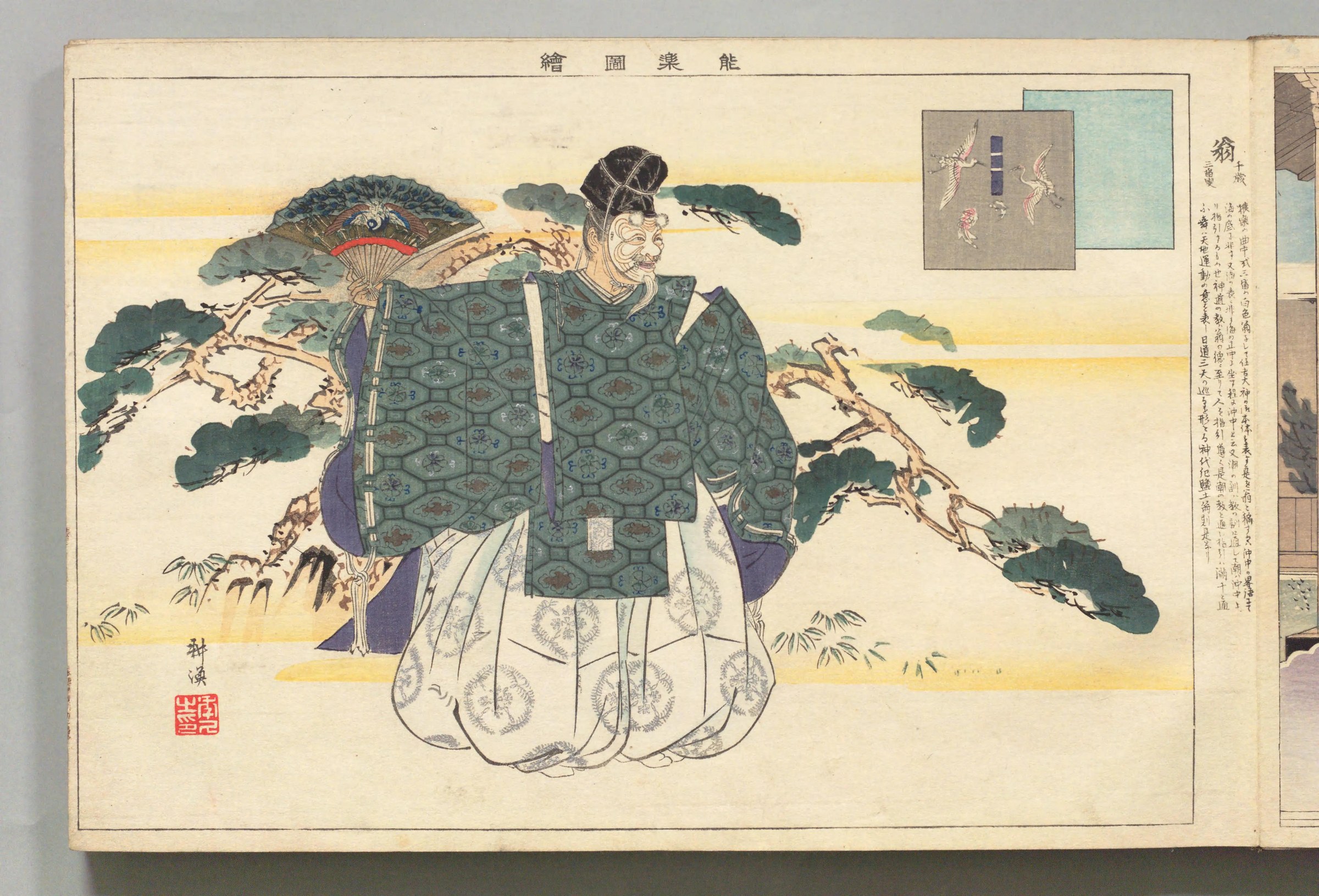
NDL-DC 1881032 Nōgaku zue 0005 翁 Okina
Kōgyo Tsukioka
- Medium:
- Oil Painting
- Era:
- 1900-1920 (Ragtime/Early Jazz)
- Source:
- Wikimedia Commons
- Rights:
- Public domain — free to use, share and adapt.
- Recorded as:
- Public Domain
Okina represents one of the world's oldest continuously performed theatrical traditions, with roots reaching back to the 14th century. Understanding how it was documented and disseminated through prints like this one reveals how classical Asian performance was preserved, taught, and circulated in the early modern period. The print also demonstrates that dance history must include forms where stillness, ritual presence, and symbolic gesture are primary—a corrective to Western assumptions that dance requires visible, rapid movement.
What you are looking at
A single figure dominates this composition, standing against a landscape of misty horizontal bands suggesting dawn or dusk, with gnarled pine trees rising behind. The figure wears an elaborate costume: a patterned green-grey silk robe (kataginu) with a small repeating motif, worn over voluminous white pleated trousers (hakama) that billow and gather at the ankles. A dark purple-blue under-robe (kosode) is visible at the sleeves and lower garment. The figure's face is painted white with exaggerated features—a prominent nose, stylized eyes, and a carved expression suggesting age or deity-like qualities. On the head sits a tall black hat (eboshi) with a long trailing element. The figure's left hand holds an ornate folding fan (uchiwa) with deep blue and red decoration, while the right arm extends naturally. The pose is frontal and ceremonial, the body neither in motion nor at rest, but suspended in ritual presence. The background trees and mist create atmospheric depth; the palette is restrained—ochres, greens, purples, and whites—with careful use of wash technique.
The dancing
A single standing figure, centered and frontal, with weight evenly distributed in a stable stance. The arms hang naturally with the left slightly raised to hold the fan; there is no indication of locomotion or turn. The silhouette is dominated by the voluminous hakama, which obscures the legs entirely, making footwork impossible to assess. The figure's bearing is dignified and still rather than dynamic; the posture suggests ritual stillness or a ceremonial moment rather than active dance movement. The fan is held as an attribute or prop, not as an instrument of movement.
The dance depicted
This is Okina (老人), the opening play of a Noh cycle, one of the most sacred and formal works in Japanese classical theatre. Okina is not a narrative drama but a purification ritual performed at New Year and other auspicious occasions. The role is traditionally performed by the most senior actor, and the performance combines elements of dance (mai), chant, and ritual gesture rather than conventional narrative. The figure shown is the Okina character himself—an aged deity or spirit of prosperity and longevity. The image captures the character in his essential iconic form rather than mid-movement; Noh performance involves highly codified, economical movement quite different from Western dance, where stillness, weight shifts, and subtle arm gestures carry profound meaning. The fan (uchiwa) is both a stage property and a symbol of rank and blessing.
How it was made
This is a colour woodblock print (likely an oban format, a standard large sheet size), executed in the traditional Japanese technique of separate blocks for each colour layer. The artist has used restraint in the palette—approximately seven to nine colour blocks—and the printing shows careful registration between layers. The technique allows for the precise reproduction of the actor's costume details and the atmospheric effects of the background mist, achieved through careful overprinting and partial inking (bokashi). This is a commercial theatrical print, created for circulation among audiences of Noh theatre and collectors of actor and stage imagery; the small artist's seal visible in the lower left confirms professional production. Woodblock printing made images of this quality affordable and widely distributed, creating a substantial market for theatrical documentation.
About this work
This is a colour woodblock print of the Okina character from Noh theatre, the most formal and sacred genre of Japanese classical theatre, showing a single figure in full ceremonial dress against an atmospheric landscape. The work belongs to the nishiki-e (full-colour woodblock print) tradition that flourished in the late 19th and early 20th century, documenting actors and roles from the Kabuki and Noh stages. The image is not a representation of dance in the Western sense—it is a portrait of a character in a form of theatre where movement is highly codified, sparse, and symbolic. The work is valuable precisely because it captures the visual language of Noh performance: the costume, makeup, prop, and bearing that constitute the role rather than the moment of active movement.
How to look at it
Attend to the costume: the kataginu, hakama, and kosode are all precisely rendered and carry symbolic weight in Noh convention—this is not decoration but the language of the role. Note the frontality of the figure and the stillness of the pose; the artist has not chosen a moment of movement but rather a moment of presence. The face is the most stylized element—the white makeup (shironuri), exaggerated nose, and carved expression are conventions of Okina makeup, not portraiture of an individual actor. The relationship between figure and landscape—the small, still human form against the vast misted trees—reflects both Noh's spatial conventions and Japanese landscape painting tradition. The fan in the hand is not an instrument of dance but a ritual object and symbol of blessing, so look at how the artist positions it as an attribute rather than in motion.
The artist
Tsukioka Kōgyo (1869–1927) was a celebrated actor and painter of the Meiji and Taishō periods who specialized in theatrical prints (yakusha-e) and studies of Noh and Kabuki performance. He was known for his precise rendering of costume detail and his commitment to documenting classical theatre during a period of rapid modernization in Japan. Kōgyo combined a background in traditional painting (he studied under several masters) with a theatre practitioner's insider knowledge, giving his prints both artistic refinement and authenticity. He was regarded as one of the finest theatrical artists of his generation and produced numerous series documenting Noh plays and actors.
The period
This print was created in 1901, during the Meiji period (1868–1912), a time of intense cultural negotiation in Japan. While Western forms were being eagerly adopted, there was also a parallel movement to document, preserve, and elevate traditional forms like Noh theatre as national cultural treasures. Okina in particular was undergoing scholarly and performance revival; interest in Noh as 'high art' rather than merely folk entertainment was growing among intellectuals. Woodblock prints like this one served both to record performances for theatre-goers and to position Noh within a modern, nationally conscious cultural framework. The early 20th century saw renewed patronage for both Noh performance and theatrical prints as modernization made such documentation feel urgent.
Where it lives
The work is held in the National Diet Library Digital Collections in Japan and is available through Wikimedia Commons. It is part of the Nōgaku zue (能楽図), a series of prints documenting Noh theatre, likely commissioned or compiled as a record of performance and costume during a period of national interest in preserving classical forms.
Dance in this work
Questions about this work
Is this a dance?
Okina includes dance-like elements (mai) but is better understood as a ritual performance that combines chant, gesture, and movement within a highly codified theatrical form. The boundaries between dance and theatre are looser in classical Japanese performance than in Western tradition. The work is relevant to dance history because it documents a major theatrical tradition where movement—though economical and symbolic—is central to meaning.
What is the white face paint?
This is shironuri (白塗), the Noh makeup convention for the Okina role. The white base, painted nose, and stylized eyes are part of the character's visual language, signifying age, divinity, or otherworldly status. The makeup is applied according to strict rules passed down through theatrical lineages and is recognized instantly by Japanese audiences.
Why is the figure so still?
Noh performance privileges stillness, restraint, and subtle weight shifts over large, visible movement. The actor's standing pose, which might appear static to a Western viewer accustomed to dynamic choreography, is itself a carefully maintained and meaningful performance state. The power of Noh lies partly in what is not done.
What does the fan mean?
The fan (uchiwa) is both a stage property and a symbol. In Okina, it represents blessing, authority, and auspiciousness. The character uses it in specific ritualized gestures, though this print captures the figure at rest rather than in the moment of its use.
More dance artwork