49 works in this view — arrow keys or swipe to move between them.
Dance in Art · 1899
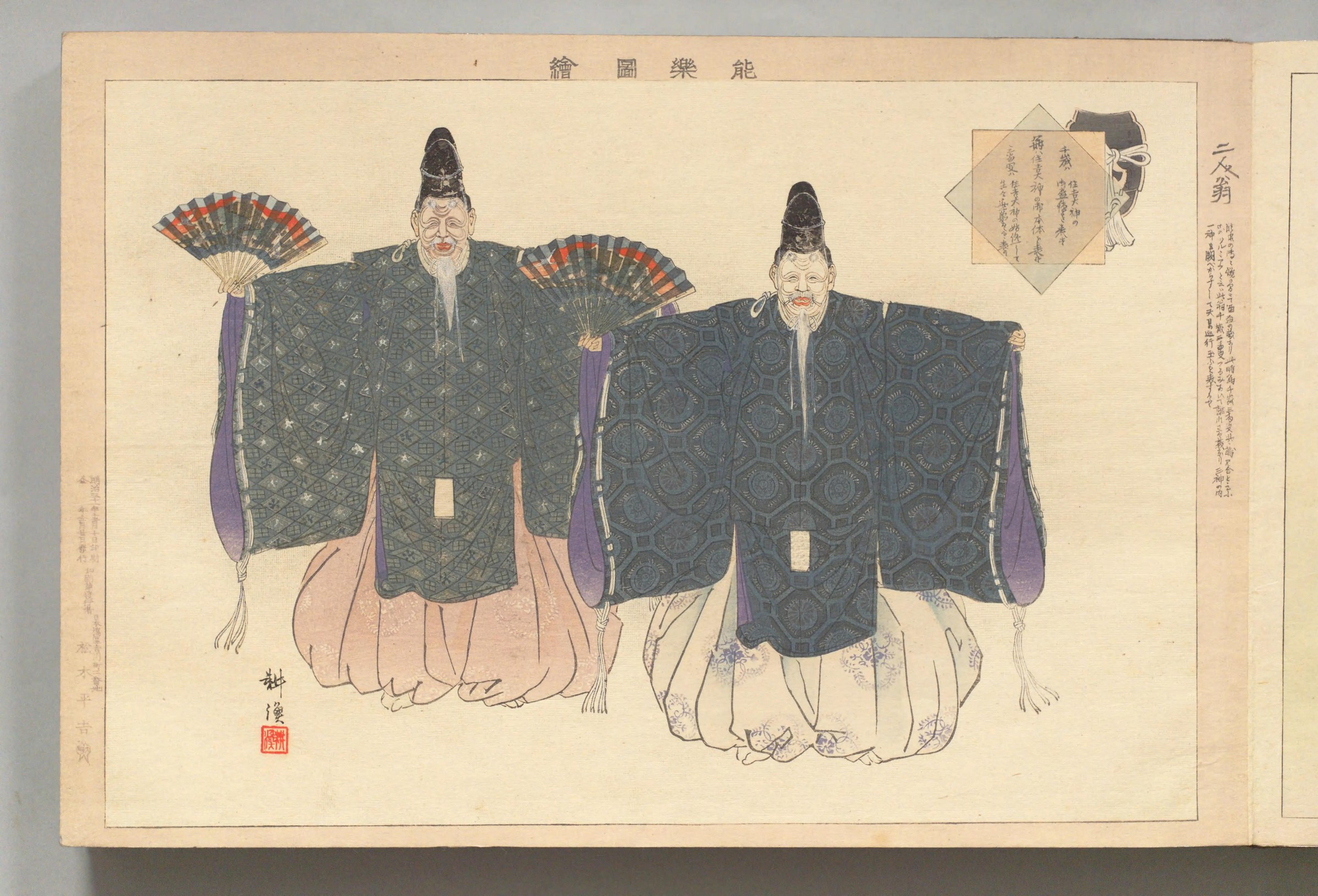
NDL-DC 1881033 Nōgaku zue 0005 二人翁 Futari Okina
Kōgyo Tsukioka
- Medium:
- Oil Painting
- Era:
- Late 1800s (Victorian Ballroom)
- Source:
- Wikimedia Commons
- Rights:
- Public domain — free to use, share and adapt.
- Recorded as:
- Public Domain
Tsukioka Kōgyo's *Nōgaku zue* series represents one of the most sustained and detailed visual documentations of classical Japanese theater ever produced. For historians of Noh and dance practitioners, this print preserves costume detail, character type, and formal bearing of a sacred theatrical form. The work sits at the intersection of theater history, printmaking tradition, and the visual documentation of embodied performance — making it essential for understanding how 19th-century Japan recorded and circulated knowledge of its own classical arts.
What you are looking at
Two elderly male figures stand facing the viewer in a roughly symmetrical composition, their bodies occupying the full height of the frame. Both wear elaborate dark patterned jackets (appearing to depict silk with geometric or floral motifs) worn open over pale pleated skirts that bunch at the ankles. Each holds a decorative fan in one hand, with deep red underside visible. Their faces are rendered with age lines and stern expressions; both have dark hair pulled up in the traditional topknot. The setting is minimal — a pale background with no architectural or landscape detail — which focuses all attention on the figures' costume and stance. A cartouche with calligraphic text appears in the upper right, and a red seal mark is visible on the lower left. The composition and costume suggest a formal theatrical presentation rather than a spontaneous scene.
The dancing
Both figures stand with weight centered and upright posture, knees slightly bent beneath the voluminous skirts, in a stable frontal stance. Their arms hang with the fans held at mid-body level, in a pose of formal presentation rather than active movement. Neither figure shows extension, weight transfer, or any suggestion of locomotion or partnered interaction. The symmetry of placement and gesture emphasizes stasis and ceremonial formality. This is a posed representation of costume and character type rather than a moment of dancing action.
The dance depicted
This is a representation of the Noh theatrical tradition, specifically the *Okina* (old man) character type, depicted here as *Futari Okina* (two old men). *Okina* is among the most sacred and formal pieces in the Noh repertoire, performed at celebratory occasions, and the role is danced by senior male performers. The piece features slow, dignified movement, symbolic gestures, and formal procession rather than virtuosic steps. The print documents the visual identity of the character — the costume, facial expression, and bearing — rather than capturing a moment of choreographic action. This is a costume study and character portrait within theatrical documentation.
How it was made
The work is a woodblock print (ukiyo-e), a medium that allowed for mass production and wide circulation of theatrical imagery. The soft tonal palette, fine linear detail in the costume patterns, and careful gradation suggest this comes from a multi-block color printing process. The delicate rendering of the silk patterns and the controlled use of pale ochre, dark blue, red, and purple indicate skilled carving and registration. This is part of a documented series (Nōgaku zue, or 'Pictures of Noh'), which suggests systematic theatrical documentation made for collectors and theater enthusiasts.
About this work
This is a woodblock print by Tsukioka Kōgyo documenting two *Okina* characters from Noh theater in formal costume and stance. *Okina* is among the most important and sacred pieces in the Noh repertoire, traditionally performed at auspicious occasions by established senior actors. The work belongs to a larger documentary project on Noh theater (*Nōgaku zue*) and serves as both costume reference and character study. Rather than depicting a dynamic dance moment, it presents the visual identity and formal bearing of the character type, making it a record of theatrical tradition and visual culture in late-19th-century Japan.
How to look at it
Attend first to the costume detail: the geometric and floral patterns printed into the silk, the quality of the pleating in the voluminous skirts, the style of the fans, and the precision of the topknot. These specifics ground the work in documented theatrical practice. Then observe the formal stance and facial expression — the stern dignity, the frontal orientation, the weight held in the center. This is not a naturalistic representation of a body in motion, but a formalized presentation of character and status. The pale background removes any context and insists you read the figure as an image of the *type* of Okina, not a particular moment in a narrative.
The artist
Tsukioka Kōgyo (1869–1927) was a master of the ukiyo-e woodblock tradition and among the last major practitioners of the form. He trained in both the Kanō school of painting and woodblock technique, and devoted significant energy to depicting kabuki and Noh theater. His *Nōgaku zue* series, spanning many prints, represents a systematic visual archive of Noh costumes, characters, and performance conventions. Kōgyo worked at a moment when these traditional arts were under pressure from modernization, and his print series functioned as both artistic practice and cultural preservation.
The period
This print dates to the late Meiji period (1899), when Japan was rapidly modernizing while simultaneously developing renewed interest in its own classical traditions. Noh theater had survived centuries of popularity fluctuation but faced competition from kabuki and Western theatrical forms in the late 19th century. Simultaneously, Japanese elites and cultural institutions were beginning systematic efforts to define and preserve *traditional* arts as national patrimony. The growth of ukiyo-e theatrical prints in this period reflects both popular appetite for theater documentation and a more self-conscious archival impulse — recording performance forms before they might disappear.
Where it lives
This print comes from the National Diet Library Digital Collections and is part of the documented *Nōgaku zue* series by Tsukioka Kōgyo. It is catalogued as print 0005 in that series, suggesting it is part of a systematically numbered sequence of Noh documentation.
Dance in this work
Questions about this work
Is this a dance or a portrait?
It is a theatrical character portrait — a formal representation of the *Okina* type as it appears in Noh theater, rather than a depiction of the character in motion. Noh performance involves movement and gesture, but this print focuses on costume, bearing, and character identity rather than choreographic action. It functions as both artwork and documentary record.
Why are there two figures when the title says 'Two Old Men'?
*Futari Okina* (Two Old Men) is a structured piece within Noh in which two Okina characters appear, often in mirrored or complementary roles. This print shows both characters in their formal costume and stance, allowing viewers to understand the doubling that structures the piece. The symmetry of their presentation emphasizes the formality and ritual nature of the performance.
What is Noh?
Noh is a form of classical Japanese musical theater that emerged in the 14th century. It combines stylized movement, mask work, poetry, and instrumental music (particularly the flute and hand drums) to present narratives often drawn from history, legend, or supernatural encounters. Performances are slow-paced and highly formal, with emphasis on symbolic gesture and the spiritual or emotional states of characters rather than plot. It remains one of the world's oldest continuously performed theater traditions.
Who was Tsukioka Kōgyo?
Kōgyo (1869–1927) was a master woodblock printmaker working at the end of the ukiyo-e tradition. He specialized in theater documentation, particularly Noh and kabuki, and created the *Nōgaku zue* series as a systematic visual record of Noh performance. His work represents both artistic practice and cultural preservation, made at a historical moment when Japan was defining and protecting its classical arts traditions.
More dance artwork