49 works in this view — arrow keys or swipe to move between them.
Dance in Art · 1898
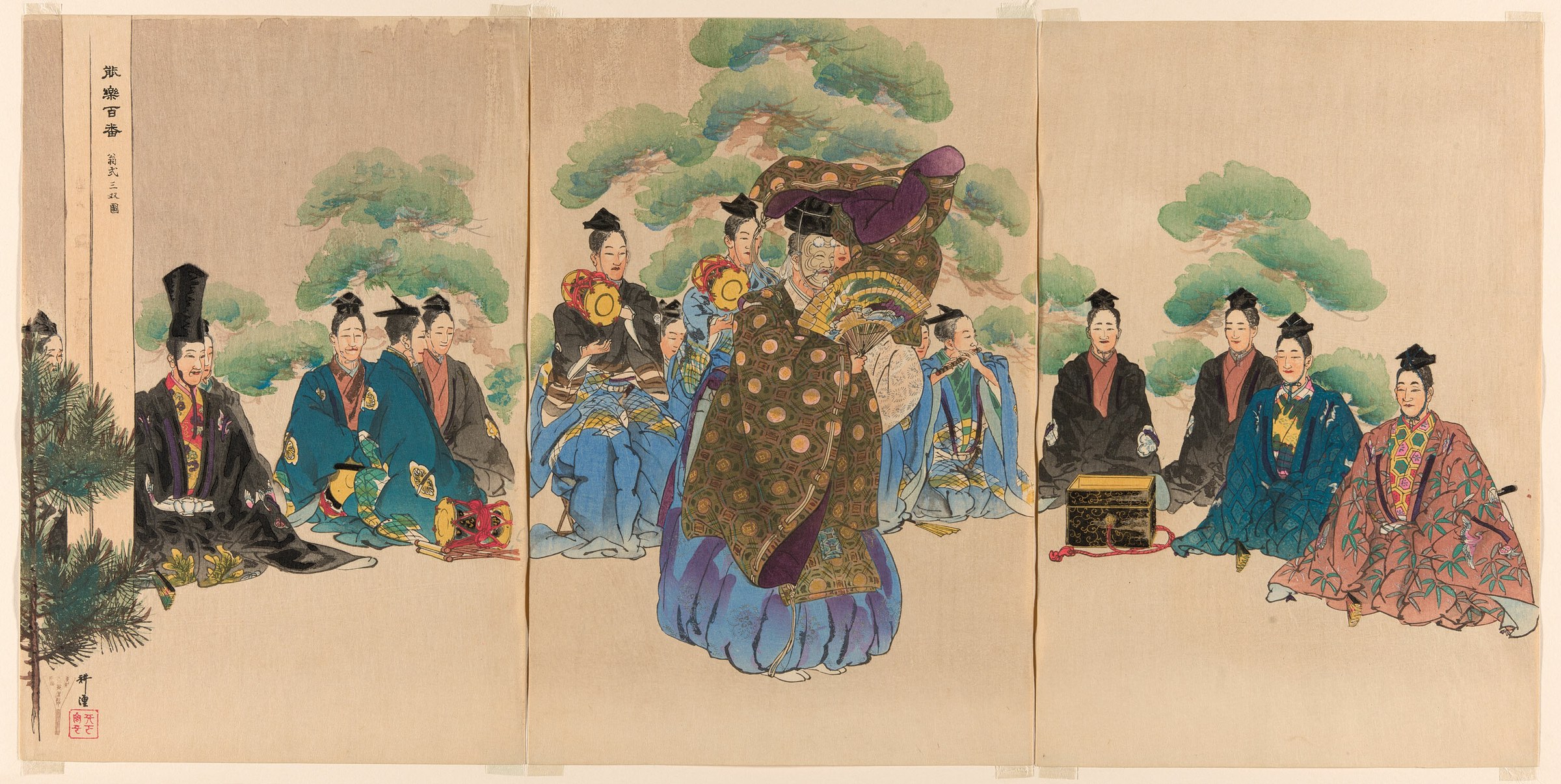
Okina 翁 - Nōgaku hyakuban 能樂百番 - Tsukioka Kōgyo 月岡耕漁 (Art Institute of Chicago)
Kōgyo Tsukioka
- Medium:
- Oil Painting
- Era:
- Late 1800s (Victorian Ballroom)
- Source:
- Wikimedia Commons
- Rights:
- Public domain — free to use, share and adapt.
- Recorded as:
- Public Domain
Okina is foundational to the entire Nōgaku tradition and represents a dance-theatre form in which minimal movement carries maximum spiritual and aesthetic weight. Kōgyo's systematic documentation of the Nōgaku repertory is one of the few surviving visual records of how these classical performances were staged and understood at the moment of Japan's rapid modernization, making it essential evidence for historians of Japanese theatre.
What you are looking at
A three-panel composition depicting a formal court or theatrical gathering arranged in a rising composition that stages the central drama. The right and left panels show seated figures in rich silk robes—blues, blacks, and deep reds—arranged in informal groups beneath spreading pine trees rendered in soft greens and golds. The central panel dominates: a figure in an enormous pleated robe of deep purple and brown patterned silk, with an outsized cylindrical hat, faces away from the assembly toward the viewer's right. This figure's robes are voluminous and heavily decorated with gold roundels and woven patterns. Attendants in blue and gold flank this central figure. The entire scene is rendered in the delicate hand-colored woodblock print style of late 19th-century Japanese art, with careful attention to textile pattern, mineral pigment, and the play of light across silk. The composition reads as a moment of formal presentation or entrance, with all subsidiary figures arranged to direct attention to the monumental central form.
The dancing
The primary figure occupies the center with a posture of stillness and formal bearing, the body upright within the massive swath of fabric, the head directed slightly outward in profile. The surrounding figures sit in varied but composed attitudes—some with legs crossed, others kneeling, all maintaining the formal bearing expected of court attendants. Their hands rest on their laps or gesture with gentle repose. The scale difference between the central figure and the attendants, and the geometric clarity of their arrangement in space, suggests this is not spontaneous movement but ritualized positioning.
The dance depicted
This is Okina, the opening dance of the Nōgaku (classical Japanese no theatre) repertory. Okina is not danced in the Western sense but rather performed as a highly formalized, slow movement vocabulary of extreme dignity and spiritual weight. The monumental central figure is Okina himself, the deity of longevity and prosperity, whose entrance and minimal gestural vocabulary constitute the entire dramatic action. The play exists in a liminal space between dance and ritual: the performer moves with deliberate, grounded weight, the feet rarely leaving the wooden stage floor, with changes of direction and posture that read as sculptural transitions rather than flowing motion. This print captures the moment of Okina's formal entry and presentation to the assembly, a moment considered auspicious and sacred in the Nōgaku tradition.
How it was made
This is a hand-colored woodblock print (likely a modern reprinting from woodblocks, or possibly a later lithographic reproduction in the style of ukiyo-e), showing the technical sophistication of Meiji-era Japanese commercial art. The careful gradation of mineral pigments—particularly the luminous greens of the foliage and the jewel tones of the silk—speaks to the labor-intensive process of hand-coloring and the skill of the artisan colorists. The medium allowed for wide circulation and distribution of images of theatrical moments, making Nōgaku visual documentation accessible to a public that might not attend performances. The format as a triptych follows the conventions of theatrical prints (yakusha-e) that documented celebrated performances and roles.
About this work
This work documents a single moment in Okina, the opening ritual dance-drama of the Nōgaku theatre tradition in Japan. Created by Tsukioka Kōgyo in 1898, it is part of a larger series (Nōgaku hyakuban, 'One Hundred Nō Plays') that systematically illustrated the classical Nōgaku repertory at a moment when Japanese artists were both preserving traditional forms and engaging with Western artistic techniques. The print captures the formal presentation of the deity Okina to his court assembly, a gesture of greeting and blessing that constitutes the emotional and spiritual center of the performance. The work sits at the intersection of theatrical documentation, devotional imagery, and modernist printmaking, representing both a deep commitment to preserving Nōgaku tradition and the emergence of new visual media for its circulation.
For a contemporary viewer, the image asks what dance is when movement is reduced to essential gesture and formal positioning. Okina contains no virtuosity, no display, and minimal physical change—yet it has been performed continuously for over 600 years as the opening rite of Nōgaku theatre. This print is a rare document of how that tradition was understood and visualized in the Meiji period, when Japanese modernizers chose to invest serious artistic effort in preserving pre-modern theatrical forms.
How to look at it
Attend to the stillness of the central figure and the way the composition uses scale and formal arrangement rather than action to create visual drama. Notice how Kōgyo has captured not a moment of dynamic movement but a moment of formal presentation—the frozen pause before gesture. The richness of the textile patterning and the careful rendering of the robes' volume and weight are themselves part of the visual meaning: in Nōgaku, costume and positioning carry as much expressive weight as movement. Look at how the surrounding figures frame and stabilize the central presence, creating a formal court geometry that mirrors the ordered, ritualized nature of the performance itself.
The artist
Tsukioka Kōgyo (1869–1927) was a master of the woodblock print medium and one of the major figures in the documentation of Kabuki and Nōgaku theatre in the late 19th and early 20th centuries. He moved beyond the earlier theatrical print tradition (yakusha-e) to create more psychologically complex and artistically ambitious images, often working on large-format prints and series. His commitment to depicting the emotional and spiritual dimensions of classical Japanese theatre, combined with his technical mastery of color printing, made him a bridge between ukiyo-e traditions and modern Japanese art. He is particularly celebrated for his Nōgaku hyakuban series, of which this work is a part.
The period
This print was made during the Meiji period (1868–1912), a time of rapid industrialization and Westernization in Japan, when traditional arts faced pressure to prove their cultural value and artistic legitimacy. While many Japanese intellectuals and artists were engaged in wholesale adoption of Western models, a parallel movement worked to preserve and aestheticize pre-modern forms. Nōgaku, which had been supported by feudal patronage in earlier centuries, was in the process of being reconstructed as a high art form for modern audiences. Kōgyo's documentation project was part of this broader effort to position classical Japanese theatre as worthy of serious artistic and scholarly attention. At the same time, the shift to prints and photography as means of theatrical documentation reflected the broader impact of new reproductive media on how performance was preserved and circulated.
Where it lives
The work is recorded as part of the Art Institute of Chicago's collection. It is part of the Nōgaku hyakuban series, a systematic visual documentation of the classical Nōgaku repertory created over the course of Kōgyo's career. The series functioned as both artistic achievement and archival project.
Dance in this work
Questions about this work
Is Okina actually a dance?
Okina is classified as a Nōgaku play, but it functions as ritual rather than narrative drama. The movement vocabulary is extremely restricted: the performer walks, turns, and makes slow gestures of greeting and blessing. Yet it has been considered foundational to the Nōgaku tradition for centuries and requires years of training to perform correctly. Whether to call it dance depends on how broadly you define dance; Nōgaku performers themselves train as dancers, and the aesthetic principles governing movement are shared with other Japanese dance forms.
Why is this figure so much larger than the others?
The scale difference is compositional rather than literal—Kōgyo is using perspective and figure size to emphasize that Okina is the focal point and the spiritual center of the performance. In an actual Nōgaku performance, all performers would be the same physical size, but the robes of Okina are extraordinarily voluminous, making the figure visually massive and commanding on stage.
What is that enormous hat?
The tall cylindrical hat is part of the Okina costume and is believed to have ancient roots in court dress or ritual regalia. The hat, combined with the voluminous robes, makes the figure of Okina into an almost abstract geometric form—broad, stable, and monumental. The costume is one of the few in Nōgaku that prioritizes visual grandeur over naturalism.
Why did Kōgyo create a hundred prints of different Nōgaku plays?
The Nōgaku hyakuban series was both a preservation project and an artistic one. During the Meiji period, traditional arts were under pressure, and Kōgyo's series functioned as a visual archive of the full repertory at a moment when that repertory was being formalized and standardized. The series also allowed Kōgyo to demonstrate the artistic and technical sophistication of Nōgaku to modern audiences who might otherwise dismiss it as outdated.
More dance artwork