49 works in this view — arrow keys or swipe to move between them.
Dance in Art · 1790
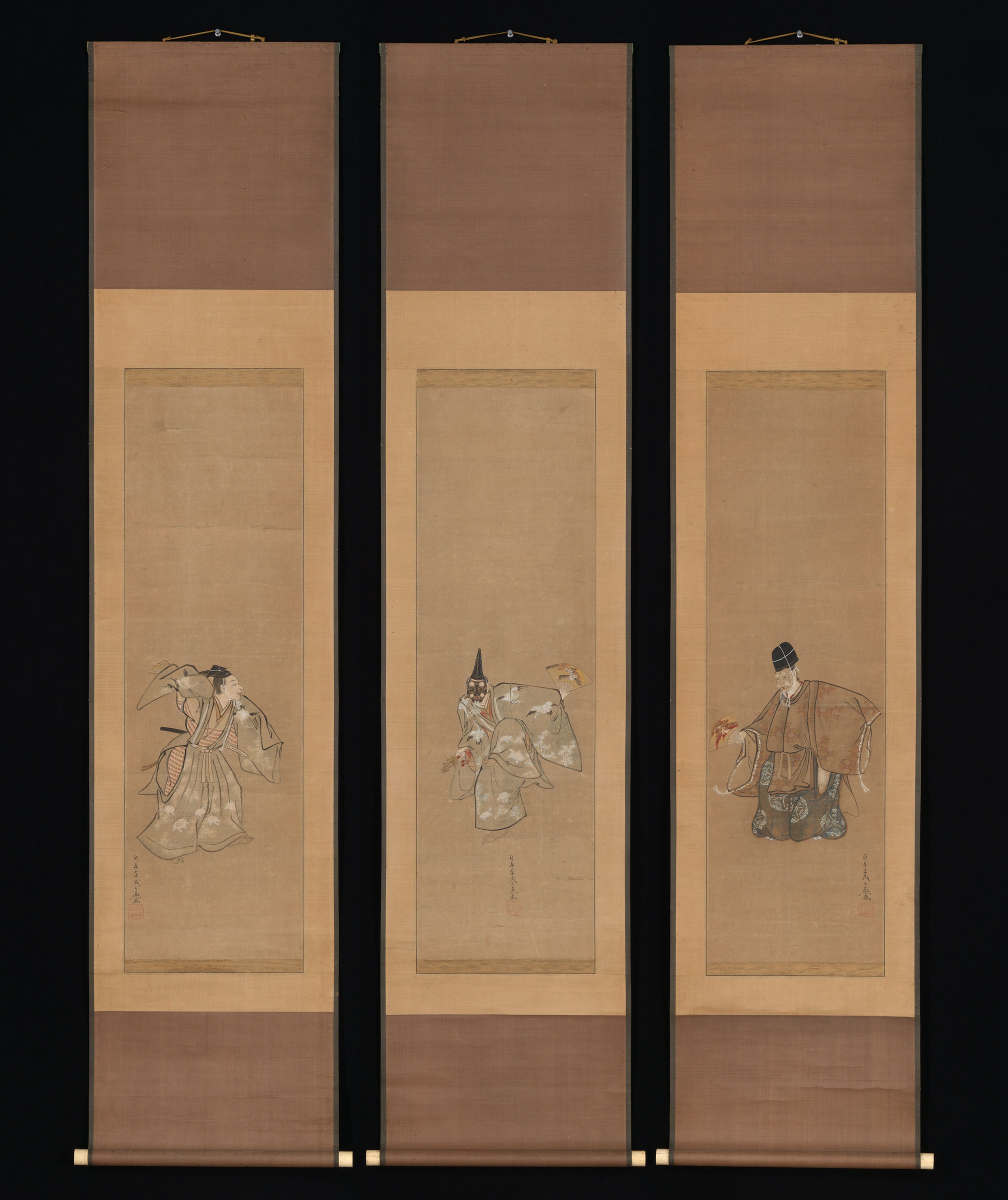
「翁」図-The Auspicious Noh Dance "Okina" MET DP-12232-116
Toriyama Sekien
- Medium:
- Oil Painting
- Era:
- 1700s (Enlightenment/Minuet Era)
- Source:
- Wikimedia Commons
- Rights:
- Public domain — free to use, share and adapt.
- Recorded as:
- CC0
Okina is among the oldest continuously performed theatrical forms in the world, and these scrolls represent its visual codification during the 1790s, a period when Noh was consolidating into the repertory we know today. For researchers of Asian theatre history and Japanese aesthetics, the work offers precise documentation of costume, posture, and formal movement vocabulary at a specific historical moment. These images constitute rare visual evidence of how Noh performers understood and transmitted the physical language of their art.
What you are looking at
Three vertical scroll paintings present three figures in Japanese theatrical costume against plain cream grounds, each scroll framed by darker silk borders top and bottom. The figures wear elaborate kimonos with geometric patterns—the leftmost in striped silk, the center in white with bold patterning, the right in brown—and each wears a close-fitting dark cap. All three stand in contrapposto stance, weight shifted slightly, with one arm raised or gesturing and the other lowered. The leftmost figure holds what appears to be a fan or implement in one hand. The compositions are spare, with no scenic elements: the focus is entirely on the costumed body and its arrested gesture. The ink work is minimal and precise, rendered in sepia or dark brown on the cream silk.
The dancing
All three figures stand in similar weight distribution—upright, with hips slightly canted and one leg apparently bearing more weight than the other. The raised arm positions differ slightly but all suggest deliberate, formal gesture rather than energetic movement. The leftmost figure's arms frame the body with a curved quality; the central figure extends one arm across the body with open palm; the rightmost raises an arm while the other rests at the side. None depict the turned-out legs or lifted spine of ballet vocabulary; instead the posture is grounded and frontal, with the torso as the expressive center.
The dance depicted
These are representations of Okina, the ceremonial masked dance of classical Japanese Noh theatre. Okina is an auspicious opening piece performed to bring blessing and good fortune, and traditionally involves masked and unmasked male performers in formal dress moving through prescribed gesture sequences. The three scrolls likely represent different moments or characters from the Okina performance—possibly the progression through the dance's phases or the three principal actors (Shite, Waki, and Ai). The spare, dignified postures and formal kimonos match documented practice in Noh, though the precision of these particular poses cannot be verified from the scrolls alone.
How it was made
The record identifies these as oil paintings, but they are mounted as Japanese hanging scrolls (kakemono) on silk with wood roller bars—a format that required either post-mounting of an oil work or misidentification in the record. The delicate ink rendering and pale palette suggest these may instead be ink on silk or light pigment on paper, mounted in the traditional Japanese manner. The technique allowed for fine detail in costume patterning and subtle modeling of the figures while maintaining the austerity appropriate to Noh documentation. The scroll format privileges the vertical figure and suggests these were intended for private viewing or archival record rather than public exhibition.
About this work
These three hanging scrolls document Okina, the classical Japanese Noh theatre's auspicious opening dance, recorded by Toriyama Sekien in 1790. They are formal representations of masked and costumed performers captured in the formal stances and gesture-work of the Noh stage. As a set they likely chart a sequence through the performance or present its principal characters in their defining poses. The work belongs to a Japanese tradition of recording theatrical practice through visual documentation—preserving not narrative or emotion but the precise codes of formal movement and dress that constitute the performance itself. For dance historians, these scrolls are primary evidence of late-Edo Noh practice and Sekien's role in documenting performance traditions at the moment of their refinement into classical form.
How to look at it
Attend to the posture and hand position of each figure: these are not snapshots of movement but formal poses held as the legible units of the dance. Notice how each scroll presents the figure frontally and nearly symmetrically, which distinguishes Noh's ceremonial dignity from the more dynamic gestures of Kabuki, which was contemporary and popular. The stillness of the image—the absence of motion blur or trailing drapery—is itself documentation: it records that Noh movement is economical, sustained, and formally contained. Compare the three scrolls as a sequence to read the ceremonial progression.
The artist
Toriyama Sekien (1712–1788, though the record dates this work 1790) was a celebrated painter and illustrator of the Edo period, known for his ukiyo-e prints and paintings of landscape, narrative, and theatrical subjects. He worked extensively documenting performance traditions and was associated with the Utagawa school. His interest in Noh and other classical arts reflected the late-Edo fascination with preserving and standardising performance knowledge. Sekien's theatrical works are valued both as accurate records and as art objects in their own right.
The period
The late 18th century saw Noh consolidating into its classical form after centuries of evolution. The Edo period (1603–1868) had stabilized Noh's repertory and moved it from street performance into formal contexts sponsored by the shogunate and wealthy patrons. Documentation through visual art became part of this codification process. Meanwhile, Japanese painting was experiencing renewed interest in precise figural representation and in recording ephemeral arts—the tradition of theatre painting and scroll documentation was well established by the 1790s.
Where it lives
The work is held in the Metropolitan Museum of Art (accession DP-12232-116) and was accessed via Wikimedia Commons. It is listed as three hanging scrolls of the same series, indicating they were originally conceived as a set or suite and have remained grouped.
Dance in this work
Questions about this work
What is Okina?
Okina is the auspicious opening ceremony of Noh theatre, performed to bring blessing and good fortune. It is among the oldest continuously performed theatrical pieces in human history, with origins in earlier ritual forms. The performance involves masked actors and prescribed gesture sequences that remain largely unchanged across centuries.
Why are these paintings mounted as Japanese scrolls?
The scroll format (kakemono) was the standard display method for Japanese paintings and documents meant for private viewing or archival preservation. The vertical orientation and textile mounting suggest these were intended as a set for a patron or collector interested in preserving theatrical knowledge, rather than for public exhibition.
Can you identify which Noh character each figure represents?
The scrolls do not include identifying labels visible in the image, and without expert knowledge of Noh costume variation it is difficult to distinguish Shite (principal actor), Waki (secondary actor), and Ai (comic interlude performer) from the visual record alone. The three poses and costume variations suggest they represent the main roles, but this would require consultation with Noh specialists to confirm.
Is the catalogue record correct that this is oil painting?
The mounting and delicate appearance suggest these may be ink or light pigment on silk rather than oil painting. Oil paint would be unusual for Japanese scroll work of this period. The record may reflect uncertain identification; visual examination by a conservator would clarify the actual medium.
More dance artwork