49 works in this view — arrow keys or swipe to move between them.
Dance in Art · 1790
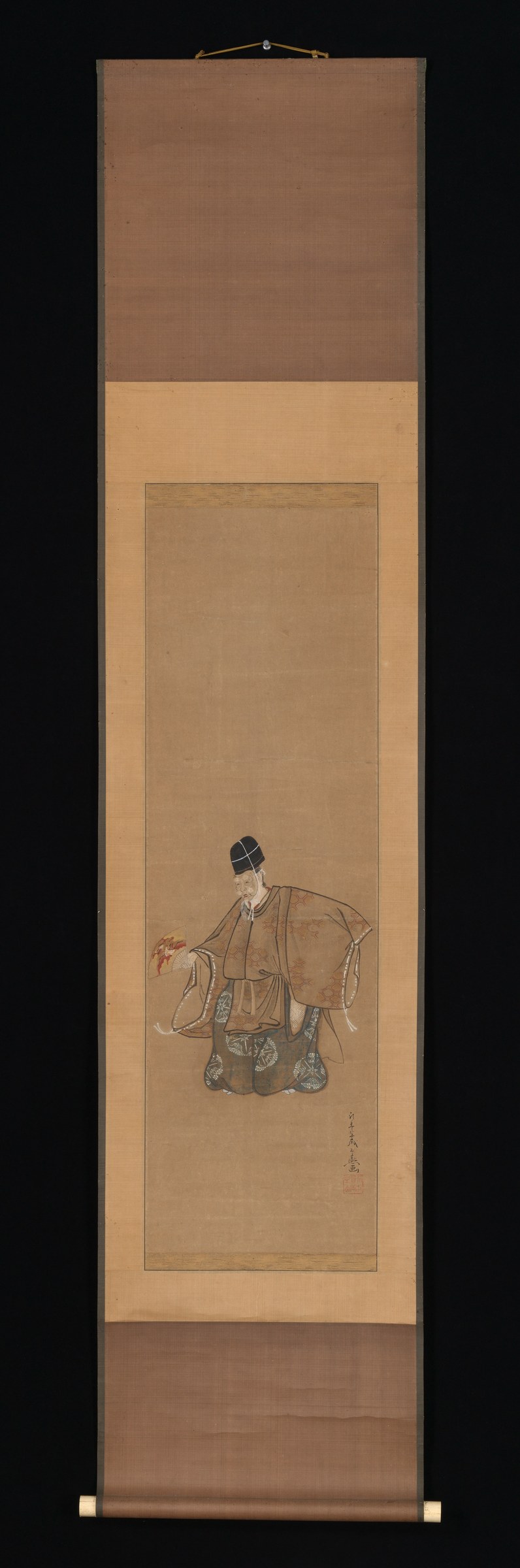
「翁」図-The Auspicious Noh Dance "Okina" MET DP-12232-117
Toriyama Sekien
- Medium:
- Oil Painting
- Era:
- 1700s (Enlightenment/Minuet Era)
- Source:
- Wikimedia Commons
- Rights:
- Public domain — free to use, share and adapt.
- Recorded as:
- CC0
Okina represents a direct unbroken lineage to some of the oldest structured performance in Japanese culture, and this image is valuable evidence of how the form was embodied and understood in the 18th century. For anyone studying either Noh theatre or the visual documentation of dance before photography, this work shows how artists navigated the challenge of capturing non-narrative movement—stillness, gesture, and spiritual intent rather than dramatic action.
What you are looking at
A single figure, rendered in ink and pale wash on silk, occupies the lower two-thirds of a tall vertical scroll. The dancer wears a deep brown robe with visible geometric patterns on the sleeves and lower garment, their posture bent forward at the waist in a pronounced stoop. The figure's head is covered with what appears to be a dark patterned cap or mask. The right arm extends outward with fingers splayed in a deliberate gesture; the left arm hangs at the side. The body weight appears settled and grounded, the knees slightly flexed. The upper portion of the scroll shows the mounting—a tan silk backing with darker brown borders top and bottom, and a wooden hanging rod with metal fittings at the apex. The composition is spare, even austere, with the figure isolated against unmarked ground, demanding close attention to the bodily position rather than narrative context.
The dancing
A single dancer, their body folded forward from the hips in what appears to be a deep, reverent bow or genuflection. The spine curves in an arc; the head angles downward. One arm extends away from the body with fingers spread open—a gesture that reads as either an offering or a completion of a formal movement phrase. The other arm remains passive at the side. The stance is static and contained rather than dynamic; this is not a moment of rapid motion but of deliberate placement and weight distribution, suggesting the capture of a formal pose or stillness within a larger movement sequence.
The dance depicted
This image depicts Okina (翁), one of the oldest and most sacred forms in Japanese Noh theatre, identifiable by the distinctive patterned costume (particularly the brocaded robe and breeches), the mask-like head covering, and the characteristic forward-bending posture that is fundamental to this form. Okina is not a dramatic narrative but a ritual blessing dance, traditionally performed at the opening of theatre seasons and auspicious occasions. The gesture shown here—the extended arm with splayed fingers—is consistent with the formal, ceremonial movements that constitute Okina's vocabulary. The pose suggests a moment within the slow, meditative sequence of movements that define this form, where each gesture carries symbolic weight and spiritual significance.
How it was made
This is a hanging scroll painted in ink and watercolour wash on silk—a traditional East Asian format designed for display in an alcove (tokonoma). The technique employs fine brushwork for contour lines, particularly visible in the folds and patterns of the costume, with subtle wash layers creating volume and shadow. The monochromatic palette with touches of ochre and earth tones is characteristic of literati painting and theatrical documentation from this period. The scroll format itself indicates this work was intended for private or semi-private viewing, possibly in a collector's study or in a theatre-affiliated context, rather than mass circulation.
About this work
This is a document of Noh theatre practice from late 18th-century Japan, rendered by Toriyama Sekien, a painter known for combining artistic refinement with close observation of performance. The work captures a single moment from Okina—the ritual opening dance that remains one of the most conservative and sacred forms in Japanese theatre. Rather than attempting to render the full flow of movement or contextualise the dancer within a scene, Sekien isolates the figure against empty ground, treating the body as a study in formal gesture and ritual posture. The painting functions simultaneously as a theatrical document (recording what Okina looked like in performance) and as an artwork in its own right, respecting both the demands of the medium (painting on silk) and the austerity of the subject (a dance of profound ceremonial restraint).
How to look at it
Look first at the spine and the forward bend—this is the defining physical signature of Okina, required of any performer in the role. The extension of the arm and splaying of the fingers is a deliberate formal gesture; watch how Sekien has drawn it with precision, as if the position matters deeply (it does). Notice the detailed patterning on the costume—these are not decorative flourishes but specific costume elements of the role, recorded with care. Finally, observe how the artist has left the upper half of the scroll blank; this emptiness is not a lack but a choice, forcing you to concentrate on the figure and the pose rather than on narrative or setting. The painting asks you to see the body as the primary subject.
The artist
Toriyama Sekien (1712–1788) was a prolific Edo-period painter and printmaker whose practice encompassed ukiyo-e, literati painting, and theatrical subjects. He was known for his ability to observe and document performance with accuracy while maintaining artistic sophistication. Sekien belonged to the wider Toriyama school and worked in a moment when Japanese artists were beginning to document theatre and performer practice more systematically, bridging the gap between fine art and entertainment culture.
The period
The late 18th century was a period of intense cultural refinement in Edo Japan. Noh theatre itself had already existed for over three centuries in its mature form, and by this era it had settled into the highly codified, conservative practice that persists today. The impulse to document theatre through painting was part of a broader cultural attention to performance and its aesthetics. Simultaneously, Sekien was working in a tradition of Japanese painting that valued restraint, asymmetry, and the power of empty space—aesthetic principles that aligned perfectly with Noh's own philosophy. This was not documentary realism but a meeting of performance culture and fine art convention.
Where it lives
The work is documented in the Metropolitan Museum of Art collection (accession DP-12232-117) and circulates via Wikimedia Commons, where it is publicly accessible. It is catalogued as a hanging scroll in the museum's holdings.
Dance in this work
Questions about this work
What is Okina, and why is it sacred?
Okina is the oldest form in Japanese Noh theatre, traditionally performed only at the opening of theatre seasons or at auspicious occasions. It is a ritual blessing dance rather than a dramatic narrative, and it has been preserved with almost no changes for over six centuries. The form is believed to bring good fortune and to honour the spirit of theatre itself.
How do we know this is Okina and not another Noh form?
The costume is the primary identifier: the deep brocaded robe with geometric patterns, the patterned breeches, and the distinctive mask or head covering are unique to Okina. The forward-bending posture is also characteristic. Sekien has recorded these costume and bodily markers with enough precision that the form is unmistakable to anyone familiar with Noh.
Why is the dancer shown alone and against blank ground?
This compositional choice reflects both the painting tradition Sekien worked in and the nature of Okina itself. The spare presentation emphasizes the gesture and the posture as primary subjects. There is no narrative context to provide—Okina is pure form and ritual, and the painting respects that by isolating the body.
Was Toriyama Sekien himself involved in theatre?
Sekien was a painter and printmaker, not a performer, but he was deeply engaged with Edo-period theatre culture and created many works documenting performance. His knowledge of theatrical subjects came through close observation and his position within a society where theatre was central to urban culture.
More dance artwork