49 works in this view — arrow keys or swipe to move between them.
Dance in Art · 1790
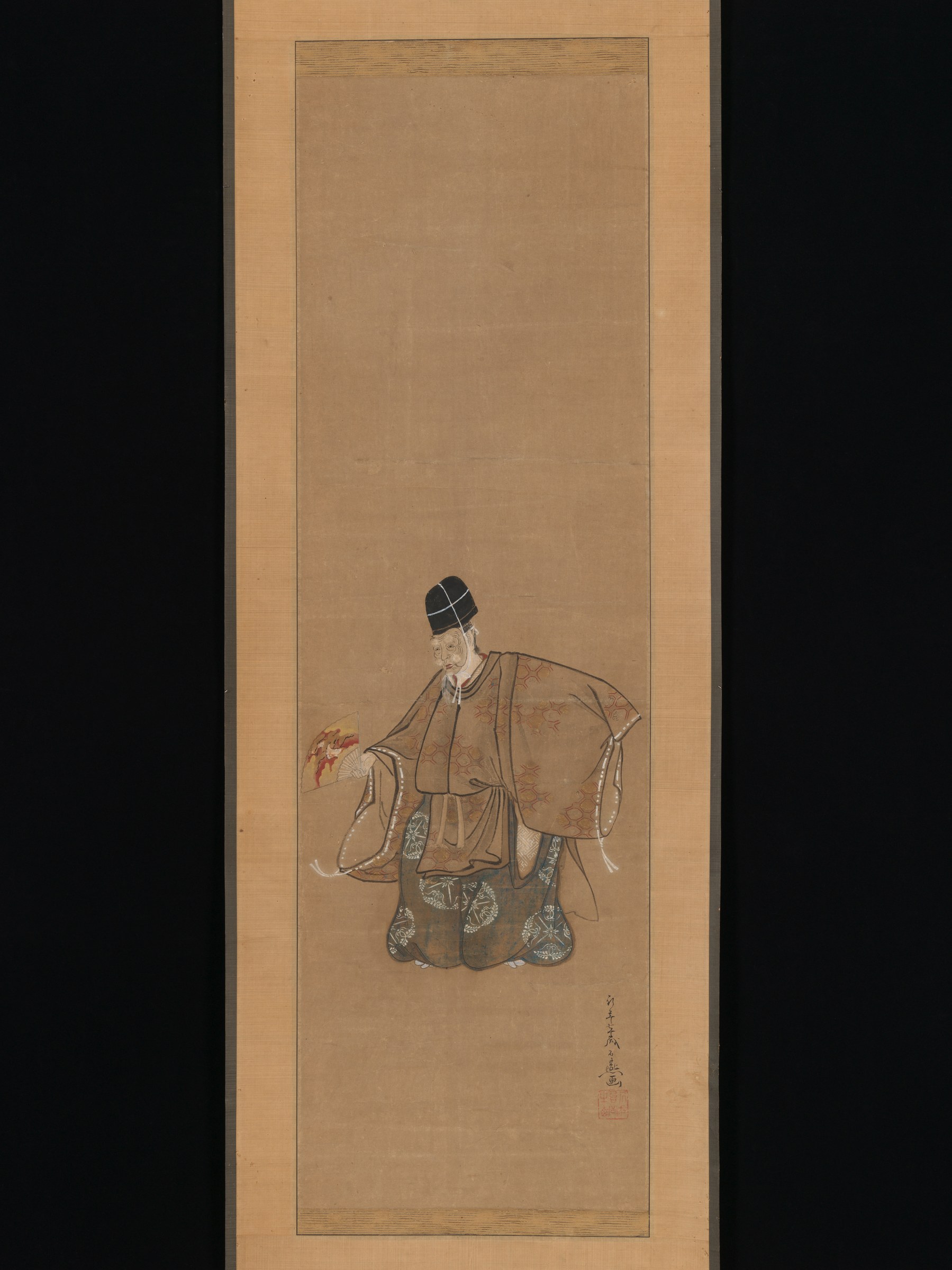
「翁」図-The Auspicious Noh Dance "Okina" MET DP-12232-118
Toriyama Sekien
- Medium:
- Oil Painting
- Era:
- 1700s (Enlightenment/Minuet Era)
- Source:
- Wikimedia Commons
- Rights:
- Public domain — free to use, share and adapt.
- Recorded as:
- CC0
Okina is the oldest continuously performed theatrical work in the world, and this image provides rare visual documentation of how the performer was dressed and how he presented himself in the late 18th century. For historians of Noh, Japanese performance, and the broader history of dance, this offers evidence of costume, bearing, and the ceremonial seriousness with which the tradition was regarded even as Japan was modernizing.
What you are looking at
A single male figure occupies the lower portion of a tall vertical composition, set against a plain tan background. The figure wears formal Japanese dress: a dark patterned cap (eboshi), a bronze-brown outer robe (karaori or similar garment) with long sleeves, and patterned lower garments in muted tones suggesting damask or brocade. He holds what appears to be a fan or ceremonial implement in his right hand. His posture is upright but relaxed, with weight settled and a slight forward inclination of the torso. The face is rendered in muted tones with careful attention to age—the figure appears to be an older man. The composition emphasizes stillness and dignity rather than dynamic movement; the immense negative space above the figure creates a sense of ceremonial formality and meditative calm. A signature in Japanese characters appears in the lower right.
The dancing
The single figure stands in a grounded, stable stance with legs slightly apart beneath the lower garments, suggesting weight evenly distributed. The arms are relaxed at the sides, with the right hand holding a folded fan (likely a tessen or similar implement), a gesture of calm authority rather than dynamic movement. The shoulders are level and the head erect. There is no visible tension in the frame; this is a portrait of composure and ceremonial presence rather than kinetic action. The figure's bearing suggests a performer or dignitary at rest, or frozen in a moment of formal presentation rather than active dance.
The dance depicted
This is an image of Okina (翁), the oldest and most sacred Noh drama, a form of Japanese classical theater that blends music, dance, and poetry. Okina is not a narrative drama but a ritual performance of auspicious blessing, traditionally performed at the start of the Noh season. The figure depicted is likely the Okina character himself—the old man who performs the central blessing dance (mai). In Okina, the dance movements are deliberate, slow, and deeply rooted, with the dancer maintaining a composed, almost sculptural quality while executing subtle shifts of weight and subtle gestural language. The image captures not the moment of visible motion but the essential stillness and spiritual authority that defines the Okina performance.
How it was made
This is a hanging scroll painted in mineral pigments and ink on paper or silk, executed in the Japanese literati or scholarly style (bunjinga). The artist employs restrained color—ochre, tan, black, and muted greens and blues in the patterned textiles—with careful brushwork defining the garments and facial features. The technique allows for the subtle gradation and wash effects visible in the face and robe, and the composition's vertical format and ample negative space are characteristic of Japanese scroll painting conventions. This format would have circulated among educated patrons, scholars, and theater enthusiasts, not as a mass-produced image but as a valued artwork for private appreciation or display.
About this work
This is a scholarly or artistic record of Okina, the foundational sacred dance-drama of the Noh tradition, made by a recognized artist of the late Edo period. The image does not capture movement in the Western sense but rather the essential ceremonial presence and dignified stillness that define the performance. Toriyama Sekien (1736–1820) was known for his studies of Japanese history, culture, and the supernatural; this work appears to be part of his broader project of documenting traditional Japanese performance and visual culture. The hanging scroll format situates this as a cultured object for a literate audience interested in the preservation and appreciation of Noh tradition.
How to look at it
Look at the stillness of the figure and the formal composition: this is not a snapshot of dance but a study in ceremonial presence and hierarchical dignity. The careful rendering of the textile patterns and the aged, composed face tell us that Sekien was interested in capturing the seriousness and authority of the Okina figure. The weight settling into the ground, the upright carriage, and the calm hold of the fan or implement reflect a conception of Noh performance in which power and meaning reside not in large movement but in stillness, breath, and the subtle shifting of weight. The immense negative space is intentional—it emphasizes the solemnity and ritual significance of the figure.
The artist
Toriyama Sekien (1736–1820) was a prolific painter, printmaker, and scholar of the Edo period, known for his studies of Japanese folklore, ghosts, and supernatural imagery (yōkai), as well as for his more scholarly works documenting traditional arts and customs. He worked in a literati style influenced by Chinese painting but applied it to distinctly Japanese subjects. Sekien was connected to educated patrons and intellectuals interested in the documentation and preservation of Japanese cultural traditions. His works on performance arts and historical subjects reflect the antiquarian interests of his circle and the broader late-Edo fascination with Japanese cultural heritage.
The period
The late 18th century in Japan was a period of relative peace and cultural flourishing under the Edo shogunate. Though Japan was largely closed to foreign trade and influence, there was intense internal interest in documenting, studying, and preserving traditional arts—including Noh, which by this time was several centuries old and regarded as a classical treasure. The rise of literati painting (bunjinga) in this period reflected growing scholarly and aesthetic engagement with both Chinese and Japanese cultural traditions. This work dates to a moment when Noh was shifting from an active living tradition to an object of historical and cultural reverence, studied and recorded by artists and intellectuals.
Where it lives
The work is recorded in the Metropolitan Museum of Art's collection (accession DP-12232-118) and is accessible via Wikimedia Commons. It is a hanging scroll in the Japanese tradition, the primary format for such works in the Edo period and remains the standard presentation for these objects in museums today.
Dance in this work
Questions about this work
What is Okina?
Okina is the oldest form of Noh theater, dating to the 14th century or earlier. It is not a narrative drama but a ritual performance of blessing and auspiciousness, traditionally performed at the beginning of the Noh season. The Okina character is an old man who performs a slow, grounded blessing dance (mai) with profound spiritual significance. It is one of the most sacred and closely guarded pieces in the Noh repertoire.
How do we know this is Okina?
The title of the work is explicit: 「翁」図 ('Okina' sketch or study). The costume, bearing, and formal presentation are consistent with historical records and depictions of the Okina character. The aged male figure in formal ceremonial dress holding a fan or implement is the standard iconography for this character in Japanese art.
Why does the figure appear so still?
Noh performance, especially Okina, emphasizes restraint, spiritual gravity, and minimal visible motion. The power of the Okina performance lies not in large, dynamic gestures but in subtle shifts of weight, precise hand and arm positions, and the overall command and composure of the performer. Sekien's decision to render the figure in a moment of formal stillness captures the essential quality of the Okina aesthetic.
Who was Toriyama Sekien?
Sekien (1736–1820) was a major Edo-period painter and scholar known for documenting Japanese folklore, ghosts, and traditional arts. He worked in the literati painting style (bunjinga) but applied it to Japanese subjects, making him an important figure in the preservation and artistic study of traditional Japanese culture. This work reflects his broader interest in recording and honoring the classical arts.
More dance artwork