49 works in this view — arrow keys or swipe to move between them.
Dance in Art · 1790
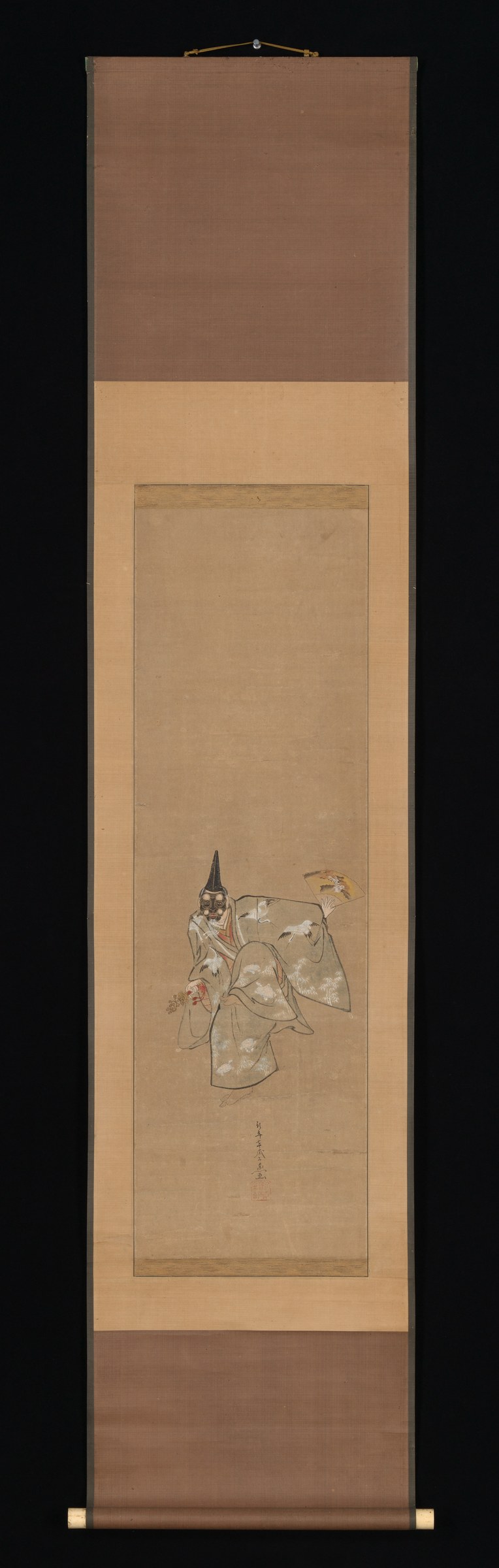
「翁」図-The Auspicious Noh Dance "Okina" MET DP-12232-119
Toriyama Sekien
- Medium:
- Oil Painting
- Era:
- 1700s (Enlightenment/Minuet Era)
- Source:
- Wikimedia Commons
- Rights:
- Public domain — free to use, share and adapt.
- Recorded as:
- CC0
Okina is the canonical auspicious Noh play, performed only on the most formal occasions, and is treated as existing partly outside narrative drama—it is a ritual blessing. This painting preserves visual evidence of how a master Noh dancer embodied that role in the late 18th century: the formal stance, the precise costume, the restraint and gravitas of the movement. For anyone studying the history of Noh performance, Japanese theatrical aesthetics, or the place of dance in ceremonial life, this image offers concrete visual information about what mattered in the tradition.
What you are looking at
A single figure dominates this hanging scroll, rendered in ink and subtle color wash on paper. The dancer wears the distinctive tall black lacquered hat (eboshi) and pale silk robes characteristic of the Noh theatre, with the garment's hem and sleeves arranged to suggest weight and volume. The figure is captured mid-movement, the torso angled and one arm extended while the other curves inward—a posture suggesting both dignity and the controlled, deliberate pacing of Noh performance. The composition is spare: the figure occupies the lower half of the composition against an expanse of pale paper, with only a few scattered flowering branches rendered in gold and rust wash to suggest a spring setting. The mounting is in the traditional hanging scroll format (kakemono) with darker silk borders at top and bottom and a wooden dowel for hanging.
The dancing
The single dancer fills the frame from roughly the waist up, allowing clear observation of the upper body's articulation. The posture is fundamentally vertical and stable rather than dynamic—the knees remain slightly bent but grounded, the weight held centered. The arm positions are asymmetrical: one arm extends outward at roughly shoulder height with a gentle curve, while the other curves inward across the body, with the hand positioned near the hip. The robes, rendered in pale pigment with darker outlines, are so voluminous they obscure the legs entirely, creating the visual effect of the dancer gliding rather than walking. The face is rendered in profile or three-quarter view, calm and mask-like, which is consistent with Noh aesthetic.
The dance depicted
This is almost certainly a depiction of *Okina* (翁), one of the oldest and most ceremonial Noh plays, performed at auspicious occasions and the beginning of Noh theatre seasons. *Okina* features an elderly man (the okina, or "old man") whose dance is slow, solemn, and deeply ritualized rather than narrative. The play is notable for existing partially outside the standard Noh drama structure—it is treated as a benediction. The image captures the essential qualities of *Okina*'s movement: the stately restraint, the formal costume, and the sense that this is sacred or auspicious movement rather than entertainment. The sparse composition and the figure's centrality reflect *Okina*'s spiritual and ceremonial importance.
How it was made
This is an ink and watercolor painting on paper, mounted as a hanging scroll in the Japanese tradition. The technique employs delicate washes of mineral pigments—the pale ochre and cream for the robes, the touches of rust and gold for the scattered plant life—over carefully controlled brushwork in black ink for outlines and details. The artist has worked within the constraints of the scroll format, using empty space as compositional element rather than filling the surface. This technique was common for recording theatrical subjects in Japan during the 18th century, particularly for the educated elite who collected images of Noh performers and plays.
About this work
This is a record of *Okina*, the oldest and most ceremonially important play in the Noh canon, captured by Toriyama Sekien in 1790. The work documents not a narrative drama but a ritual performance—the slow, formal dance of an old man that serves as a benediction and an opening to the Noh season. The painting is spare and reverent in its approach, centering the solitary figure and leaving space for the viewer to contemplate the dancer's stillness and restraint. It represents an 18th-century artist's attempt to preserve the essential image of one of Japanese theatre's most sacred forms, at a moment when such visual recording was becoming increasingly valued by collectors.
How to look at it
Attend to the dancer's absolute stillness and control. In Noh, the most important movement is often the least visible—the work happens in the body's internal centering, in the precise angle of the torso, in the measured pace. The artist has frozen the dancer at a moment of deliberate, formal positioning rather than in a moment of dramatic action. Notice too how the costume itself is part of the image's meaning: the voluminous pale robes dominate the composition, suggesting that in *Okina*, the performer's body and the formal beauty of the costume are inseparable. The sparse setting—just a few flowering branches—indicates that this is not a drama of narrative or place, but a timeless ritual.
The artist
Toriyama Sekien (1736–1806) was a prominent Japanese painter and illustrator active during the late Edo period. He was known for both ukiyo-e woodblock prints and more formal painted works, and for his antiquarian interests in Japanese culture and theatre. Sekien worked across multiple genres and styles, from humorous and commercial subjects to serious antiquarian recordings of Noh and kyōgen performance. His interest in capturing theatrical subjects—particularly the more formally prestigious Noh tradition—reflects the tastes of educated Edo-period collectors and the growing antiquarian impulse of the late 18th century.
The period
By 1790, Noh theatre was more than 400 years old and was maintained primarily as an elite courtly and samurai art form, performed at formal occasions and patronized by the shogunate. The late Edo period (late 1700s) saw an increase in antiquarian interest among the educated classes—collectors and artists became invested in documenting and preserving traditional Japanese cultural forms, including Noh. At the same time, new printing and painting techniques made it possible to circulate images of theatrical performance more widely than before. The creation of formal painted records of Noh actors and plays was part of this broader antiquarian movement, reflecting anxiety about preservation and a sense that traditional forms needed to be documented for posterity.
Where it lives
The work is recorded as a hanging scroll from the Edo period, held in a collection (unspecified in the current record). The source is listed as Wikimedia Commons. This is a formal painted scroll rather than a popular print, indicating it was created for a collector rather than for mass circulation.
Dance in this work
Questions about this work
What is *Okina*?
*Okina* (翁, "the old man") is one of the oldest and most sacred plays in the Noh canon, performed at the beginning of Noh seasons and at auspicious occasions. Unlike narrative Noh plays, *Okina* is partly a benediction and blessing, performed in formal ritual manner. The play typically features an old man (the okina) whose dance is slow, solemn, and ceremonial rather than dramatic.
Who was Toriyama Sekien?
Toriyama Sekien (1736–1806) was a prominent Edo-period painter and illustrator known for both popular woodblock prints and more formal antiquarian works. He was particularly interested in documenting traditional Japanese cultural forms, including Noh theatre, and was part of the late-18th-century movement among educated collectors to preserve and record classical Japanese arts.
Is this an engraving or a painting?
This is a hand-painted work in ink and watercolor on paper, mounted as a traditional Japanese hanging scroll. It is not a print and not an engraving. The technique allowed for subtle variations in color wash and gave the artist direct control over the final image, which is typical of formal antiquarian recordings of this period.
Why is the figure so still?
The apparent stillness is fundamental to Noh aesthetics, and especially to *Okina*. In Noh, movement is often minimal and formalized; the art lies in precise, controlled positioning and the subtle shifts in weight and posture. The artist has captured a moment that is not climactic or dramatic but rather a state of formal, ritual composure—which is exactly what matters in *Okina* performance.
More dance artwork