49 works in this view — arrow keys or swipe to move between them.
Dance in Art · 1790
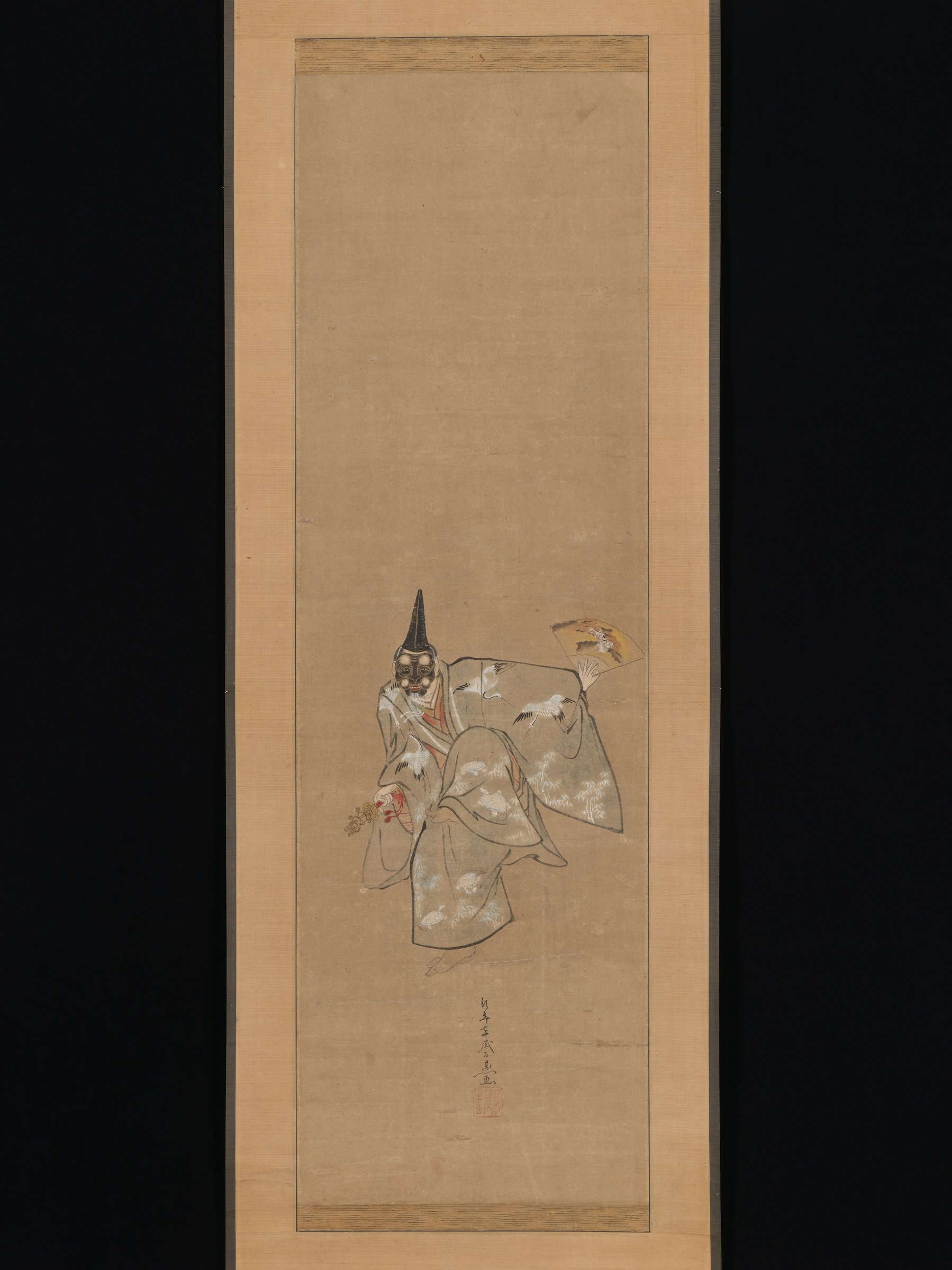
「翁」図-The Auspicious Noh Dance "Okina" MET DP-12232-120
Toriyama Sekien
- Medium:
- Oil Painting
- Era:
- 1700s (Enlightenment/Minuet Era)
- Source:
- Wikimedia Commons
- Rights:
- Public domain — free to use, share and adapt.
- Recorded as:
- CC0
Okina is Noh's ritual anchor, performed before every public programme to consecrate the space and invoke good fortune; it has been danced in essentially this form for five centuries. Sekien's image is rare documentary evidence of the work's visual composition and costume from the Edo period, and shows how seriously visual artists took the task of recording classical dance—not as entertainment to be caught in dramatic action, but as formal knowledge to be preserved.
What you are looking at
A single figure in a dramatic pose dominates the composition, rendered in delicate ink and subtle color on paper mounted as a hanging scroll. The dancer wears layered robes with large, sweeping sleeves in pale tones with fine pattern details and gold accents; the garments billow outward in a silhouette suggesting dynamic movement. Most striking is the tall, pointed black mask covering the head—austere and otherworldly, with a narrow face and prominent nose. The figure leans forward from the waist in an exaggerated curve, the body weight shifted, one arm extended upward and outward while the other rests lower, creating an asymmetrical composition of great tension and grace. A small seal—the artist's signature—appears in red at the lower center of the scroll.
The dancing
A single performer shown in a profound forward bow or lean, the torso flexed from the hips with the spine curved. The shoulders are drawn back despite the forward bend, and the raised arm creates an elegant upward diagonal that draws the eye from the figure's base through the extended limb. The robes themselves are as much a component of the choreography as the body: the wide sleeves fall away from the arms in arcs that amplify the gesture's scale and suggest the momentum of the movement. The masked head remains aloof, tilted slightly, maintaining the dignity of the character even in this extreme flexion.
The dance depicted
This is the Noh dance *Okina*, the auspicious opening performance of the Noh theatre repertory. *Okina* is danced by the protagonist (*shite*) in a mask that renders him ageless and otherworldly—here depicted as the old man who is the work's central figure. The performance is not narrative but ceremonial, composed of formal sequences of movement that invoke blessing and good fortune. The forward bend captured here is one of several set poses (*kata*) that recur throughout the performance. The artist has chosen a moment of profound obeisance or humble devotion, typical of the work's role as an invocation rather than drama.
How it was made
Ink and color on paper, mounted as a hanging scroll (*kakemono*)—a format that invites intimate, sustained looking. The artist has worked in the Japanese literati painting tradition, using minimal but precisely placed pigment: pale washes for the robes, fine brushwork for pattern and facial features, and the crisp black that anchors the mask. The vertical format elongates the figure and emphasizes the column of the body and raised arm. The technique allows the artist to render both the solid bulk of the layered costume and the immaterial quality of the mask simultaneously, through different handling of line and tone.
About this work
This is a portrait of *Okina*, the ceremonial opening dance of the Noh theatre, recorded by Toriyama Sekien in the late 18th century. The work captures not a narrative moment but a *kata*—a formal sequence held in the dancer's body and performed identically across centuries. The subject is Noh's most conservative and oldest piece, rooted in ritual and blessing rather than story. Sekien's scroll documents not just a dance but a philosophy: the masked figure, the layered robes, the pose of profound respect, all combine to show dance as a vehicle for accessing something beyond the temporal or human. The work belongs in a dance archive because it represents how one major theatrical tradition froze its forms—and because the artist chose to preserve not the narrative but the *posture*, the held moment where the body becomes a vessel.
How to look at it
Look first at the mask: its austerity and the artist's refusal to soften or humanize it. Then follow the line of the body from the bent waist up through the raised arm—notice how the robes amplify the gesture, turning a simple flex into a sculptural form. The small seal at the bottom is the artist's claim on this image: he is not illustrating a story or a famous actor, but recording a *kata*, a formal shape. The emptiness of the scroll around the figure matters too—it is characteristic of Noh itself, which performs on an empty stage and leaves interpretation to the observer.
The artist
Toriyama Sekien (1712–1788) was a major Edo-period painter and printmaker known for his studies of nature, supernatural beings, and theatrical subjects. He worked across multiple media—oil painting (rare in 18th-century Japan), ink painting, and woodblock prints—and moved fluidly between the scholarly literati tradition and commercial illustration. His interest in Noh and Kabuki was consistent with the literati painter's role as a documenter of culture; recording the masked theatre was a serious antiquarian undertaking, not mere entertainment.
The period
Toriyama Sekien lived during the Edo period (1603–1868), when Noh was increasingly patronized by the merchant class and urban intellectuals as well as the samurai and court who had sponsored it for centuries. The late 18th century saw a flourishing of detailed visual documentation of Noh costumes, masks, and poses—often undertaken by artists with direct access to performances. Simultaneously, Japanese literati painters were absorbing European techniques, including oil painting, which Sekien practiced; this work shows the synthesis of those influences, using Japanese materials and format but demonstrating the European interest in precise naturalistic portraiture.
Where it lives
The work is recorded in the Metropolitan Museum of Art collection (DP-12232-120). It is a hanging scroll, the traditional Japanese format for artworks intended for contemplation in an alcove; the Metropolitan's holdings of Toriyama Sekien's works include other Noh and Kabuki studies.
Dance in this work
Questions about this work
What is the mask and why is it so important?
In Noh, the mask (*men*) is not a costume piece but a sacred object that transforms the wearer into a supernatural or mythological being. The mask worn in *Okina* renders the dancer ageless and timeless. Okina's mask is one of the oldest and most revered in the Noh repertory and is treated with ceremonial respect; some are considered national treasures. The mask does not hide the performer's humanity but transcends it.
Is Okina still danced this way?
Yes. *Okina* remains the ritual opening of every public Noh performance and is danced according to lineage traditions that trace back centuries. The fundamental poses (*kata*) have changed minimally, though training and interpretation vary across the five major schools of Noh. Sekien's image documents a posture that performers still hold today.
Why did an oil painter record a Noh dance?
Toriyama Sekien was a major artist in multiple media who took theatrical documentation seriously. Recording Noh was understood as a scholarly and antiquarian task, not entertainment. By the late Edo period, such visual records served both the theatre community (for training and preservation) and collectors of natural history and cultural knowledge.
What is this pose? Is it the whole dance?
*Okina* consists of a series of formal sequences and set poses performed over roughly an hour. This bent-forward pose is one *kata* among many. The dance is not narrative; instead, each pose is held, moved through, and returned to, creating a meditative and ritualized experience. Sekien has chosen to record a single, signature moment rather than the entire sequence.
More dance artwork