49 works in this view — arrow keys or swipe to move between them.
Dance in Art · 1790
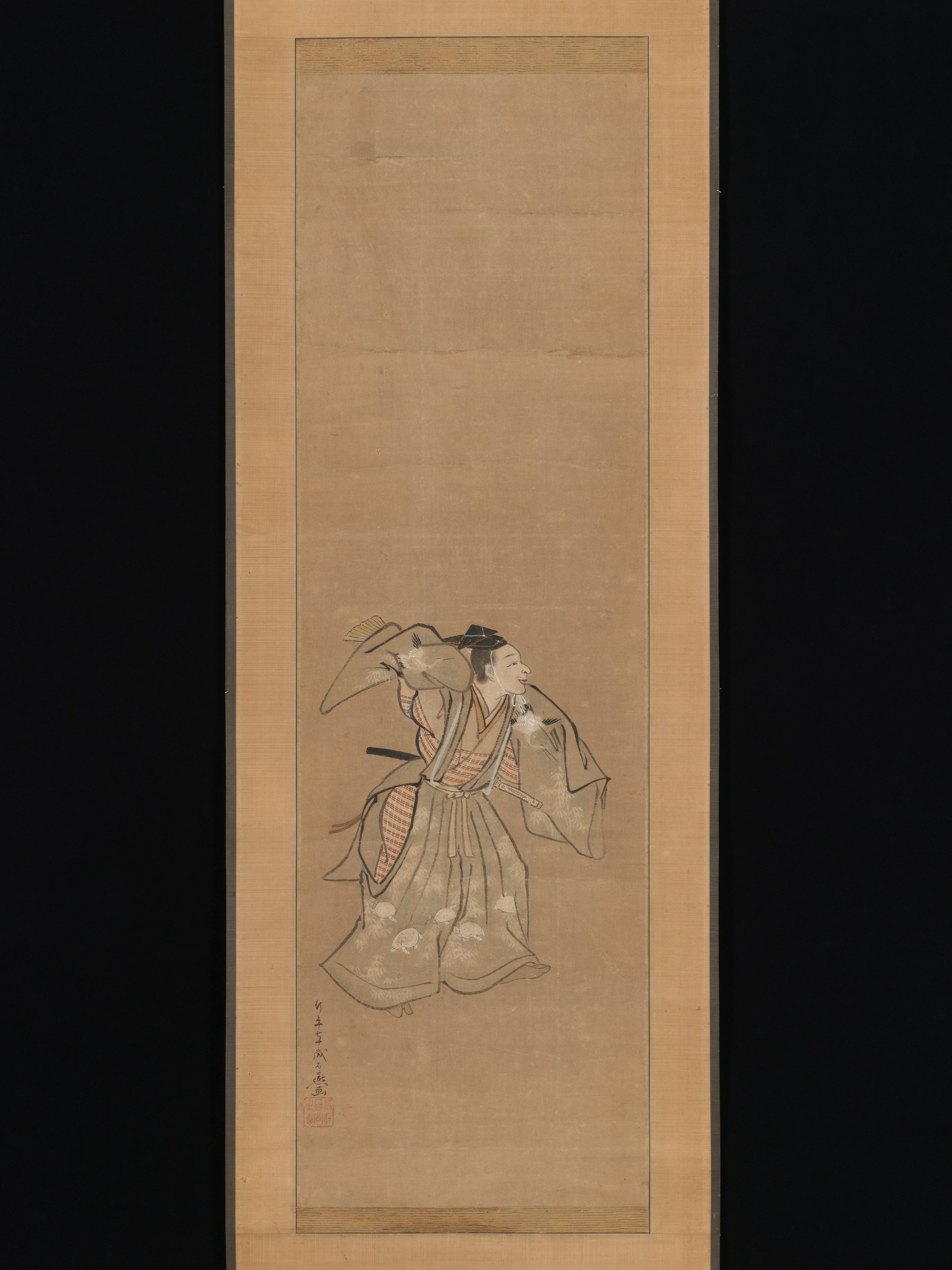
「翁」図-The Auspicious Noh Dance "Okina" MET DP-12232-122
Toriyama Sekien
- Medium:
- Oil Painting
- Era:
- 1700s (Enlightenment/Minuet Era)
- Source:
- Wikimedia Commons
- Rights:
- Public domain — free to use, share and adapt.
- Recorded as:
- CC0
Okina is one of the oldest and most sacred dances in Japanese culture, performed for nearly seven centuries with virtually unbroken continuity. This image by a major Edo-period artist captures how the dance was understood and valued at a moment when Japan was beginning to encounter Western art traditions, offering evidence of how Noh performance was documented by the visual arts establishment of its own culture.
What you are looking at
A single figure is depicted in three-quarter profile facing left, set against a plain tan background. The dancer wears layered garments in pale cream and grey tones with patterned silk panels showing geometric designs in rust and ochre. A dark hat sits atop the figure's head. The dancer's posture is upright and dignified, with one arm extended forward in a graceful gesture while the other is positioned near the body. The composition is vertically oriented on a hanging scroll format with wide margins of cream-coloured silk, consistent with traditional Japanese painting presentation. A seal mark appears in the lower left corner. The figure occupies the lower half of the composition, leaving substantial empty space above—characteristic of scroll painting that invites contemplation of the void.
The dancing
The single dancer stands in an upright, formal stance with weight evenly distributed. The forward arm gesture is fluid and extended, suggesting a deliberate, ceremonial movement rather than vigorous motion. The posture conveys restraint and control; the body is not in a dramatic tilt or extreme extension. The layered costume—visible as separate panels and fabric weights—moves subtly around the figure, indicating that the artist understood how heavy formal dress constrains and shapes the dancer's silhouette and movement quality.
The dance depicted
This is Okina (翁), one of the most sacred and formal dances in the Noh theatre tradition. Okina is performed as an auspicious opening piece in Noh programs and involves highly codified, slow, deliberate movement weighted with spiritual significance. The upright posture, formal dress, and measured gesture here are consistent with Okina's characteristically restrained vocabulary. The dance is almost exclusively performed by senior male actors of the Noh, and the figure's noble bearing and formal costume align with that status. Okina employs minimal but profoundly meaningful gestures; this extended arm movement is typical of the dance's vocabulary.
How it was made
The catalogue record identifies this as oil painting, but the technique visible here is more consistent with ink drawing on silk or paper, with subtle colour washes in ochre, rust, and grey added to an underlying line drawing. The precision of the line work, the delicate modulation of tone, and the composition all suggest traditional East Asian brush technique rather than Western oil painting. The work appears to be on a hanging scroll mount, a format standard for Japanese art of the Edo and early modern periods. If this is indeed oil, it would represent an unusual fusion of Japanese scroll format with Western medium—a possibility during Japan's period of increasing Western contact in the late 18th century, though the visual evidence suggests ink and wash on silk is more likely.
About this work
This is a study of Okina, the sacred opening dance of Japanese Noh theatre, rendered by Toriyama Sekien in the late 18th century. The work captures the formal, measured quality of Okina through a single figure in ceremonial dress, posed in a moment of controlled, deliberate gesture. The scroll format and technique place it within the tradition of Japanese theatrical documentation and artists' studies of performance. For historians of Noh and East Asian dance, the image preserves not only the visual form of the costume and posture but the aesthetic philosophy underlying the performance—restraint, dignity, and spiritual weight expressed through minimal physical language.
How to look at it
Attend to the stillness of the pose and the economy of gesture. The extended arm is not in motion but in a held position—this is the characteristic vocabulary of Okina, where meaning emerges from sustained, minimal movements rather than rapid transitions. The weight and layering of the costume is crucial to understanding the dance; the heavy silk panels and formal garments do not move freely but respond subtly to the body's position, constraining and dignifying every gesture. The artist has chosen to depict the figure in a moment of formal address or greeting, which is central to Okina's ritual function as an auspicious opening.
The artist
Toriyama Sekien (1712–1788) was a prominent Edo-period painter, printmaker, and illustrator known for his work in the ukiyo-e tradition and his studies of supernatural and theatrical subjects. He was active in Kyoto and produced works across multiple genres including landscape, portraiture, and performance documentation. His interest in Noh and other classical Japanese arts is evident in his body of work, and he was part of an intellectual circle that valued the preservation of traditional culture alongside engagement with new ideas.
The period
This work dates to 1790, during the late Edo period, a time of relative cultural stability and antiquarian interest in classical Japanese arts. Noh theatre itself had already been performed in its codified form for over 300 years. The late 18th century saw increasing documentation of Noh by visual artists, as the form came to be viewed as a precious cultural heritage deserving of scholarly and artistic attention. Simultaneously, Japan was in early contact with European art through Dutch traders at Nagasaki, creating a moment when traditional Japanese artistic forms were being studied with renewed intensity even as Western techniques became known to elite artists.
Where it lives
The work is identified in the catalogue as held in an unrecorded collection and was accessed via Wikimedia Commons. The hanging scroll format and seal mark suggest it was part of a collector's holding in Japan, though its current location and institutional affiliation are not recorded.
Dance in this work
Questions about this work
What is Okina and why is it important?
Okina is the oldest and most sacred ritual dance in Noh theatre, performed continuously since at least the 14th century. It opens formal Noh programs and is believed to bring auspiciousness and blessing. The performance is restricted to senior actors and involves highly codified, slow movements weighted with spiritual meaning rather than narrative content. It represents one of the longest unbroken performance traditions in world theatre.
Why did Toriyama Sekien paint Okina?
Late Edo-period artists and intellectuals valued the documentation and preservation of classical Japanese arts as a form of cultural scholarship. Sekien's work reflects this antiquarian interest and his personal engagement with Noh and other traditional forms. The scroll study format was a standard way for artists to record and honour performance traditions.
How does the costume shape the dance?
Okina's formal dress—the layered silk robes, the hat, the geometric patterning—is integral to the dance's aesthetic. The weight and bulk of the garments restrict free movement and require the dancer to control every gesture with precision. This constraint is not a limitation but essential to Okina's character: the dance emerges from how the body moves within and is shaped by the costume, not from unrestricted motion.
Is this really oil painting?
The catalogue record lists the medium as oil painting, but the visual evidence—the precision of line work, the delicate colour washes, the composition on a hanging scroll—is more consistent with East Asian ink and wash technique. This discrepancy may reflect cataloguing uncertainty or represent an early modern fusion of Japanese scroll format with Western medium. The record should be verified.
More dance artwork