49 works in this view — arrow keys or swipe to move between them.
Dance in Art · 1899
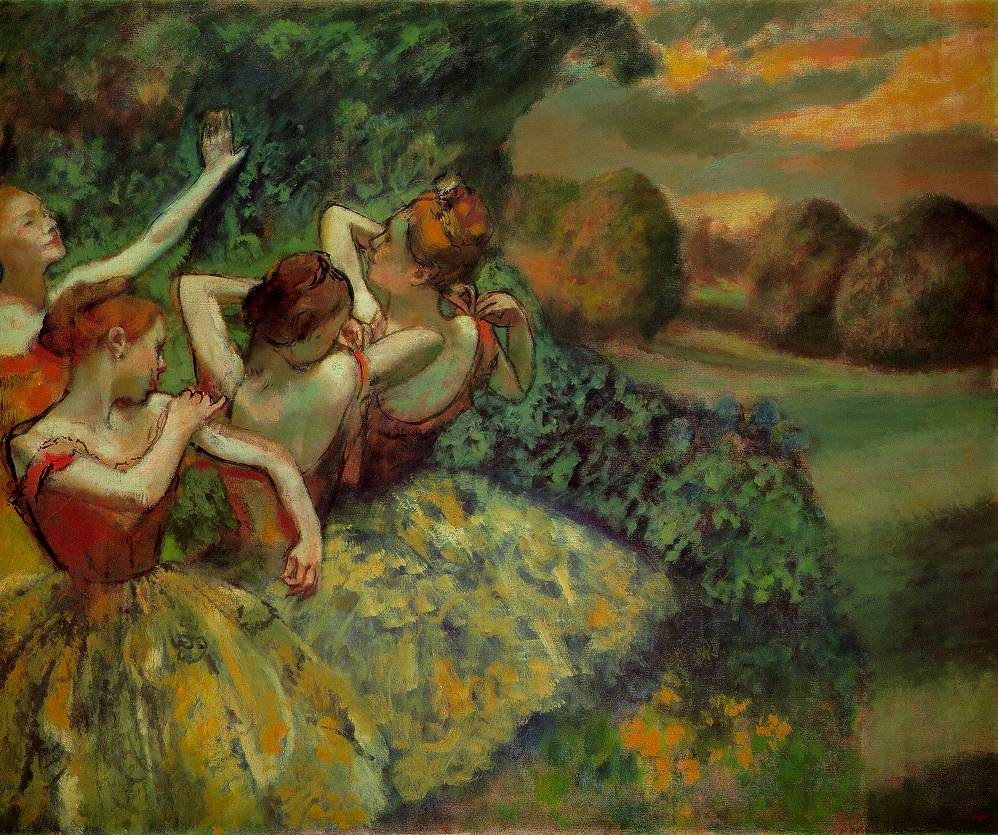
Degas Four dancers 1899
Edgar Degas
- Medium:
- Oil Painting
- Dance:
- Ballet
- Era:
- Late 1800s (Victorian Ballroom)
- Source:
- Wikimedia Commons
- Rights:
- Public domain — free to use, share and adapt.
- Recorded as:
- Public Domain
This painting shows how Degas, the preeminent painter of the working ballet, returned in old age to the Romantic ideal of the dancer as ethereal, timeless, and divorced from the commercial and technical reality he had spent a career recording. It demonstrates that late nineteenth-century dance imagery could be visionary and anti-realistic, even when produced by an artist famous for his unsparing documentary eye.
What you are looking at
Four young women in pale, seminude bodies and colorful draperies occupy a shadowed, verdant landscape. The nearest figure, at left, extends her arm upward toward ivy-covered rock; her companions cluster behind and to the right, their poses suggesting languor or rest rather than exertion. Their pale flesh and the warm ochres and reds of their garments glow against deep greens of foliage and the amber-tinged sky. The setting is arcadian—a rocky grotto or dell overhung with vegetation—rendered in loose, broken brushwork that dissolves form into color and atmosphere. The composition feels orchestrated around a moment of pause or transition, the figures caught between stillness and movement, their gazes directed inward or downward rather than outward to the viewer.
The dancing
The bodies are arranged in a loose diagonal, without rigid formation or symmetry. Limbs are extended with a languorous quality—raised arms, relaxed necks, weight distributed unevenly as if the figures are both reclining and alert. There is no closed partnering or formal ballroom frame; instead, each body occupies its own space, oriented toward the landscape and each other in a casual, almost indolent manner. The nearest figure's raised arm suggests a reaching gesture, but not one driven by momentum or tension. All four appear to be young women with reddish or auburn hair, their bodies pale and gently modeled.
The dance depicted
This work depicts ballet dancers at rest in a romantic, idealized landscape—a subject that belongs to the Romantic ballet tradition of the mid-nineteenth century, in which dancers were frequently portrayed in sylph-like or nymph-like guise, suspended between the natural and the supernatural. The dancers wear no pointe shoes or tutus of the kind Degas usually recorded, and the landscape setting suggests mythological or dreamlike space rather than a stage. The painting captures not a moment of performance but of preparation, repose, or imaginative reverie—a recurring theme in Degas's late work, in which dancers appear as both working professionals and subjects of aesthetic fantasy. The loose, impressionistic handling suggests a study or memory rather than a documentary record.
How it was made
This is an oil painting worked in a late nineteenth-century Impressionist manner, with broken brushwork and a palette dominated by greens, ochres, and flesh tones. The paint is applied with considerable fluidity; forms are suggested rather than precisely defined, and the composition relies on color harmony and atmospheric effect rather than linear clarity. This technique allowed Degas to evoke mood and movement through suggestion rather than explicit description—a mode well suited to capturing the dreamlike quality of late Romantic ballet imagery. The work dates to Degas's later years, when his eyesight was failing and his style became increasingly loose and expressive.
About this work
This painting is one of Degas's late meditations on the ballet, produced at a moment when his eyesight was declining and his artistic practice was turning toward memory, fantasy, and colored atmosphere rather than precise observation of the stage. The work belongs to a long tradition of Romantic ballet imagery in which dancers are portrayed not as performers executing choreography but as idealized, timeless figures inhabiting a space between nature and art. Unlike Degas's earlier, sharply observed rehearsal scenes and stage studies, this painting is lyrical and evocative, concerned with the body as subject of beauty and reverie rather than as instrument of technique.
The work represents a late flowering of the Romantic ballet aesthetic at a moment when that aesthetic was fading from the stage itself. By 1899, the Romantic era was long past, and Degas's return to its imagery—dancers as nymphs, resting in arcadian groves—suggests both nostalgia and artistic freedom. The painting's loose technique and small scale mark it as a private work, a meditation on memory and desire rather than a public statement about dance.
How to look at it
Attend to the moment the painter chose: not a leap or turn, but a pause or turning point, where energy is gathered but not released. Notice how the figures are arranged in depth and how Degas uses color—the warm flesh tones and red-orange draperies—to pull them forward against the cool greens and browns of the landscape. Look at the brushwork: the paint is applied broadly and quickly, especially in the foliage, while the flesh tones are more carefully modeled. This technique creates a sense of the figures emerging from or dissolving into their setting, as if they are half-real, half-imagined. The painting rewards a viewer who recognizes that Degas is here working in the tradition of Romantic landscape painting, not documentary art.
The artist
Edgar Degas (1834–1917) was a French painter, printmaker, and sculptor best known for his scenes of Parisian ballet rehearsals, classes, and performances. His relationship to dance was complex: while he observed dancers with a draftsman's precision, recording movement, costume, and the spatial logic of the studio and stage, he also treated the dancer's body as a vehicle for exploring form, color, and composition. By the 1890s, when his eyesight was failing, Degas moved away from precise observation toward a more intuitive, memory-based practice. His late works often revisit subjects from earlier decades—including dancers and women at their toilette—reimagining them in looser, more expressive modes.
The period
In the 1890s, the Romantic ballet era (roughly 1830–1870) had passed into history, superseded by the Petipa-dominated classical ballet of Russia. Yet the Romantic aesthetic—the figure of the ballerina as otherworldly spirit, the fantasy of transcendence through movement—retained powerful appeal as a cultural memory and artistic ideal. Degas's late ballet paintings align him with a fin-de-siècle revival of Romanticism in the arts, a nostalgia for earlier modes of feeling and beauty. Simultaneously, the Impressionist movement's emphasis on light, color, and the subjective experience of perception was reaching its mature phase, and younger artists were beginning to move away from Impressionism toward Symbolism and Post-Impressionism. Degas's late style, with its atmospheric effects and dreamlike subjects, bridges these movements.
Where it lives
The work is recorded as an oil painting from 1899, held in an unspecified collection. It is known through reproduction on Wikimedia Commons and belongs to the category of Degas's late studio works, which often remained in his possession or that of his heirs and are now dispersed among major museums.
Dance in this work
Questions about this work
Are these dancers performing ballet?
Not in any staged sense. The painting depicts dancers in an imaginary, pastoral landscape, resting or in a moment of reverie. They wear no stage costume or pointe shoes and are posed as if outdoors rather than on a stage. The work is a fantasy on the theme of the dancer as an idealized, timeless figure—a Romantic conceit rather than a record of actual performance.
Why did Degas paint dancers in so many different ways?
Degas was fascinated by the body in motion and at rest, and by the ballet as both a technical discipline and a subject of aesthetic imagination. His earlier works are sharply observed records of rehearsal and performance; his late works are more dreamlike and expressive. This shift reflects both his changing eyesight and his evolving artistic interests—a move from documentary precision toward emotional and formal exploration.
What is the relationship between this painting and Romantic ballet?
This painting deliberately evokes the aesthetic of Romantic ballet—the ballerina as ethereal spirit, the fantasy of transcendence. Degas painted this work decades after the Romantic era had ended, suggesting a return to or reinterpretation of that earlier aesthetic through the lens of late nineteenth-century Symbolism and Impressionism. It is nostalgia, but also artistic reinvention.
More Ballet artwork