49 works in this view — arrow keys or swipe to move between them.
Dance in Art · 1899
Edgar Germain Hilaire Degas 081
Edgar Degas
- Medium:
- Oil Painting
- Dance:
- Ballet
- Era:
- Late 1800s (Victorian Ballroom)
- Source:
- Wikimedia Commons
- Rights:
- Public domain — free to use, share and adapt.
- Recorded as:
- Public Domain
Degas is the premier artistic chronicler of ballet in the nineteenth century, and his ballet paintings are invaluable documents of how the art was performed, costumed, and understood. This work demonstrates his sophisticated grasp of classical technique and the Romantic ballet idiom, even as his loose, atmospheric technique—which departs from academic realism—shows how a modernist sensibility could coexist with an interest in dance. For anyone studying the history of ballet representation or the development of modernism in visual art, Degas's ballet oeuvre is essential.
What you are looking at
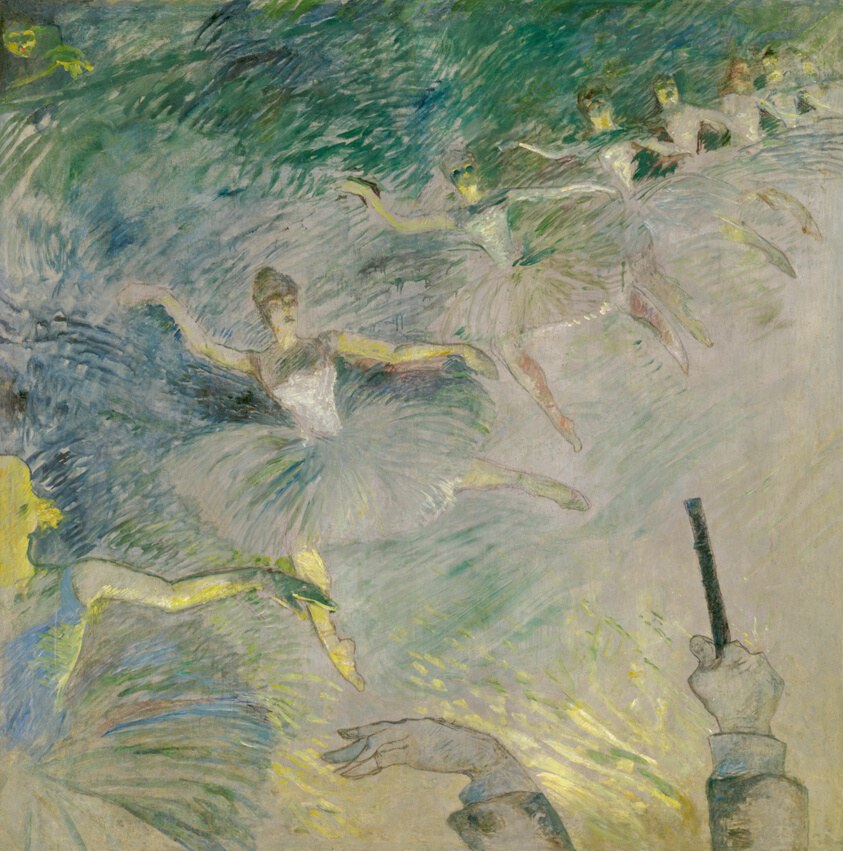
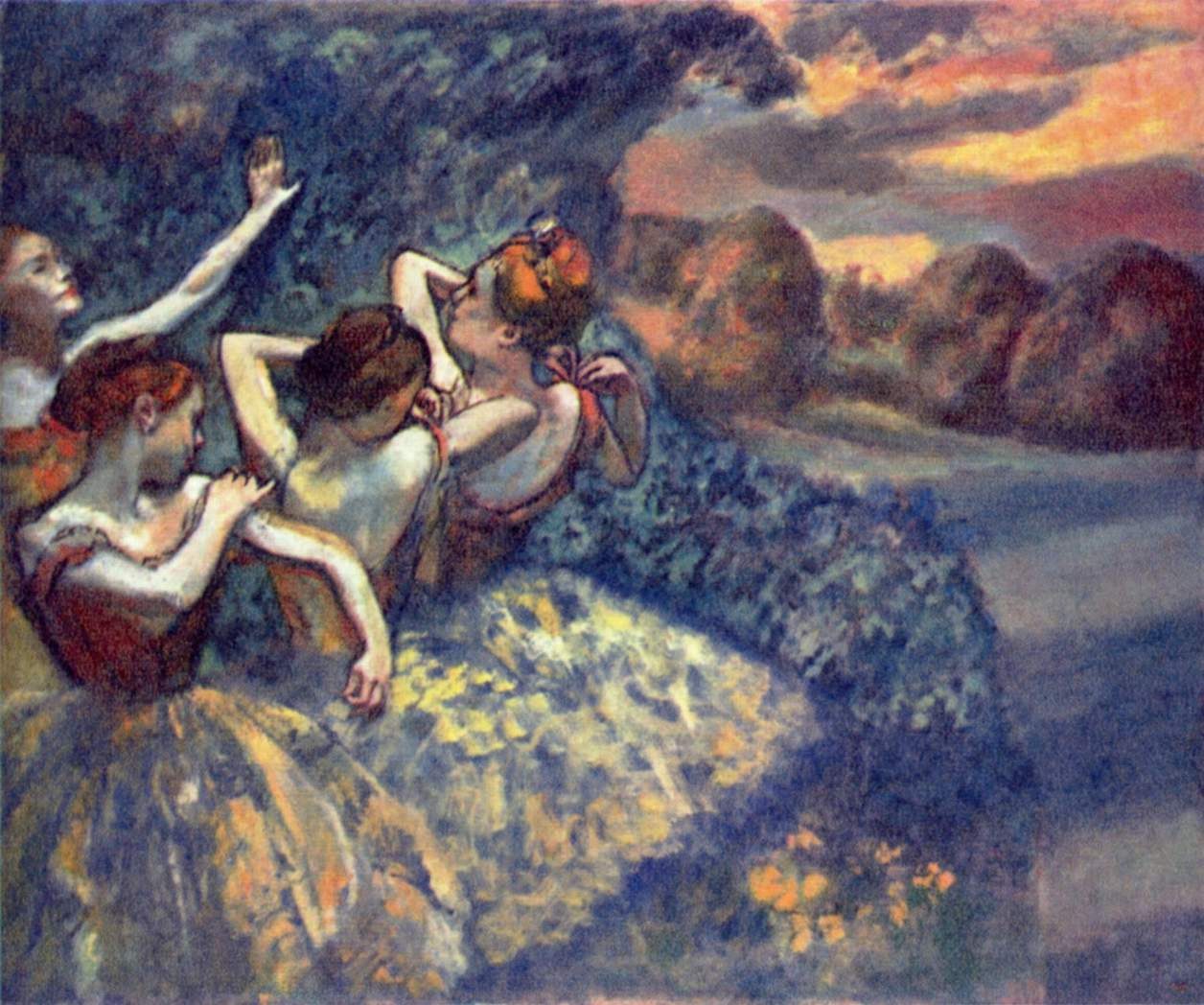
Four female figures in classical dress dance against a luminous landscape of forest and water. The foreground shows three dancers in motion, their bodies arranged in a diagonal composition that moves from lower left to upper right. The nearest figure, in the immediate left foreground, extends one leg in an elevated position while her arms are raised and her torso lifts; she wears a short classical tunic with a red-orange belt. Behind her, two more dancers in similar dress are captured mid-movement, their bodies angled in three-quarter view. A fourth figure is dimly visible in the background. The setting is a Romantic landscape: dark wooded cliffs frame the scene while a body of water and luminous golden sky occupy the distance. The overall light is warm and atmospheric, with golden and amber tones dominating the sky and catching the pale skin and fabric of the dancers' bodies. The composition suggests a moment of ethereal, weightless movement—the dancers appear almost to float rather than step on solid ground.
The dancing
The three foreground dancers are in various stages of elevation and turning, their bodies aligned in what appears to be a synchronized movement phrase. The nearest dancer has one leg extended at hip height or above in a développé or similar sustained lift, with her body twisted toward the viewer; the others show similar lifted positions and turning actions. All three wear short tunics and are barefoot or wearing soft slippers. Their arms are raised and extended in classical port de bras, with flowing gestures that emphasize upward and outward directions. The spacing and alignment suggest they are moving as a corps or ensemble rather than as individual soloists, though they are not in physical contact.
The dance depicted
This appears to be Romantic ballet, most likely from the mid-nineteenth century based on the costume, the ethereal landscape setting, and the poetic treatment of the female form. The choreography, insofar as it can be read from a static image, emphasizes sustained elevation, turned-out positions, and a weightless, otherworldly quality—hallmarks of the Romantic ballet idiom. The sylphs or nymphs depicted here were a staple of Romantic ballet, appearing in works like La Sylphide (1832) and Giselle (1841). The landscape and the dreamlike atmosphere suggest this may be depicting a scene from one of those works, or a work in that tradition, though the specific ballet cannot be determined from the image alone.
How it was made
This is an oil painting, as stated in the catalogue record. Degas's technique here emphasizes soft atmospheric effects and luminous color over line; the bodies of the dancers are suggested through subtle modulation of tone and hue rather than precise contour. The brushwork is loose and painterly, particularly in the background landscape, creating a sense of depth and atmosphere. This approach was characteristic of Degas's mature work and allowed him to capture movement and fleeting moments of stage performance in a way that emphasized the dancer's body within the space and light of the theater.
About this work
This is an oil painting by Edgar Degas from 1899 depicting four female ballet dancers in a Romantic landscape setting. The composition captures a moment of ethereal, synchronized movement: the foreground dancers are elevated and turning, their bodies arranged in a diagonal sweep across the canvas, while the atmospheric background of forest, water, and luminous sky creates a dreamlike stage environment. The work belongs to Degas's large body of ballet subjects, executed throughout his career from the 1870s onward. As both a record of late-nineteenth-century ballet aesthetics and a demonstration of how Degas translated stage movement into paint, it sits at the intersection of theatrical documentation and high art practice.
How to look at it
Note the moment Degas has chosen: not a peak of the movement but a sustained lift, with the dancers in the middle of an extended phrase. The ascending diagonal composition—from foreground left to background right—mirrors the upward thrust of the dancers' bodies and creates a sense of weightlessness and flight. Observe how the warm light of the sky is reflected in the pale tones of the dancers' skin and costumes, binding them visually to the landscape. The brushwork is looser and more suggestive in the background and in the handling of atmosphere, but the dancers themselves are rendered with enough specificity that their lifted positions and classical alignment are clear.
The artist
Edgar Degas (1834–1917) was a French painter, printmaker, and sculptor who became obsessed with dance—and ballet in particular—from the 1870s onward. He attended rehearsals and performances at the Opéra, sketched dancers in the studio and on stage, and produced hundreds of works on the subject: paintings, pastels, prints, and sculptures. Unlike his Impressionist colleagues, Degas maintained a commitment to drawing and composition rooted in academic training, but he deployed it in service of capturing movement, light, and the ephemeral moments of rehearsal and performance. His ballet works range from carefully finished oils to rapid sketches and experimental monotypes, and they remain the most sustained artistic engagement with dance by any major artist of the period.
The period
By 1899, Romantic ballet had long since given way to other forms, but the aesthetic and the repertoire persisted, particularly in Paris. The Romantic ballet's emphasis on the female dancer as weightless, ethereal, and otherworldly—often dancing the role of a supernatural being—had shaped ballet aesthetics for over half a century. Degas came of age as an artist during the height of this idiom and remained attached to it throughout his career, even as the broader art world moved toward modernism. In visual art, Impressionism and Post-Impressionism were ascendant in the 1890s, and Degas's loose, atmospheric technique in this work shows his engagement with those developments, even as his subject matter remained rooted in the Romantic ballet tradition.
Where it lives
The work is listed as coming from Wikimedia Commons in the catalogue record, with no holding institution recorded. This suggests it may be in a public collection, or the provenance information was not available when the record was created.
Dance in this work
Questions about this work
Is this from a specific ballet?
The painting does not contain enough detail to identify a specific work with certainty. However, the costume, setting, and choreographic vocabulary are consistent with mid-nineteenth-century Romantic ballets like La Sylphide or Giselle. Degas often painted scenes that evoked the Romantic ballet tradition without necessarily depicting a particular ballet's plot.
Why are the dancers barefoot and in such simple costumes?
The short tunic and bare feet are characteristic of classical and Romantic ballet practice. Degas painted dancers in rehearsal dress and stage costume indiscriminately, capturing the essential forms and gestures of the art rather than always depicting the full theatrical apparatus.
How does Degas's style differ from earlier ballet paintings?
Degas brought a modern sensibility to his ballet subjects. Rather than rendering the stage as a proscenium box with precise linear perspective, he used cropping, unusual viewpoints, atmospheric effects, and a looser touch to capture the sense of movement and the dancer's experience of space and light. This modernism coexisted with his commitment to observing actual dance technique.
What was Degas's relationship to ballet?
Degas was an obsessive observer of ballet. He attended rehearsals, had access to backstage and studio spaces, and spent decades studying dancers' bodies, movements, and the organization of dance training. His ballet works are not mere entertainments but serious investigations of how bodies move, balance, and express themselves through movement.
More Ballet artwork