49 works in this view — arrow keys or swipe to move between them.
Dance in Art
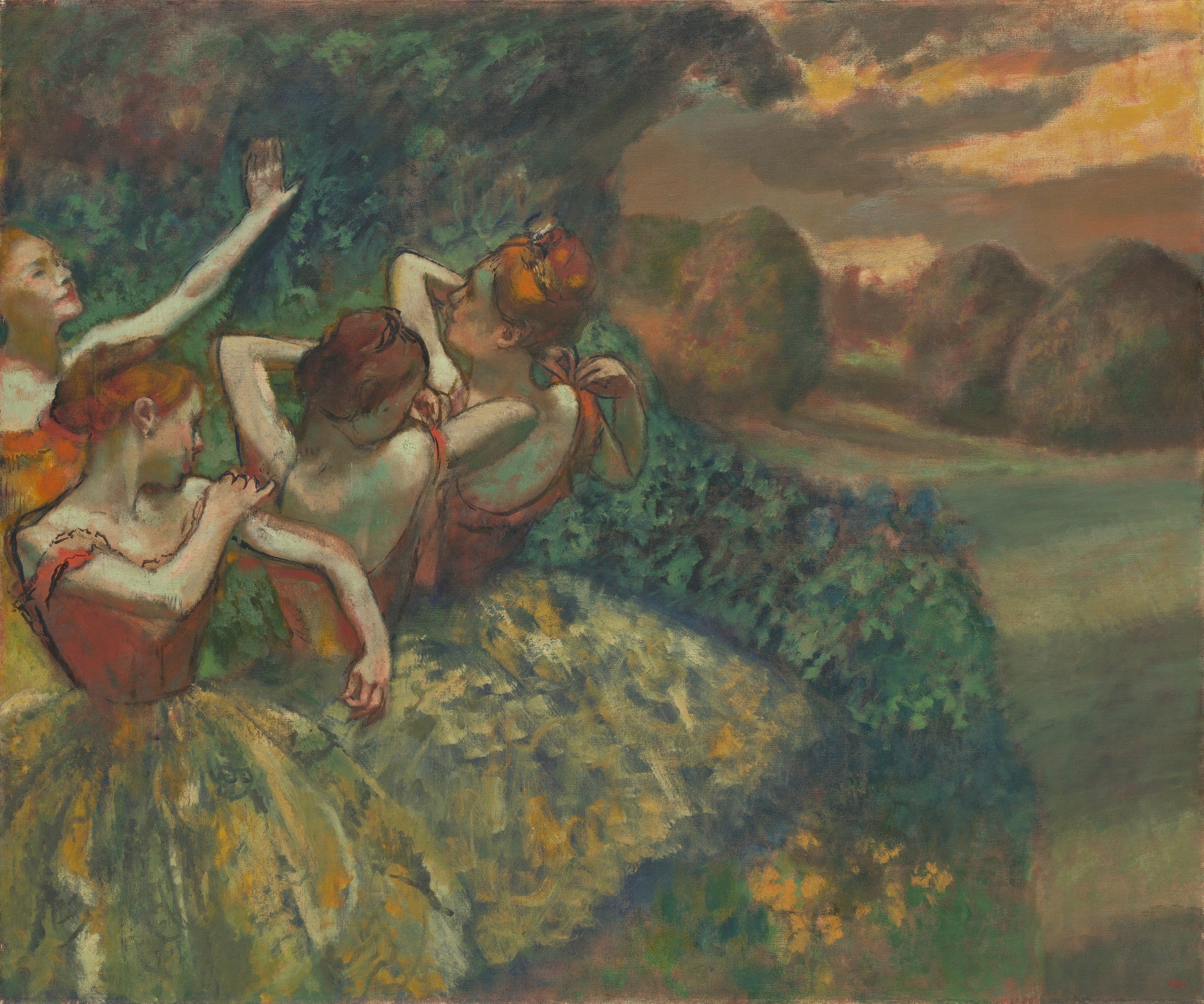
Four Dancers
Edgar Degas
- Medium:
- Oil Painting
- Dance:
- Ballet
- Era:
- Late 1800s (Victorian Ballroom)
- Source:
- Wikimedia Commons
- Rights:
- Public domain — free to use, share and adapt.
- Recorded as:
- Public Domain
This painting shows Degas not as a painter of ballet spectacle but as a late Romantic visionary, translating the ephemeral beauty of human movement into a timeless landscape. For historians, it documents the cultural mythology of dance in the fin de siècle—the fantasy of the dancer as muse and nymph, untouched by the economic and physical realities of the stage. For dancers, it offers an image of movement as poetry rather than technique, a moment of aspiration toward grace itself.
What you are looking at
Four young women in classical dress dance or pose together in a sunlit landscape. The foreground figures wear diaphanous pale fabrics with red-orange drapery accents; their poses are fluid and unstudied, with raised arms and tilted heads suggesting movement caught mid-gesture rather than static arrangement. The setting is sylvan—dark green foliage rises behind them, and a pastoral valley opens to the right under a golden-hour sky with warm clouds. The lighting is soft and diffuse, characteristic of Degas's later work, with the artist applying color in visible strokes that create an impressionistic shimmer across the fabrics and bodies. The composition is informal and asymmetrical, with the four figures clustered at varying depths, some partially obscured or cropped by the picture plane.
The dancing
The bodies are relaxed and lyrical rather than technically rigorous. The nearest dancer raises one arm overhead in a languorous arc while her weight appears to settle on one leg; another tilts her head back with arms loosely positioned; a third stretches an arm upward in a reaching gesture. None are in a closed partnership or formal hold. The poses suggest classical training—extended limbs, turned-out positions—but are arranged for visual effect rather than dance progression, with bodies overlapping and at different angles to the viewer. The overall impression is of grace and repose rather than active dancing.
The dance depicted
This appears to be a late-nineteenth-century vision of classical dance or nymph-like movement in an arcadian setting, rather than a specific identifiable dance form. The soft classical tutus, the lack of pointe shoes, and the diaphanous fabrics suggest either a nostalgic reference to Romantic ballet (c. 1840s–1850s) or an allegorical fantasy of ideal beauty and movement. Degas often depicted backstage ballet rehearsals and off-stage moments of dancers; this work, by contrast, removes the dancers from any theatrical or institutional context into an imagined idyll. The dance, if one is occurring, is private, leisured, and untethered to the rigorous technique of the ballet stage.
How it was made
Oil painting. The work demonstrates Degas's mature technique: the composition is built from soft, broken color laid down in visible strokes, with particular attention to the interplay of pale flesh tones against warmer draperies and cool shadows. The landscape is suggested rather than rendered in detail, with thick, directional brushwork in the foliage and sky that creates atmosphere and luminosity. This approach—prioritizing light, mood, and the sensuous surface of paint over precise drawing—is characteristic of Degas's later works and reflects his engagement with Impressionist methods, even as his subject matter remained rooted in human figuration.
About this work
Four Dancers is a late nineteenth-century oil painting depicting four young women in classical or allegorical dress within a pastoral landscape. Rather than documenting the spectacle of the ballet stage, Degas has reimagined dancing as an intimate, transcendent act in nature—a private dream of grace and movement remote from the theater and its crowds. The work sits at the intersection of Degas's two great preoccupations: the representation of the dancing body and the technical challenges of capturing light and atmosphere. It is a meditation on the ideal of dance itself: movement divorced from performance, beauty divorced from labor.
How to look at it
Attend first to the variety of body positions: no two dancers are aligned or symmetrical, yet the composition achieves balance through color and tone. Notice how the pale fabrics read as luminous forms against the dark foliage, and how the warm red-orange draperies anchor the composition and draw the eye. The faces are summarily rendered—this is not portraiture but the imaging of movement and ideal beauty. The landscape is almost abstract, described in sketchy, directional brushwork; it is atmosphere and context rather than a topographical place. Finally, observe the moment chosen: not the apex of a leap or the precision of a posed line, but an in-between instant of ease and repose, as if the artist has captured dancers between movements.
The artist
Edgar Degas (1834–1917) was a French painter and sculptor whose career was defined by the dancing body. Though often grouped with the Impressionists, Degas maintained his allegiance to drawing, line, and classical composition throughout his life. He made over 1,500 works depicting dancers—in rehearsal, onstage, at rest—observing them with anthropological precision while also, as in this painting, allowing them to become vehicles for more poetic or allegorical feeling. His later works, produced as his eyesight failed, show increasing freedom in handling, with color becoming more expressive and compositions more daring. Four Dancers exemplifies this late phase: the dance subject remains, but it has been liberated from the specificity of the stage into a realm of myth and reverie.
The period
This work was created in the waning years of the nineteenth century, a period when Romantic ballet was already a historical memory (the Romantic movement had peaked decades earlier) and modern ballet was still being invented. The image of dancers in gauzy skirts in an idyll reflects the enduring cultural appeal of the Romantic ballet aesthetic—sylphs, undines, and ethereal femininity—even as the actual ballet stage had moved into more eclectic and narrative modes. Simultaneously, Degas's technique—the broken color, the emphasis on light, the informal composition—reflects the continued evolution of modernism and the aging artist's growing experimentation with color and form.
Where it lives
The work is recorded as being in the National Gallery of Art's West Building, Washington, D.C., according to the source metadata provided. Degas's dancer paintings have been widely dispersed among major museums; this holding indicates the work's significance in the American institutional canon.
Dance in this work
Questions about this work
Is this a ballet?
Not a specific ballet. Degas has imagined four dancers in a landscape in a style evocative of Romantic ballet (the early-to-mid nineteenth-century aesthetic of ethereal female dancers), but there is no narrative, no theater, and no corps de ballet. It is closer to an allegorical or fantasy image than a documentation of an actual dance form or performance.
Why aren't they on pointe?
The absence of pointe shoes and the soft, almost weightless quality of the poses suggest that this is not a depiction of classical ballet technique but rather an idealized or mythological vision of dance—movement as poetry and grace rather than the rigorous technical practice of the stage. Degas was intensely interested in ballet technique and often painted it with precision; here, he has chosen a different register entirely.
What is the date of this painting?
The catalogue record does not specify a date beyond 'unknown,' though the style—the loose brushwork, the color handling, the freedom of composition—is consistent with Degas's work in the 1890s or early 1900s. The existing description in the record mentions 1899, but this is not confirmed by the primary catalogue information provided.
Why did Degas paint dancers so much?
Degas was fascinated by the moving human body and by the ballet as a subject of visual and social inquiry. Dancers offered him endless variations of pose, grace, and exertion; the theater itself—its lighting, its artificiality, its hierarchy—was endlessly productive for his art. This painting, however, shows him using the dancer as a vehicle for something more transcendent: the image of beauty and movement itself.
More Ballet artwork