49 works in this view — arrow keys or swipe to move between them.
Dance in Art · 1877
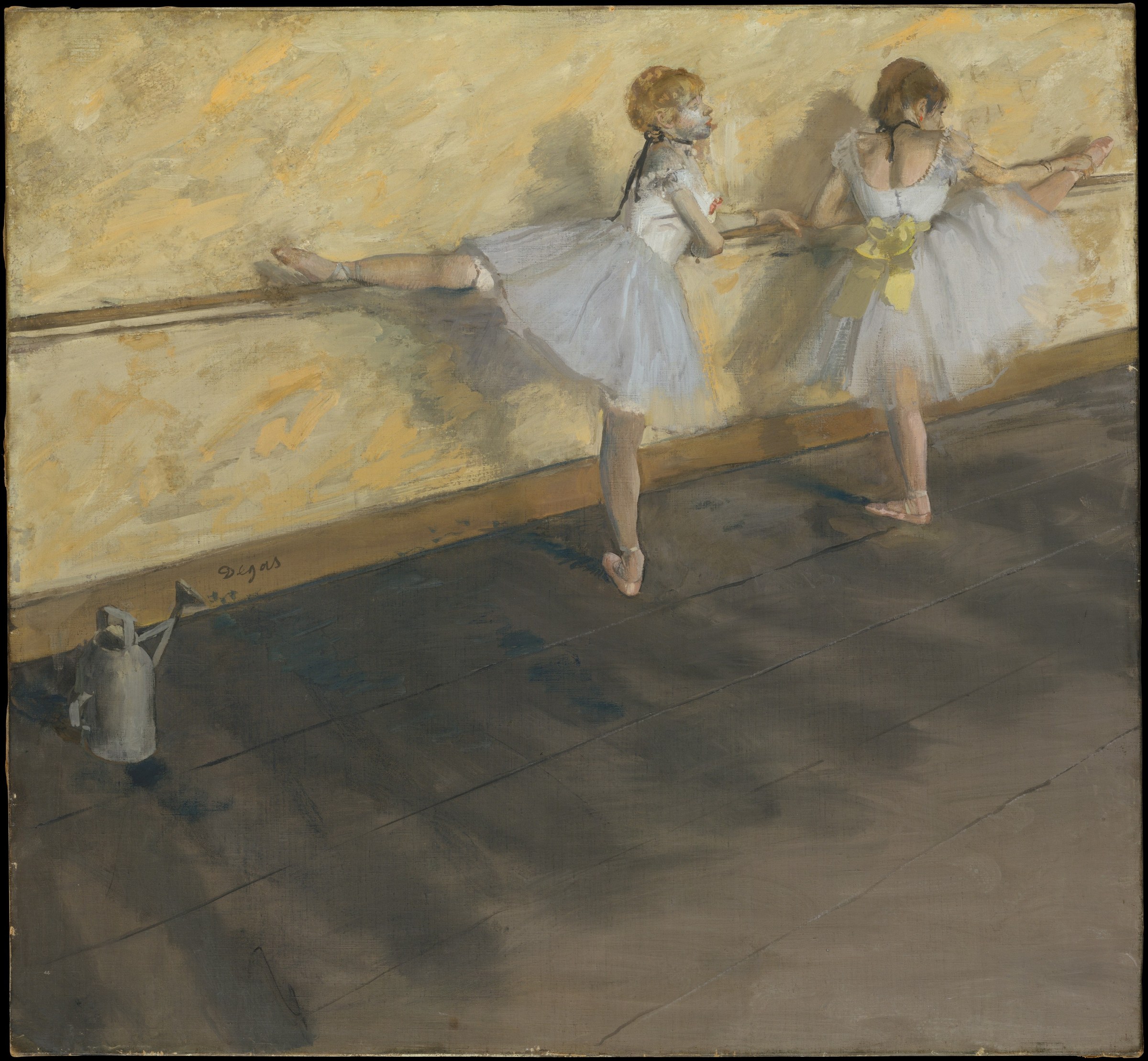
Dancers Practicing at the Barre MET DT840
Edgar Degas
- Medium:
- Oil Painting
- Dance:
- Ballet
- Era:
- Late 1800s (Victorian Ballroom)
- Source:
- Wikimedia Commons
- Rights:
- Public domain — free to use, share and adapt.
- Recorded as:
- CC0
Degas's ballet paintings fundamentally shifted how art represented dance, moving from idealization and spectacle to observation and process. For dancers and dance historians, this work documents the actual pedagogy and posture of late nineteenth-century classical training—the barre, the tutus, the weight distribution, the studio environment—and does so with the precision of an insider or intimate observer. His insistence on showing rehearsal rather than performance has influenced how dance is understood and depicted in visual culture ever since.
What you are looking at
Two young female dancers in white tutus and pointe shoes stand at a wooden barre in what appears to be a studio or rehearsal space. The nearer dancer, shown in profile facing left, has her right leg extended in a développé or similarly controlled lift, her torso upright and arms in port de bras. The second dancer, partially visible behind and to the right, assumes a comparable pose. The floor is polished dark wood; the walls are a warm, muted cream or pale ochre, rendered with loose brushwork that suggests reflected light and studio atmosphere. A large mirror or reflective surface occupies much of the left background. In the lower left corner, a small white pitcher sits on the floor—a studio detail, possibly for water. The light is soft and diffuse, characteristic of an interior space without strong directional sources. The painting captures the quiet intensity of a private rehearsal moment rather than a performance.
The dancing
Both dancers demonstrate classical ballet alignment: upright carriage, engaged core, and controlled leg placement. The foreground dancer's right leg is extended high and straight, with her foot articulated en pointe; her left leg bears her weight as she balances. Her arms are softly curved, positioned in second position or thereabouts. The rear dancer mirrors this configuration, her silhouette slightly compressed by the spatial recession. Both dancers maintain the turned-out hip and vertical spine posture essential to ballet technique. There is no partnering; they work independently at the barre, a fundamental pedagogical arrangement.
The dance depicted
This is indisputably a ballet rehearsal, almost certainly from the Romantic period or its immediate aftermath. The tutus—short, full, and constructed from stiff tulle—and the pointe work date this to mid-to-late nineteenth-century classical ballet practice. The barre work shown is foundational: a dancer uses the barre for balance and orientation while executing movements (battements, dégagés, développés, or similar) that would later be performed in centre or in choreography. The setting and costume mark this as professional or serious student training rather than social dance, and the informal, private quality suggests a studio moment rather than performance imagery.
How it was made
Oil painting on canvas, executed with Degas's characteristic technique of blended tones, loose brushwork, and careful composition. The cream-colored wall is rendered with fluid, directional strokes suggesting light and shadow; the floor receives darker, more deliberate hatching. Degas frequently used pastel, but this work appears to be pure oil, allowing him to build atmospheric depth and soft transitions. The painting's relatively small scale and intimate subject suggest it was created for exhibition and sale to collectors rather than as a study, though Degas produced numerous ballet scenes in multiple media.
About this work
This is a mature work from Degas's sustained engagement with ballet as a subject. Between the 1870s and 1880s, Degas produced dozens of paintings, pastels, and prints of dancers in rehearsal, performance, and informal moments—transforming ballet from an anecdotal genre subject into a vehicle for exploring light, movement, composition, and the modern body. This painting exemplifies his interest in the unglamorous, quotidian side of dance: not the spectacle of the stage but the labor of training, the discipline of the barre, the repetition through which technique is internalized. The dancers are individuals caught in a moment of work, not idealized figures. Degas's use of the Impressionist vocabulary of broken color and spontaneous brushwork to depict a scene of rigorous, codified training creates a productive tension that animates much of his ballet oeuvre.
How to look at it
Notice the stillness of the pose: this is not a moment of dynamic action but of held extension, balance, and control. The leg is lifted not to create visual drama but to build strength and articulation through repetition. Look at how Degas has positioned the dancers slightly off-center and in profile, allowing the extended leg to read clearly against the pale wall. The barre is the compositional anchor, running horizontally across the canvas and anchoring the dancers' positions. Observe the tonal subtlety of the wall and floor—the painting is not about vivid color but about the quality of diffuse interior light and the spatial relationships it creates. The small details—the white pitcher, the dancers' absorbed focus, the emptiness of the studio—all reinforce that this is a moment of private work, not public performance.
The artist
Edgar Degas (1834–1917) was a French painter, sculptor, and printmaker who first trained in neoclassical history painting before pivoting toward modern subjects: urban leisure, café life, and the Paris Opera ballet. Beginning in the 1870s, he became obsessed with dancers—attending rehearsals, sketching in studios, collecting costume and anatomy studies—and produced over one thousand works on the subject across every medium he mastered: oil, pastel, monotype, lithography, and bronze sculpture. Unlike Impressionist colleagues who sought to capture fleeting effects of light in nature, Degas combined his realist commitment to contemporary subjects with a formalist interest in composition, line, and spatial structure inherited from his academic training. His ballet works are neither purely documentary nor purely aesthetic but a synthesis that has made him the canonical painter of dance.
The period
By the 1870s, the Paris Opera ballet had shifted decisively toward the shorter skirt, pointe work, and the female-centered soloism of the Romantic era's waning years. The tutu as shown here became standardized, and the rigorous barre training regimen Degas depicts was the accepted foundation of technique. Simultaneously, Impressionism was emerging as a movement, and Degas—though he rejected the label—adopted some of its formal strategies (asymmetrical composition, cropping, loose brushwork) while maintaining narrative and observational content. The 1870s–80s, when this painting was likely executed, mark both the peak of Paris Opera cultural prestige and the moment when ballet was being professionalized and systematized into the pedagogy we recognize today. Degas's decision to paint this process of training rather than the finished product was countercultural—a revaluation of labor and discipline as worthy of high art attention.
Where it lives
The work is recorded in the Metropolitan Museum of Art collection under accession MET DT840 and has been sourced via Wikimedia Commons. The specific provenance history and acquisition date are not detailed in the provided catalogue record.
Dance in this work
Questions about this work
Did Degas actually understand ballet technique, or was he just painting what he saw?
Degas studied ballet extensively, attending rehearsals and performances regularly, and his careful rendering of pose, posture, and barre work suggests genuine understanding. However, he was an artist first; his aim was not technical documentation but the capture of movement, light, and composition. His ballet paintings succeed because they combine observational fidelity with sophisticated formal choices—the cropping, asymmetry, and atmospheric effects create a mood and structure that a pure technical diagram would not.
Why did Degas paint ballet rehearsals instead of performances?
Rehearsal fascinated him for multiple reasons: it was modern, accessible (he could attend regularly), it revealed the body without artifice or costume drama, and it allowed him to explore labor and training as subjects worthy of high art. Performance is spectacular but finished; rehearsal is where technique lives, where repetition and discipline are visible. This preference aligned with his broader commitment to depicting contemporary urban life and work.
What is the barre and why is it important in ballet?
The barre is a wooden handrail, typically mounted at waist height on a studio wall or on a portable frame, used by dancers during training. It provides balance and tactile feedback while dancers execute isolate movements (plié, battement, développé, etc.) that build strength, control, and muscle memory. Barre work is fundamental to every ballet class and has been since the formalization of the technique in the seventeenth and eighteenth centuries. It is the foundation upon which all center work and choreography are built.
What does 'pointe' mean and how does it appear in this painting?
Pointe refers to dancing on the tips of the toes, supported by specially reinforced ballet pointe shoes with a hard box and shank. You can see the dancers' feet are en pointe—weight forward and balanced on the toes—which is a hallmark of classical ballet. Pointe work requires years of training and is almost exclusively performed by female dancers in classical ballet. In this painting, both dancers' feet are articulated and pointed, demonstrating their technical level.
More Ballet artwork