49 works in this view — arrow keys or swipe to move between them.
Dance in Art · 1877
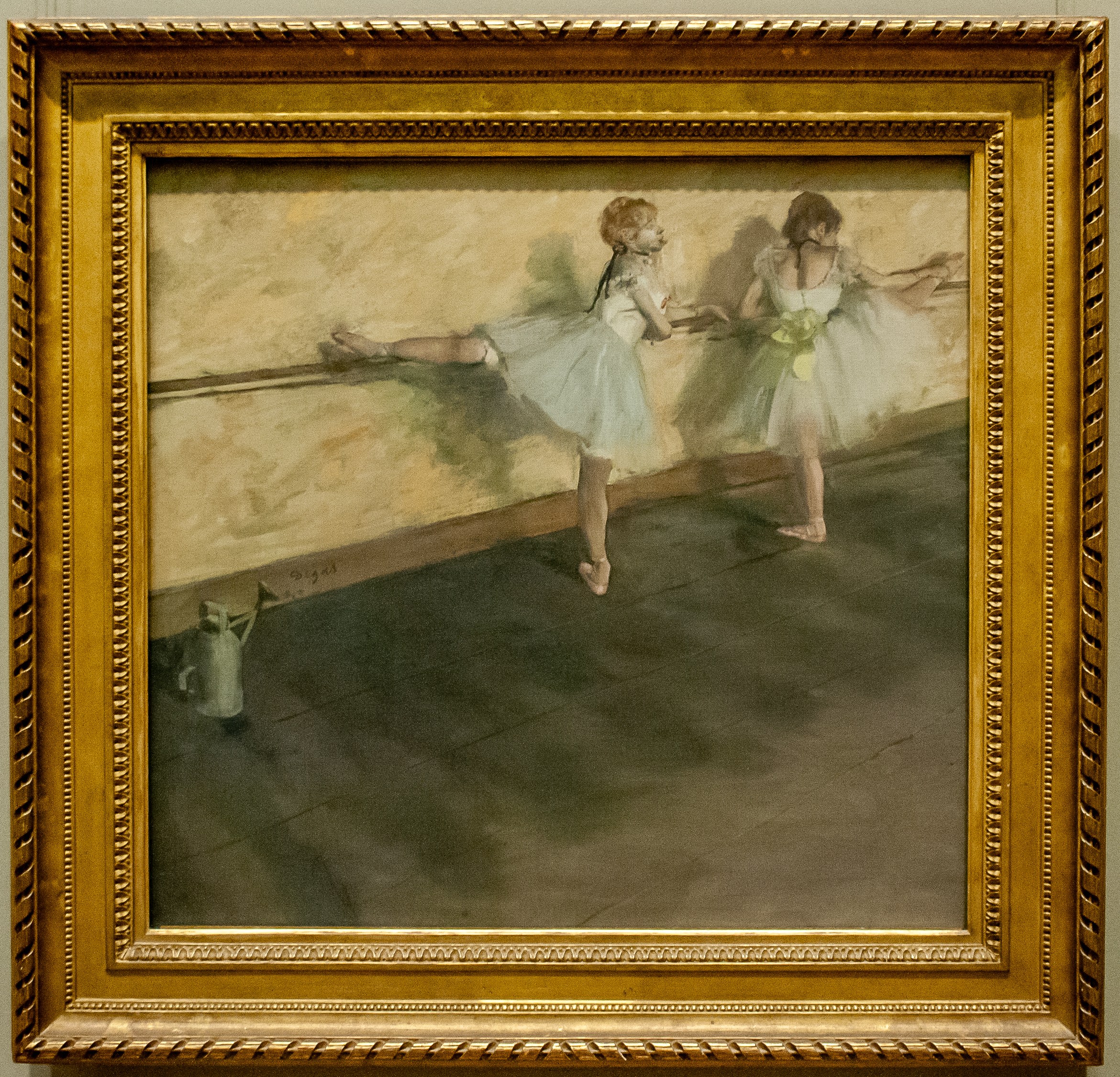
Degas - Dancers Practicing at the Bar - with frame
Edgar Degas
- Medium:
- Oil Painting
- Dance:
- Ballet
- Era:
- Late 1800s (Victorian Ballroom)
- Source:
- Wikimedia Commons
- Rights:
- Public domain — free to use, share and adapt.
- Recorded as:
- Public Domain
This painting is one of Degas's rare surviving treatments of the ballet lesson or rehearsal moment, a genre he explored repeatedly in drawings and pastels but less often in oil. For historians of nineteenth-century ballet pedagogy, it documents the postures, corrections, and spatial organization of training in an era when the Cecchetti method was becoming standardized. For viewers today, it offers a corrective to the ballet stage picture: a reminder that the art is fundamentally built on invisible, unglamorous studio work.
What you are looking at
Two young female dancers in practice clothes occupy a studio interior, captured in a moment of instruction or rehearsal. The dancer on the left, viewed in profile, leans forward with one leg extended in a développé or similar extension, her body angled as if receiving correction or demonstration. Her companion on the right, also in profile, reaches toward or supports the first dancer's raised leg, suggesting active coaching. Both wear pale practice skirts or tutus and pointe shoes. The studio is spare and functional: a wooden barre runs horizontally across the middle distance, and a watering can sits on the dark floor at left. The upper half of the composition is washed in pale, neutral tones; the lower half in shadow. The lighting is soft and naturalistic, rendering the dancers in subtle gradations rather than sharp outlines—an effect Degas achieves through his distinctive pastel and oil techniques, creating an impression of observed rather than posed movement.
The dancing
Both dancers stand on or near pointe. The left dancer's weight appears forward, with her supporting leg straight and her free leg lifted high behind or to the side in a controlled extension, the foot articulate. The right dancer's posture suggests active engagement—her torso leans in, one arm reaches toward or guides the first dancer's leg. The positioning indicates a moment of instruction: the physical intimacy of ballet pedagogy, where the teacher's hands and body guide the student's alignment. The dancers' spines are engaged and their frames upright despite the dynamic quality of the pose.
The dance depicted
This is unambiguously a scene of ballet practice or rehearsal, not performance. The wooden barre, the pointe shoes, the pale practice tutus, and the studio setting all confirm classical academic ballet training of the mid-to-late nineteenth century. The gesture of one dancer assisting or correcting the other—a common teaching method in ballet—suggests the work documents the pedagogical reality of dance rather than the theatrical spectacle. The extended leg and the supported frame indicate training in classical vocabulary, likely the Cecchetti method or comparable academic system that dominated European ballet academies in the 1870s.
How it was made
This is an oil painting, as stated in the record. Degas worked extensively in oil pastel and mixed media, and this work demonstrates his characteristic handling: a soft atmospheric quality, achieved through layering and blending, that dissolves the boundary between drawn and painted. The monochromatic upper register contrasts with the warmer tones below, a compositional choice that focuses attention on the figures and their interaction. The technique allows Degas to capture transient, off-guard moments of ballet practice—the unglamorous, instructional side of dance—with an immediacy and psychological nuance that marble sculpture or formal portraiture could not achieve.
About this work
This is a studio scene documenting the daily work of ballet training in the 1870s, painted by an artist who spent decades observing dancers in rehearsal and performance. Degas approached the ballet not as an occasion for Romantic fantasy or virtuosic display, but as a subject of formal and social interest: how bodies were shaped, corrected, and disciplined in the pursuit of technical perfection. The two dancers—student and teacher, or two students in mutual correction—occupy a moment of genuine pedagogical exchange, stripped of theatrical pretense. The work belongs in a gallery of dance because it records how classical ballet was actually practiced and taught, at a moment when the academic system was consolidating modern technique.
How to look at it
Attend to the spatial relationship between the two dancers: the teacher's hand and body guide the student's line, and the composition captures this moment of transfer—knowledge passing through the body. Notice the careful articulation of the extended leg and the supporting foot; Degas has observed and recorded the biomechanics accurately. Look at the studio itself: the barre, the floor, the neutral tones of the walls. This is not the Opéra stage; it is the working space where technique is built. The soft, diffused light and the restrained palette suggest a working day rather than an evening performance—Degas's insistence on seeing ballet as labor rather than spectacle.
The artist
Edgar Degas (1834–1917) was a painter, printmaker, and sculptor who made the observation of dancers a central subject of his practice from the 1860s onward. He attended ballet rehearsals and performances at the Opéra in Paris as a subscriber, sketching and painting dozens of scenes. Unlike his Impressionist contemporaries, Degas combined observed reality with careful compositional study, drawing on Old Master traditions of composition and perspective. His ballet scenes ranged from performance moments to the mundane: dancers stretching, adjusting costumes, resting. He worked in oil, pastel, charcoal, and mixed media, often reworking subjects across multiple techniques and compositions.
The period
In the 1870s, ballet in Paris was undergoing significant technical and aesthetic change. The Romantic era was receding; classical technique was being systematized and refined. The Opéra was the center of French theatrical dance, and dancers trained in increasingly rigorous academic methods. Degas's interest in ballet coincided with the rise of Realist and proto-Impressionist painting, which privileged observation of contemporary life over historical or mythological subjects. The ballet studio, with its ordinary light and unglamorous pedagogy, offered an ideal subject for an artist interested in how people actually moved and worked.
Where it lives
The work is sourced from Wikimedia Commons; the holding collection is not recorded in the catalogue. This is a significant gap, as Degas's ballet paintings are distributed across multiple major museums and private collections.
Dance in this work
Questions about this work
Did Degas actually attend ballet rehearsals?
Yes. Degas was a subscriber to the Opéra in Paris and had access to rehearsals and backstage areas. He sketched dancers in all contexts—performing, stretching, adjusting costumes—and developed an extensive repertoire of observed poses and movements that he then worked into his finished compositions.
Is this a portrait of real dancers?
Almost certainly not in the formal sense. Degas painted dozens of ballet studio scenes with anonymous or unidentified figures. He was interested in the type—the young dancer in training—rather than the individual. The figures are composites drawn from observation, rearranged and refined through study.
What method of ballet training is shown here?
The postures and the studio setup suggest academic classical ballet, likely aligned with or anticipating the Cecchetti method, which was becoming standard in Europe in the late nineteenth century. The focus on body alignment, the barre work, and the disciplined correction all point to this systematic approach.
Why did Degas paint so many ballet scenes?
Degas was fascinated by movement, human anatomy, and the intersection of labor and art. Ballet offered him all three: bodies in motion, studied from multiple angles, engaged in disciplined work that was also an aesthetic practice. The ballet also offered him entry to a world of female workers and training that was otherwise inaccessible to him as a male artist.
More Ballet artwork