49 works in this view — arrow keys or swipe to move between them.
Dance in Art · 1877
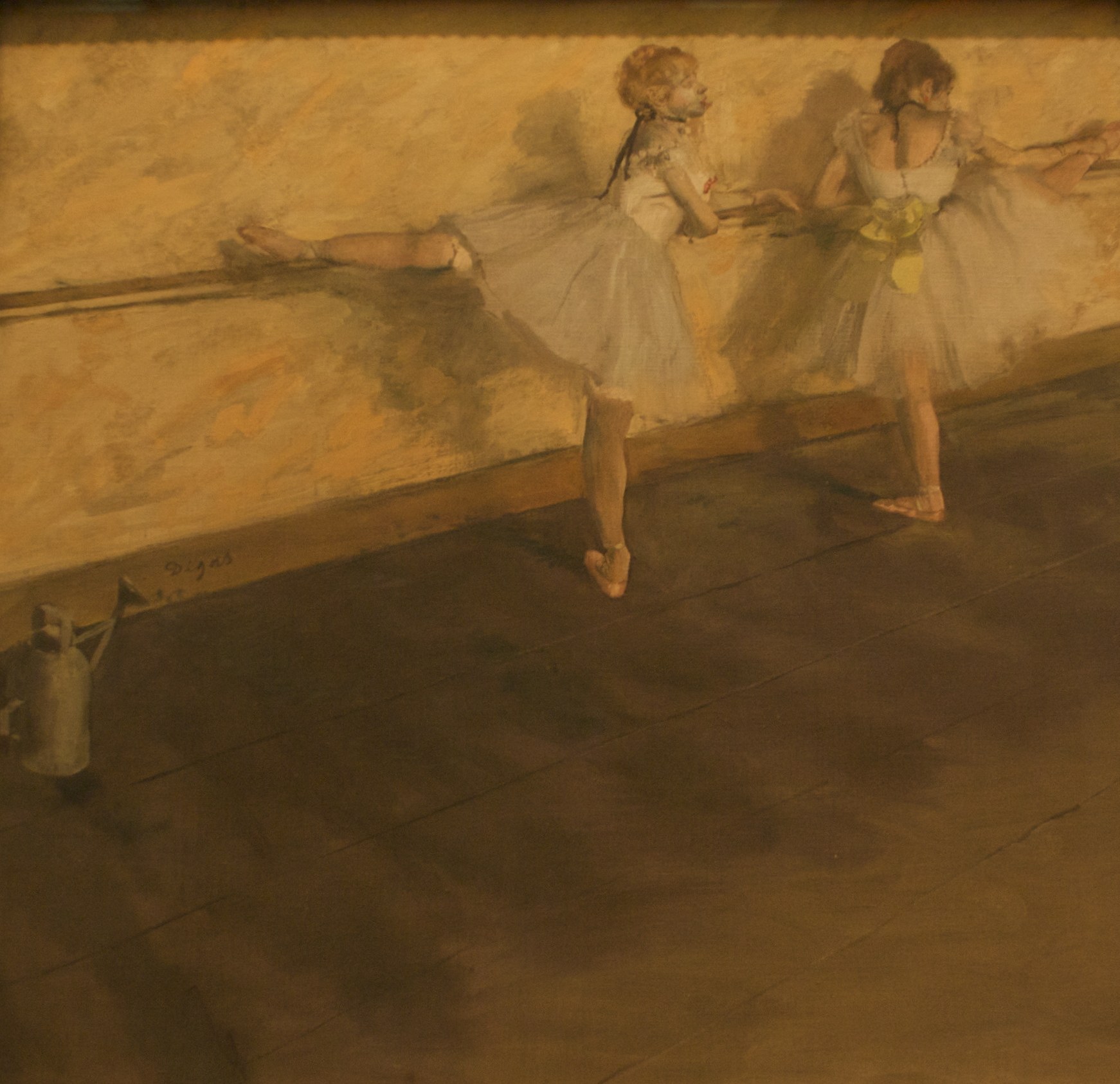
WLA metmuseum Edgar Degas Dancers Practicing at the Barre
Edgar Degas
- Medium:
- Oil Painting
- Dance:
- Ballet
- Era:
- Late 1800s (Victorian Ballroom)
- Source:
- Wikimedia Commons
- Rights:
- Public domain — free to use, share and adapt.
- Recorded as:
- Public Domain
Degas's repeated studies of the ballet studio, and particularly of barre work, legitimized the representation of training and rehearsal as subjects worthy of fine art. He showed that ballet was not only the spectacular art of the stage but also the embodied discipline of the studio, and in doing so he elevated the image of the working dancer. For historians and dancers, this work is a primary document of nineteenth-century ballet technique, pedagogy, and the conditions under which dancers practiced.
What you are looking at
Two young female dancers stand at a wooden barre mounted on a wall rendered in warm ochre tones. They are captured mid-practice in what appears to be a studio or rehearsal room, the background suffused with soft, diffused light that gives the space an intimate, ephemeral quality. Both dancers wear pale tulle skirts and are posed in profile or three-quarter view, their bodies aligned with the vertical thrust of the barre. The figure on the left stands with one leg extended; the figure on the right appears to be in a similar attitude or développé. The composition emphasizes the austere verticality of the practice space—the barre divides the canvas, and the dancers' bodies extend from it in controlled, geometric relation. The painting technique is loose and atmospheric; edges dissolve into warm shadows, and the dancers emerge from the background almost as though half-present, caught in a moment of concentration. A bucket or vessel sits at the foot of the barre in the lower left, a small domestic detail that grounds the scene in the working reality of the studio.
The dancing
Both dancers maintain an upright, elongated carriage at the barre, a fundamental position in ballet training. Their spines are extended and their heads held in profile, suggesting focus inward rather than outward display. The dancer on the left has one leg lifted and extended, indicating work on développé or similar adagio movements; the figure on the right is similarly disposed. Their arms engage the barre or extend with the controlled precision of classical technique. The parallel stance and uniform dress suggest synchronized training rather than partnered work. The painter has rendered their bodies with anatomical understanding—the elongation of the ballet body is present in the line from hip through extended leg.
The dance depicted
This is a study of classical ballet technique in its most fundamental context: the daily practice at the barre that forms the foundation of all ballet training. The work shows the petit or grand battements, développés, or similar adagio exercises performed in first or second position at the barre, in the order of a traditional ballet class. These are not performance moments but the disciplined repetition that constituted the invisible labor of ballet training, particularly for the ballerinas of the Paris Opéra where Degas had privileged access. The image documents not a story or pantomime but technique itself—the student body learning the vocabulary of movement.
How it was made
Oil painting on canvas, rendered with a soft, luminous palette dominated by warm ochres, creams, and grays that suggest studio light filtered through high windows or gaslit interiors. Degas employs a technique of sfumato and blurred edge to create atmospheric dissolve, particularly around the figures and the upper portions of the canvas, a method that heightens the sense of transient observation—we are watching an unguarded moment. The loose handling allows the figures to emerge from and merge with the studio environment; they are not isolated specimens but integral to the space. This technique was well suited to oil painting and allowed for the kind of subtle tonal modulation that printmaking or drawing could not achieve, giving the work a uniqueness that would have circulated through the Parisian art market and collectors' galleries.
About this work
This painting documents the dailiness of classical ballet training in the nineteenth century, specifically the barred exercises that were the building blocks of technique. Degas returned repeatedly to this subject—the ballet studio, the rehearsal, the barre work—because it allowed him to study the body under discipline, the moment before performance when the dancer is absorbed in the mechanics of her craft rather than the art of storytelling. The work is neither narrative nor decorative; it is documentary in its attention to the actual practice of ballet, and in that attention it achieves a rare intimacy. The painting asserts that ballet is labor, technique, and concentration as much as it is spectacle. It belongs in a gallery about dance because it shows us what dancers do when no one is watching—or rather, when only the painter is watching, and only to understand how the body learns to move.
How to look at it
The painting asks you to observe the moment of disciplined repetition rather than performance. Watch how Degas has used the barre as a compositional spine and also as a symbol of the constraint and structure that enables the dancer's art. Notice the softness of the light and the dissolution of edges, which suggests that this is a private moment, not a public spectacle—we are almost eavesdropping. The elongation of the dancers' bodies and the precision of their posture tell you that the painter understood ballet anatomy and was not sentimentalizing the figure. Look at the small details—the bucket, the wear of the studio—as evidence of the painting's commitment to truth over fantasy.
The artist
Edgar Degas (1834–1917) had privileged access to the Paris Opéra Ballet, where he sketched and painted dancers at work and in rehearsal from the 1870s onward. He was not a narrative painter in the conventional sense; he was fascinated by movement, light, and the unguarded moment, and he found in ballet a subject that allowed him to explore all three. Degas worked across media—pastel, oil, printmaking, sculpture—and his ballet works are distributed across all of them. His engagement with ballet was neither sentimental nor voyeuristic; it was a formal and anatomical investigation into how the body moves through space and how light and atmosphere transform a scene. He was influenced by photography and Japanese prints, both of which shaped his compositions toward off-center framings and unexpected angles.
The period
This work was painted in 1877, during the Romantic and early modern periods of ballet history. The 1870s saw ballet at a crossroads: the great Romantic ballets were being restaged, new works were being created, and the Paris Opéra was the epicenter of ballet training and performance. Degas's documentation of the barre arrived at a moment when ballet technique was becoming systematized and codified—the ballet class itself, as a formal structure, was becoming standardized. In art, the 1870s were the moment of Impressionism, and while Degas was not strictly an Impressionist, he shared the Impressionists' interest in light, urban life, and the moment of observation. His studio works coincided with a broader cultural turn toward documenting the everyday and the marginal—in this case, the spaces and labors behind the spectacle.
Where it lives
The work is recorded in the catalogue as an oil painting from 1877, held in an unspecified collection and sourced through Wikimedia Commons. The Metropolitan Museum of Art records are the stated source, though the current holding institution is not recorded in the metadata provided.
Dance in this work
Questions about this work
Why did Degas paint ballet dancers so often?
Degas was fascinated by movement, light, and the body in motion. Ballet gave him access to a controlled, disciplined form of movement that he could study and represent. He was not interested in the narrative or spectacle of ballet; he was interested in how the body moves, how light falls on bodies in motion, and the human effort and concentration that underlay the art. He sketched in the Paris Opéra for decades, accumulating a visual archive of ballet in all its aspects—on stage, in rehearsal, in the dressing room, and at the barre.
What is a ballet barre and why is it important?
The barre is a horizontal rail, typically wooden, mounted at waist height along the walls of a ballet studio. Dancers use it for balance and support while performing exercises that build strength, control, and technique in the legs, feet, and body alignment. Barre work is the foundation of ballet training and is performed first in every ballet class. It is where dancers learn the vocabulary of movement—the positions, the shapes, the qualities of control—before moving into the center of the studio for more complex and unsupported work.
How does the composition relate to the subject of training?
The barre divides the canvas vertically and serves as both a practical tool and a symbolic structure. It constrains the dancers' movement and frames their bodies in a systematic, almost repetitive way. The vertical orientation and the symmetry of the composition reflect the formal order of the ballet class and the discipline required of the dancer. The soft, dissolving background suggests that we are seeing a moment of focused, internal work rather than external display—the concentration and effort that happens away from the public eye.
More Ballet artwork