49 works in this view — arrow keys or swipe to move between them.
Dance in Art
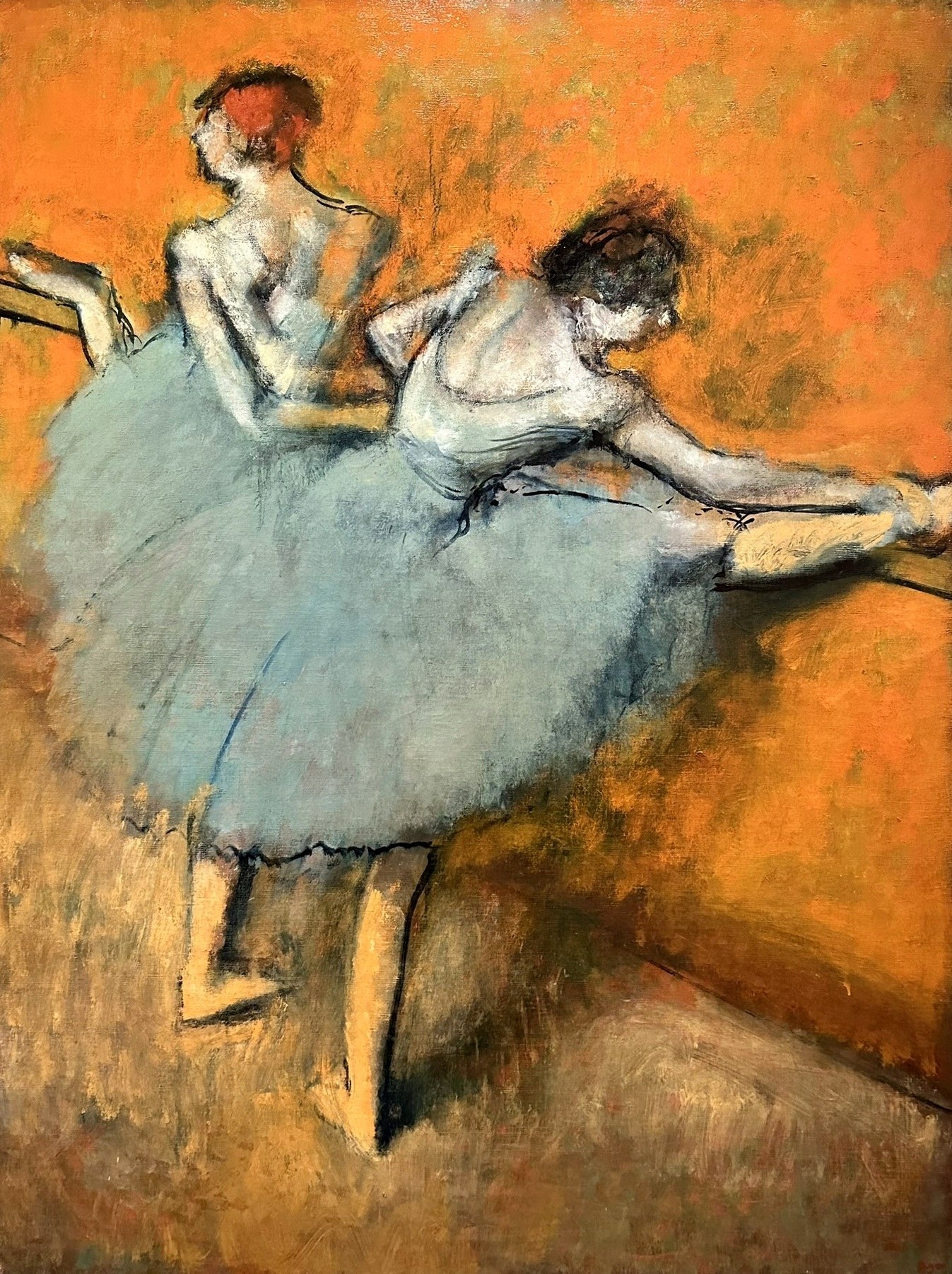
Dancers at the Barre by Edgar Degas
Edgar Degas
- Medium:
- Oil Painting
- Dance:
- Ballet
- Era:
- Late 1800s (Victorian Ballroom)
- Source:
- Wikimedia Commons
- Rights:
- Public domain — free to use, share and adapt.
- Recorded as:
- Public Domain
Degas was one of the first major artists to paint ballet rehearsal and training rather than performance, and his work documented and legitimized the physical and technical reality of professional dance. For dancers and dance historians, such works are evidence of nineteenth-century ballet pedagogy and practice—the actual teaching methods, clothing, and studio space in which classical ballet was trained and transmitted. The work also established an enduring artistic tradition: the representation of dancers not as performers but as workers engaged in the discipline and repetition that makes performance possible.
What you are looking at
Two ballet dancers in pale blue practice tutus stand at a wooden barre against a warm ochre and orange background. The figure on the left, shown from behind, grips the barre with both hands and extends one leg in a controlled extension, her body upright and engaged. The dancer on the right faces forward or slightly turned, also holding the barre, her posture similarly disciplined. Both wear their dark hair pulled back, and their pale skin contrasts sharply with the warm background. The barre itself is rendered in pale wood tones, positioned diagonally across the lower portion of the composition. The painting captures the quiet intensity of a rehearsal or training session—a moment of technical work rather than performance, with the dancers isolated against the monochromatic background that emphasizes their pale bodies and the formal geometry of their positions.
The dancing
Both dancers maintain the upright carriage and turned-out positioning fundamental to ballet technique. The figure on the left has extended one leg at hip height in what appears to be à la seconde or possibly extension en arrière, with straight knee and pointed foot, demonstrating control and flexibility. The right-hand dancer is caught in a more vertical position, both feet engaged with the floor. Both hold the barre with bent arms, using it as a support for balance and leverage—the essential barre work posture. Their bodies show the lean musculature expected of trained dancers, and their stillness suggests the sustained holds and slow extensions typical of barre exercises rather than fluid movement.
The dance depicted
This is unambiguously a ballet scene, depicting the barre work that forms the foundation of classical ballet training. The barre—the wooden rail fixed at waist height to a wall or freestanding—is where dancers begin every class, working through positions and movements with the support of the rail. The pale tutus, the turned-out legs, the formal positioning, and the barre itself are all canonical markers of ballet pedagogy and practice. The work shown here is a training or rehearsal moment, not choreography for performance; it represents the daily technical work that produces the controlled, turned-out movement of classical ballet. Degas made numerous such scenes throughout his career, and they document not the theatricality of ballet but its hidden discipline.
How it was made
Oil on canvas, executed with Degas's characteristic loose, layered brushwork. The warm ground—an orange-ochre wash applied across much of the surface—establishes the dominant color temperature and is visible between and around the figures, creating an effect of intimacy and informality rather than the polished finish of academic painting. The pale blue of the tutus is built up over this ground, and the dancers' flesh tones are rendered with a subtle modeling that suggests volume without rigid outline. The barre is indicated with confident, minimal strokes. This technique—economical, seemingly unfinished in places, with vivid color harmonies—was characteristic of Degas's ballet studio works and suited his interest in capturing ephemeral moments of movement and gesture rather than producing finished exhibition pieces.
About this work
This is a straightforward document of ballet training practice, depicting two dancers at the barre—the essential apparatus and ritual of classical ballet. The work sits within Degas's extensive series of ballet studio paintings, a body of work that revolutionized how art addressed dance by focusing on the unglamorous reality of rehearsal and training rather than the spectacle of performance. What makes this scene legible and moving is Degas's commitment to actual ballet technique and anatomy: the turned-out positions, the extended leg, the grip on the barre, the trained bodies—all rendered with the precision of an artist who understood the discipline from the inside.
The painting matters because it established a new subject for art: not dancers as symbols of beauty or performance as entertainment, but dance as a discipline, a craft, a daily practice. By removing the stage lights, the audience, and the music, Degas asked viewers to look at what dance actually is—work, technique, repetition. This painting is part of that revolution.
How to look at it
Look first at the barre and what it reveals about the dancers' relationship to it: how they grip it, how they use it for balance and leverage, how their bodies orient to it. Notice the extended leg and the turned-out positioning—these are the technical markers of ballet, instantly recognizable to anyone trained in the form. Observe the moment Degas chose: not a leap or a turn, but a sustained, stationary position—a barre exercise held or demonstrated. The warm background and the isolation of the two figures against it create an almost studio-like intimacy, drawing attention to the dancers' bodies and their work rather than to any narrative or theatrical context. The loose, visible brushwork and the unfinished quality of parts of the composition mirror the informal, in-progress nature of a rehearsal or training session.
The artist
Edgar Degas (1834–1917) was fascinated by dance and made it a major subject throughout his career. He attended the Opéra regularly, sketched and observed dancers in rehearsal, and executed hundreds of works on ballet themes—paintings, pastels, drawings, and sculpture. Unlike most nineteenth-century artists who depicted dance, Degas studied ballet technique seriously and developed a sophisticated understanding of movement, anatomy, and the training process. His ballet works ranged from spectacular stage scenes to intimate glimpses of dressing rooms and rehearsal spaces. He was drawn to the informal, the mundane, and the physiologically challenging aspects of dance, and his work helped establish the artist's studio or rehearsal space—rather than the stage—as a legitimate subject for fine art.
The period
This work dates from the later nineteenth century, a period when ballet was undergoing significant technical and artistic transformation. The barre training system shown here was becoming standardized in Russian and European ballet academies, and the pale practice tutu visible here was the standard costume for daily work. Degas's focus on rehearsal rather than performance was part of a broader nineteenth-century interest in behind-the-scenes realism—the same impulse that drew artists and writers to laundries, brothels, and workrooms. In the context of academic art, which traditionally showed finished, idealized subjects, Degas's rehearsal scenes were radical: they made visible the labor, discipline, and ordinariness that lay beneath the spectacle of performance.
Where it lives
The painting is recorded as being in The Phillips Collection, a museum in Washington, D.C., founded in 1921 and known for its modern and contemporary collections. The work's presence there places it in a significant twentieth-century context of artistic collection and interpretation. The source record is Wikimedia Commons.
Dance in this work
Questions about this work
What is the barre and why do ballet dancers use it?
The barre is a wooden rail, usually fixed at waist height to a wall or set on a freestanding frame, used in ballet training for support and balance during exercises. Dancers hold the barre lightly with one or both hands while performing movements with their legs and torso, allowing them to work on technique, alignment, and strength without the full balance demands of center-floor work. Barre work is the first part of every ballet class and is fundamental to the training method shown here.
Is this a finished painting or a study?
This is a finished painting, though it has the characteristic looseness and visible brushwork of Degas's mature style. He deliberately rejected the polished, academic finish expected of official salon paintings in favor of a more immediate, sketch-like technique that captured the fleeting quality of dance. For Degas, this was not incompleteness but a deliberate formal choice that suited his subject matter.
How do we know this is ballet and not another form of dance?
The barre, the pale practice tutus, the turned-out legs and positions, and the formal training postures are all canonical to classical ballet and appear in no other major dance form. The anatomical evidence—the extension, the turnout, the carriage—confirms this is ballet pedagogy, not choreography in another style.
Why did Degas paint so many ballet scenes?
Degas was attracted to ballet as a subject that combined movement, light, color, and human effort in ways that challenged his art. He valued the discipline and technical rigor of ballet training, and the variety of poses available to the artist. He also had regular access to the Paris Opéra and to dancers in rehearsal, and he developed genuine expertise in the form. For him, ballet was not merely entertainment but a serious subject worthy of sustained artistic investigation.
More Ballet artwork