49 works in this view — arrow keys or swipe to move between them.
Dance in Art · 1900
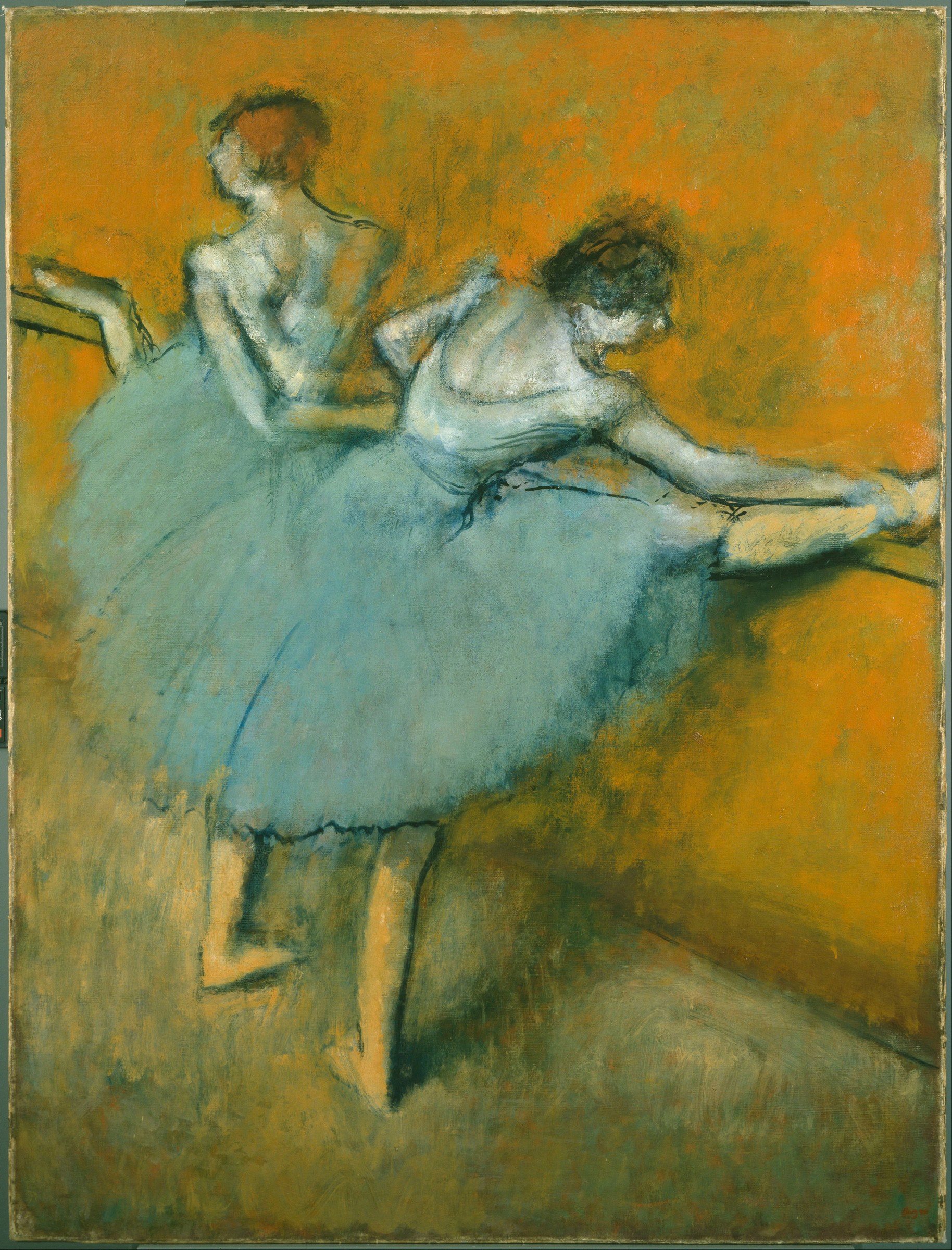
Edgar Degas - Dancers at the Barre
Edgar Degas
- Medium:
- Oil Painting
- Dance:
- Ballet
- Era:
- 1900-1920 (Ragtime/Early Jazz)
- Source:
- Wikimedia Commons
- Rights:
- Public domain — free to use, share and adapt.
- Recorded as:
- Public Domain
This work is part of a larger body of paintings and pastels that brought serious artistic attention to ballet dancers in their working lives, not just on stage. The choice to paint the private, repetitive work of the barre rather than the spectacle of performance shifted how dancers were seen in the visual culture of the period. For historians of ballet, this image is essential evidence of late-19th-century training methods, studio conditions, and the daily discipline that underpinned professional technique.
What you are looking at
Two ballet dancers in pale blue practice dresses are shown at a wooden barre against a warm ochre-gold background. The dancer on the left stands upright, one arm extended along the barre, her torso turned slightly away from the viewer. The dancer on the right bends deeply forward over her extended leg in a stretch or penché position, her body folded at the hip, arms reaching toward her leg. The background is loosely rendered in warm yellows and oranges, creating an impressionistic studio atmosphere with no architectural details. The paint surface shows the artist's characteristic loose brushwork and soft modeling of the figures' flesh tones against the warm tonality of the room.
The dancing
Both dancers wear the standard practice uniform of the period: soft pale blue practice skirts and pointe shoes. The dancer on the left maintains an upright, watchful posture with one hand lightly on the barre; the dancer on the right demonstrates advanced flexibility and strength, her torso nearly parallel to her extended leg in what appears to be an adagio stretch. The composition emphasizes the repetitive training of ballet technique—two bodies at different moments of the same disciplined work. The barre itself is rendered as a simple dark line anchoring both figures vertically within the composition.
The dance depicted
This depicts ballet training at the barre, the fundamental daily practice regimen that was central to professional ballet training in the late 19th and early 20th centuries. The work shows the private, unglamorous side of ballet—not performance but the repetitive, physically demanding drills that built technique and strength. The barre work shown here emphasizes turnout, extension, and flexibility, the core vocabulary of classical ballet. The informality of the study and the artist's attention to the mundane moment of practice, rather than theatrical spectacle, marks this as a studio scene from the romantic period of ballet when such intimate observation of dancers' working lives was relatively novel subject matter.
How it was made
This is an oil painting on canvas, executed with the loose, broken brushwork and warm color harmony characteristic of Impressionist practice. The artist has not smoothed the surface into academic finish but allowed visible brushstrokes to define form, particularly in the skirts and background. This technique conveys the transient effect of studio light and the momentary nature of the gesture—appropriate to the subject of practice, which is inherently unfinished and repetitive rather than climactic. The warm ground and cool blues of the dresses create a color harmony that emphasizes the dancers' bodies as the focal content.
About this work
This oil painting depicts two ballet dancers at a wooden barre in a practice studio, rendered in the Impressionist idiom that emerged in France in the second half of the 19th century. One dancer stretches forward in a penché, while the other stands upright, engaged in the daily repetitive work of ballet training. The composition prioritizes the unglamorous reality of ballet technique—the barre work that produced the virtuosity seen in performance—over any theatrical narrative. This belongs in a dance archive because it documents ballet training as a physical and social practice, and because it represents an artist's sustained attention to dancers as workers and subjects worthy of serious artistic study.
How to look at it
Attend first to the postures of the two dancers and what they reveal about classical ballet vocabulary: the upright stance with hand on barre, and the deep forward fold of the penché. The composition is deliberately asymmetrical and informal, capturing the moment of work rather than display. Notice how the warm ochre background unifies the space and makes the cool blue of the practice dresses vibrate; this color choice was deliberate and is characteristic of Impressionist practice. The barre itself, rendered as a simple dark line, organises the composition and anchors both bodies within the studio's geometric order.
The artist
Edgar Degas (1834–1917) was a French painter and printmaker who devoted decades to the study of dancers, particularly in Paris. He attended rehearsals and ballet schools, sketched obsessively, and produced hundreds of works in oil, pastel, and print media that document ballet dancers in rehearsal, at the barre, backstage, and in performance. Degas's interest was anthropological as much as aesthetic—he observed dancers as workers engaged in a specific craft, and his paintings and pastels constitute one of the most sustained and intimate artistic documentations of any working group in the history of modern art. His technical innovations with pastel and his radical compositions—high viewpoints, asymmetrical framing, cropped figures—were developed through this engagement with dancers.
The period
In the late 19th century, ballet training in Paris was undergoing professionalisation and codification. The ballet schools attached to the Opéra were rigorous institutions, and the daily barre work shown here was the foundation of the classical technique that Degas saw being built in these studios. The 1880s and 1890s were a period of transition in ballet aesthetics, between Romantic ballet and the emerging Classical style, and between the primacy of the Paris Opéra and the touring Russian Imperial Ballet. Degas's paintings of the barre coincide with a broader cultural interest in the body as a site of disciplined work—the very years in which scientific studies of motion and physiology were being conducted.
Where it lives
The source record notes this work as sourced from Wikimedia Commons and does not record a current holding institution. The catalogue record provides minimal information beyond title, artist, and date.
Dance in this work
Questions about this work
Why would an artist paint dancers at practice rather than in performance?
Ballet performance was already well documented in earlier art; the barre work was the hidden labour that produced that spectacle. Degas was interested in dancers as workers engaged in a disciplined craft, not as ethereal stage figures. Painting the studio rather than the theatre was a choice to show reality over spectacle, and to investigate how bodies were trained to achieve classical technique.
What is the barre and why is it so important to ballet?
The barre is a wooden rail, usually at waist height, that dancers hold for balance during warm-up and technical drills. It allows dancers to practise steps and positions with less risk of falling, enabling them to focus on alignment, turnout, and control. Every professional dancer begins every day with barre work; it is the foundation of classical ballet training.
How does Degas's painting style here compare to academic training painting?
Degas abandons the smooth, finish-focused technique of academic art in favour of loose, visible brushwork and warm colour harmonies influenced by Impressionism. This technique conveys immediacy and transience—the opposite of the heroic, timeless quality of much academic figure painting. The unfinished quality is itself meaningful: it mirrors the perpetual incompleteness of training, where the work is never finished.
Are these professional dancers or students?
The setting and the simple practice dresses suggest this is either a ballet school or a theatre rehearsal studio. The dancers may be students or professionals in rehearsal; the distinction is less important than the fact that both are engaged in the daily work of ballet training, which was identical across ranks.
More Ballet artwork