49 works in this view — arrow keys or swipe to move between them.
Dance in Art · 1888
Edgar Germain Hilaire Degas 072
Edgar Degas
- Medium:
- Oil Painting
- Dance:
- Ballet
- Era:
- Late 1800s (Victorian Ballroom)
- Source:
- Wikimedia Commons
- Rights:
- Public domain — free to use, share and adapt.
- Recorded as:
- Public Domain
This work documents ballet practice rather than performance—a crucial distinction for understanding both art history and dance history. It shows how late-nineteenth-century artists perceived and valued the rehearsal process, the teaching relationship, and the isolated discipline of ballet training, offering a window into the physical and emotional world of professional dancers of the period.
What you are looking at
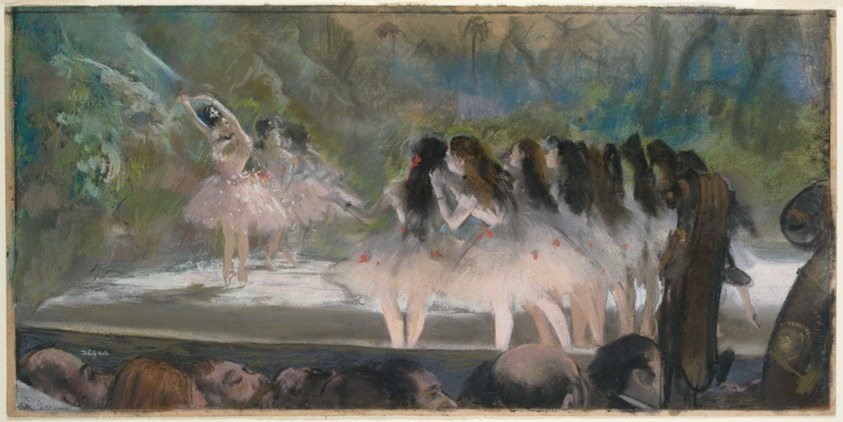
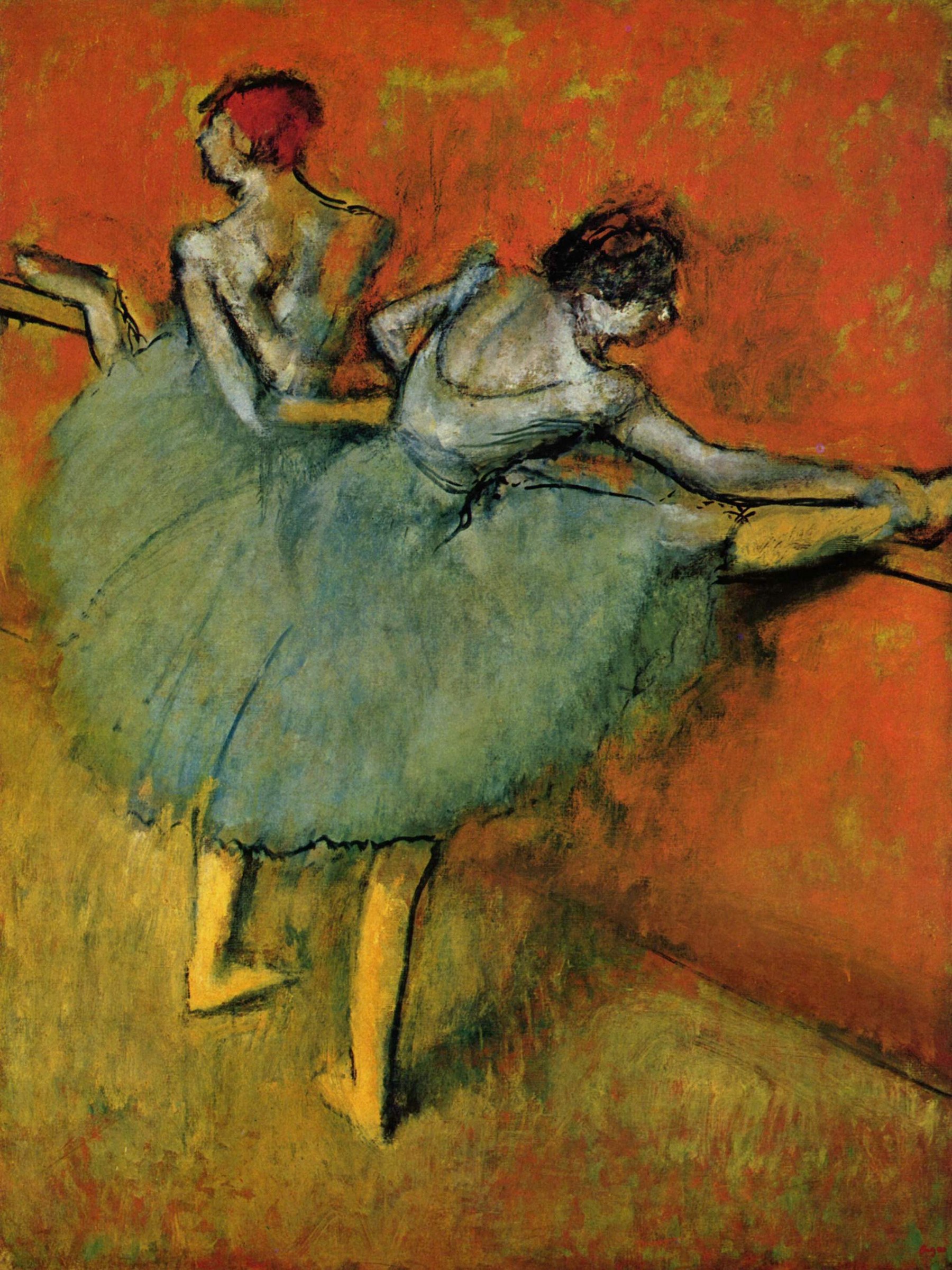
Two young female dancers in pale blue-green tutus are captured mid-rehearsal against a vivid burnt-orange background. The figure on the left stands upright, her body turned in profile as she gazes upward with her arm extended; her companion leans forward in a deep arabesque or attitude position, her extended leg reaching toward the right edge of the frame. Both wear their hair up in the style of the late nineteenth century. The composition is spare and intimate—no studio props, no corps de ballet, no audience—suggesting a private moment of instruction or self-directed practice rather than a performance. The background is handled loosely with visible brushwork and touches of yellow-ochre, creating atmosphere without narrative clutter. The painting's loose, gestural approach and the dancers' absorbed concentration convey the physical and emotional intensity of ballet training.
The dancing
The figure on the left stands nearly straight, her weight centered, her gaze directed upward in a moment of reflection or instruction. The dancer on the right is pitched forward in a deep arabesque or attitude—her torso inclined, her back leg extended high and forward, her working arms creating the elongated line characteristic of Romantic ballet. Both dancers' bodies are lean and elongated, their posture emphasizing the lifted quality and ethereal lightness demanded of the form. The spatial relationship between them suggests a teaching or mirroring moment rather than a duet in performance.
The dance depicted
This is unmistakably a ballet rehearsal scene, most likely depicting the Romantic ballet tradition of the mid-to-late nineteenth century. The tutus, pointe work, and arabesque attitude confirm the genre. The image captures not a formal performance but the private, often repetitive work of training—a subject that fascinated late-nineteenth-century artists, particularly those depicting the Paris Opéra ballet. The loose, almost impressionistic handling suggests the ephemeral, in-the-moment quality of rehearsal, as distinct from the polished spectacle of the stage.
How it was made
Oil on canvas, executed with loose, gestural brushwork that prioritizes atmosphere and movement over descriptive detail. The artist has used a restricted palette—pale greens and blues for the dancers' bodies and tutus, burnt orange for the dominant background, with accents of darker charcoal or black for the dancers' hair and outlines. This approach allows the figures to read clearly against the warm ground while the painterly technique suggests spontaneity and immediacy. The work appears to be a small sketch or finished study rather than a monumental exhibition piece, consistent with the intimate, private moment it depicts.
About this work
This is a ballet rehearsal scene painted in oil, depicting two young dancers in pale blue tutus against a warm, loosely handled background. The composition captures a moment of instruction or practice rather than formal performance, emphasizing the physical discipline and spatial relationships of Romantic ballet technique. The painting sits within a long nineteenth-century tradition of artists documenting the behind-the-scenes life of ballet, a subject that held particular fascination for Parisian artists and audiences who followed the fortunes of the Opéra ballet. The work's loose, atmospheric handling and intimate scale distinguish it from grander narrative scenes, positioning it instead as a study of the dancers' bodies in motion and the quiet intensity of their labor.
How to look at it
Attend to the two dancers' different moments and attitudes: one is relatively still, gazing upward, while the other is suspended in a deep arabesque, her body angled toward the edge of the canvas. This compositional asymmetry and the artists' choice to freeze that particular instant—not a pose held for an audience, but a transitional moment in a class or rehearsal—is characteristic of late-nineteenth-century ballet imagery. Notice too the spatial emptiness around the figures and the way the warm orange background seems to dematerialize rather than situate them in a specific room. The loose brushwork and the painters' apparent indifference to anatomical precision create a sense of immediacy and movement that a more tightly rendered academic canvas might not convey.
The artist
Edgar Degas (1834–1917) was obsessed with ballet for over four decades, producing hundreds of paintings, pastels, prints, and sculptures depicting dancers of the Paris Opéra. Unlike many of his contemporaries, Degas was drawn to the mundane, the unglamorous, and the behind-the-scenes: dancers tying their shoes, stretching, yawning, being corrected by their masters. He had privileged access to the Opéra and spent countless hours observing rehearsals, allowing him to capture not the polished artifice of performance but the raw physicality and discipline of training. His works fundamentally changed how artists and audiences understood ballet, shifting focus from the romantic fantasy to the labor and the body itself.
The period
In the 1880s, Romantic ballet was in decline and classical ballet (in its modern, post-Romantic form) was emerging. The Paris Opéra ballet remained a central institution of Parisian cultural life, and ballet dancers, particularly female dancers, occupied an ambiguous social position—celebrated as artists yet often regarded as vulnerable or morally suspect. Degas's attention to the private world of rehearsal emerged partly from his broader Impressionist commitment to painting contemporary, everyday life rather than history or mythology. At the same time, his obsession with the human figure and with capturing movement itself—the moment between poses—aligned him with late-nineteenth-century scientific and artistic interest in the mechanics of the body. Photography was also transforming how artists understood and represented movement; Degas was keenly aware of photographic innovation and its implications for depicting the human form in motion.
Where it lives
The work is sourced to Wikimedia Commons and is recorded as an oil painting from 1888. No current holding collection or accession number is recorded in the catalogue data provided.
Dance in this work
Questions about this work
Why did Degas paint ballet so often?
Degas was fascinated by the human body in motion and by the discipline and labor of professional dancers. Ballet offered him both a visually compelling subject—graceful, challenging movement—and a window into a particular social world. He had rare access to rehearsals, which allowed him to move beyond the clichés of Romantic ballet imagery and capture the unglamorous reality of training and practice.
What is the difference between this rehearsal scene and a stage scene?
A rehearsal scene depicts dancers in practice clothes (simpler, more practical tutus and tights), in a bare studio, often correcting or repeating movements. A stage scene shows polished performance, often with scenery, elaborate costumes, and a narrative or purely formal choreographic moment. Degas painted both, but was drawn to rehearsals because they revealed the body's true work and the teaching relationships that shaped dancers' technique.
Is this a finished painting or a sketch?
The work has the character of a finished, autonomous painting despite its intimate scale and loose handling. Late-nineteenth-century artists, especially Impressionists and artists influenced by Impressionism, frequently treated sketchy or gestural brushwork as fully realized artistic statements rather than preliminary studies. This painting appears complete as a work of art, not a study for a larger composition.
More Ballet artwork