49 works in this view — arrow keys or swipe to move between them.
Dance in Art · 1877
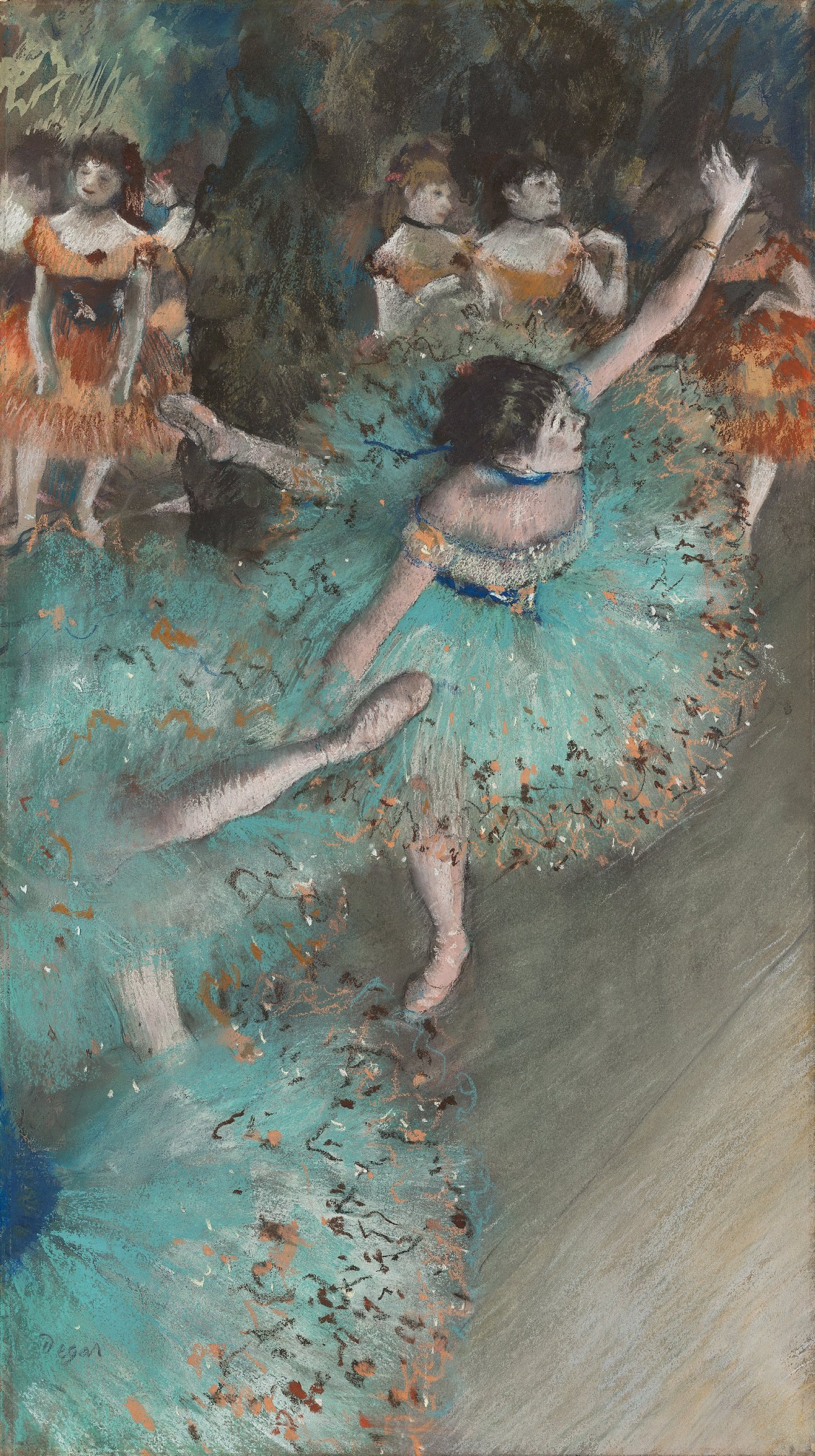
Danceringreen
Edgar Degas
- Medium:
- Oil Painting
- Dance:
- Ballet
- Era:
- Late 1800s (Victorian Ballroom)
- Source:
- Wikimedia Commons
- Rights:
- Public domain — free to use, share and adapt.
- Recorded as:
- Public Domain
Degas's ballet paintings redefined how art could represent dance, moving away from narrative spectacle toward the intimate, unguarded moments of rehearsal and training. This work is foundational to any modern understanding of how painters understood the moving body, and it provides direct visual evidence of ballet training practices and costume in the late 19th century. It also shaped how subsequent artists approached dance as a subject for serious artistic investigation.
What you are looking at
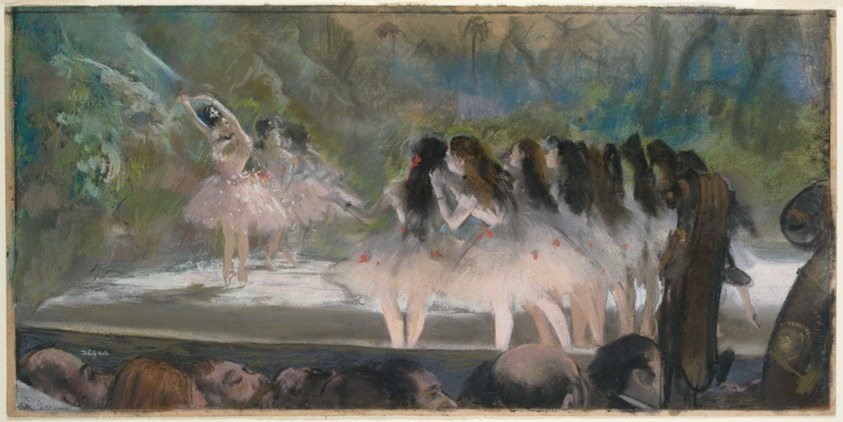
A rehearsal or performance scene in a theatre or studio, painted in Degas's characteristic Impressionist style with bold compositional choices and luminous color. Six female dancers in practice or performance costume occupy the canvas—some in the foreground, others receding into shadow in the background. The dominant figure is a dancer in the center-right, caught mid-movement with her right arm extended upward and her body in a graceful arc, wearing a gauzy skirt in peachy-orange tones. Her companions wear similar tutus in whites and warm ochres. The background is deliberately obscured by dark, sketchy brushwork—architectural forms suggest theatre wings or a studio wall. The floor is rendered in loose turquoise and gray strokes, creating a sense of stage lighting or the particular atmosphere of rehearsal space. Degas has cropped the composition tightly and from an unusual angle, as though the viewer is watching from the wings or from an unexpected vantage point within the space itself.
The dancing
The central dancer's pose suggests a moment of extension or balance—her torso leans backward slightly, right arm lifted, left arm lower, head turned away from the viewer in classical ballet carriage. Around her, other dancers in various states of rest or transition: one sits or reclines on the floor in the immediate foreground, another stands in profile at left, others cluster in the middle distance. The poses are naturalistic rather than formally composed—some dancers appear to be waiting, watching, or recovering between repetitions. The spacing and informality suggest a working rehearsal rather than a formal performance, though the tutus and the careful staging of light indicate this is a professional or semi-professional setting.
The dance depicted
This is an Opéra Garnier ballet scene, almost certainly from the working life of the Paris ballet in the 1870s. Degas was obsessively drawn to the ballet studios and stage of the Paris Opéra during this period, and this work depicts the training and rehearsal that was central to his artistic practice. The dancers wear the standard ballet costume of the era—tulle skirts, pointe shoes (though not clearly visible in the loose brushwork), and simple bodices. The extended arm position and the arched back of the central figure are consistent with classical ballet vocabulary of the period, though Degas is not attempting to document a specific ballet or position. Rather, he captures the momentary grace and informal movement of dancers between formal demands—a rehearsal sensibility that was revolutionary in art of this period.
How it was made
Oil on canvas, executed in Degas's mature Impressionist manner with loose, directional brushwork and a high-keyed palette dominated by blues, greens, and warm ochres. The paint is applied in thin, semi-transparent layers in some areas and with more body elsewhere, creating a sense of depth and atmosphere. The background is deliberately unfinished and suggestive rather than descriptive—a technique that was radical for its time and emphasizes the momentary, fleeting quality of the scene. This technique of loose finish, unexpected cropping, and emphasis on movement and light was influential in Impressionism and challenged academic painting conventions.
About this work
This is a characteristic work from Degas's sustained engagement with ballet as both subject and formal problem. Painted in 1877, it belongs to a series of studio and stage scenes that documented the working lives of dancers at the Paris Opéra. Unlike academic ballet painting, which depicted heroic moments and formal costumes, Degas was interested in the unglamorous reality of training, the awkward intervals between steps, and the particular effects of stage and studio light on the body. The work sits at the intersection of dance practice and modernist painting—it is both a sociological document of late 19th-century dance and an exploration of how the moving body could be rendered in paint.
For historians of dance, the work is invaluable evidence of ballet training and costume in the 1870s Opéra. For art historians, it represents a watershed moment in the representation of movement and the challenge to academic compositional principles. The painting asks viewers to see ballet not as a finished spectacle but as a discipline, a labor, and an arena of grace unfolding in real time.
How to look at it
Attend first to the central dancer's posture and the particular moment Degas has chosen to freeze—not a leap or a turn, but a moment of extension and balance that reveals the discipline underlying apparent effortlessness. Notice how Degas has positioned the viewer as if looking from the wings or from an off-center position in the studio, not from the orchestra pit of a theatre: this creates intimacy with the working dancers rather than distance. The cropping is radical—figures are cut off at edges, the space is ambiguous, and the background is sketchy and uncertain. This was deliberately modern: it mimicked the effects of a photograph or a casual glance, rather than the composed symmetry of academic art. Notice too the color—the luminous turquoise of the floor, the warm peachy tones of the tutus, the cool shadows—and how these colors model the forms and suggest stage or studio lighting.
The artist
Edgar Degas (1834–1917) was born in Paris and trained in the academic tradition under Louis Lamothe, but rapidly moved toward independent practice and association with the Impressionists, exhibiting with them from 1874 onward. From the mid-1860s until near the end of his life, Degas was fascinated by the Paris Opéra, particularly its ballet studios and dancers. He had privileged access to backstage areas and rehearsal spaces, which he exploited to create hundreds of paintings, pastels, and drawings. His interest was not in the spectacle of performance but in the body in motion, the discipline of training, and the formal problems of representing transient movement. He developed a distinctive compositional approach—unusual cropping, high viewpoints, and asymmetrical framing—that conveyed the immediacy and momentariness of the scenes he witnessed. By the 1870s, when this work was painted, Degas was the leading artist of ballet and had become closely identified with the subject.
The period
The 1870s was a transformative moment for ballet in Paris. The Franco-Prussian War (1870–71) had disrupted cultural life, but the Opéra quickly recovered and became a center of social and artistic prestige. Ballet was at the height of its popularity as public entertainment, drawing audiences from all social classes. The ballet world was also changing: new choreographic methods were being developed, training was becoming more rigorous, and the role of the male dancer was being reassessed. Artistically, Impressionism was emerging as a challenge to academic painting, and Degas's ballet scenes were part of a broader interest in capturing modern life in paint—not historical subjects or grand narratives, but the everyday scenes of contemporary Paris. His ballet paintings coincided with the rise of photography, which was also beginning to document movement and the human body in new ways.
Where it lives
The work is recorded as oil on canvas, dated 1877, and is known from Wikimedia Commons. The current holding collection is not recorded in the available catalogue information.
Dance in this work
Questions about this work
Did Degas actually watch dancers in the Opéra rehearsal studios?
Yes. Degas had remarkable access to the Paris Opéra studios, and he used this access systematically from the mid-1860s onward. He was permitted to sketch during rehearsals and had relationships with dancers, choreographers, and administrators. The intimacy and specificity of his ballet paintings derive from this direct observation.
Why is the painting so unfinished-looking, especially the background?
Degas deliberately left backgrounds loose and suggestive to emphasize the dancers as the focus and to convey a sense of immediacy and sketchy reality. This technique was modern and controversial—academic painters would have finished every detail. It also mimics the visual effect of attention in the moment: you notice the moving dancer, not the walls behind her.
What does this tell us about ballet training in the 1870s?
The costumes—tutus, pointe shoes, simple bodices—are consistent with documented ballet practice of the era. The poses and body positions reflect classical ballet vocabulary. The casual, informal arrangement of dancers waiting and resting suggests rehearsal rather than performance, showing that training involved repetition, correction, and periods of inactivity between efforts.
Is this a specific ballet, or a generic rehearsal scene?
It is a generic rehearsal scene—not a depiction of a specific choreography or narrative ballet. Degas was interested in the general condition of ballet training and the beauty of the body in motion, not in documenting particular works.
More Ballet artwork