49 works in this view — arrow keys or swipe to move between them.
Dance in Art · 1877
Danseuse verte (Degas)
Edgar Degas
- Medium:
- Oil Painting
- Dance:
- Ballet
- Era:
- Late 1800s (Victorian Ballroom)
- Source:
- Wikimedia Commons
- Rights:
- Public domain — free to use, share and adapt.
- Recorded as:
- Public Domain
This work is essential to understanding the 19th-century transformation of how dance was depicted in art. Degas rejected the romantic, narrative tradition of ballet painting and instead documented the working life of dancers—their bodies in fatigue, practice, and recovery. This shift toward realism and off-stage observation fundamentally changed how visual artists approached dance as a subject, establishing the studio and rehearsal space as legitimate sites for artistic attention. For dancers and historians, the painting offers direct evidence of late-19th-century ballet training practices, costume, and the physical environment of the Paris Opéra.
What you are looking at
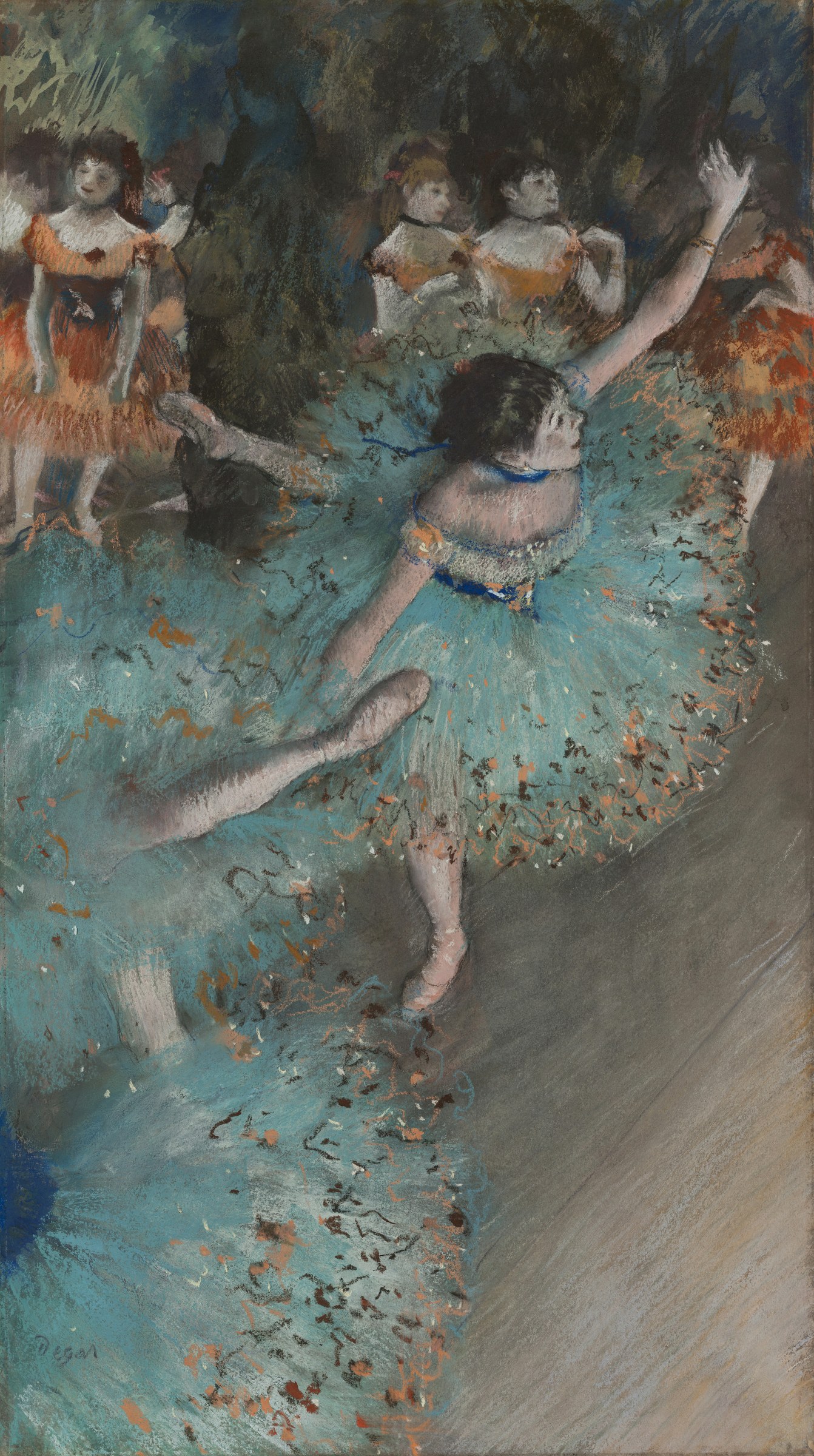
A ballet class or rehearsal captured from above, with six female dancers scattered across a turquoise stage floor marked with orange scuff marks and footprints. The composition is asymmetrical and informal: two dancers occupy the foreground in the lower portion of the canvas—one reclining or stretching with her back arched, another crouched or in a low position—while four more stand in the middle distance and background, wearing orange-trimmed practice costumes with white collars and short skirts. The dancers in the rear are caught in various poses: some with arms raised or extended, others standing at rest. The background dissolves into dark, gestural brushwork suggesting the studio wall or wings. A wooden floor or stage edge is visible at the right margin. The light is cool and theatrical, with the turquoise-painted stage contrasting sharply against flesh tones and the muted palette of the studio space beyond.
The dancing
The dancers display the informal, transitional poses typical of rehearsal or class work rather than finished choreography. The two foreground figures are notable: one extends her legs while arching backward in what appears to be a flexibility or recovery stretch; the other is deeply flexed, knees bent, in a low crouch. The standing dancers show varied arm positions—some with arms lifted or extended to the sides, suggesting they are either waiting, marking through movement, or recovering. The poses suggest a moment of pause or transition rather than a unified held position. The bodies are rendered with anatomical attention but captured in ungainly, unstaged attitudes that emphasize the working reality of the studio.
The dance depicted
This depicts a ballet class or rehearsal, most likely from the late 19th century (the era of Degas's most intensive observation of the Paris Opéra). The informal arrangement and variety of poses suggest a moment during or between exercises, not a performance. The turquoise stage floor is a specific historical detail—such floors were indeed used in 19th-century European opera houses and ballet studios. The asymmetrical composition and candid quality suggest Degas was interested in capturing the unglamorous, off-guard reality of dancers at work, consistent with his broader practice of treating ballet as a subject for close, repeated study rather than romantic spectacle. The dancers are almost certainly students or corps members at the Paris Opéra Ballet.
How it was made
Oil on canvas, worked with a loose, impressionistic handling that allows form to emerge from broad color areas and gestural marks. The turquoise of the stage dominates and unifies the composition, while Degas has built up the figures with opaque highlights—particularly the white of the collars and the pale flesh of arms and legs—creating strong visual contrast. The background is sketched in with dark tones and visible brushstrokes, suggesting either the unfinished state of the work or a deliberate choice to keep the focus on the stage and figures. The technique's economy and the work's apparent spontaneity—the scattered arrangement of figures, the unrefined edges—are consistent with Degas's practice of working from memory and sketches rather than from life, synthesizing observed moments into compositions that prioritize psychological and gestural truth over photographic accuracy.
About this work
This is an oil painting by Edgar Degas from 1877, part of his sustained investigation of ballet dancers at the Paris Opéra. The work captures a moment during rehearsal or class, with six dancers in various poses on a turquoise stage floor. Rather than celebrating ballet as spectacle, the painting records the physical reality of dancers—tired, stretching, waiting, practicing—in an informal and unsentimental way. The composition is deliberately asymmetrical and candid, suggesting Degas's fascination with catching dancers in unguarded, transitional moments rather than idealized performance positions. The title references the green-tinted stage floor, which is both a historically specific detail and a dominant formal element that organizes the entire composition.
How to look at it
Attend first to the color and composition: the turquoise floor is not incidental decoration but the organizing plane of the entire scene, and Degas's handling of its surface—marked with the wear and marks of actual use—is central to the work's claim to authenticity. Notice the poses of the dancers: none is heroic or graceful in a conventional sense. The reclining figure in the foreground is the most radical choice—a body stretched out, almost vulnerable, in a pose that no finished ballet would include. This is the studio as a space where bodies are worked, not displayed. Finally, observe how Degas has scattered the figures across the composition: there is no hierarchy, no single focal point, no narrative. Instead, the painting captures a moment of time in a room where multiple activities are happening simultaneously and independently—a fundamentally modern way of seeing.
The artist
Edgar Degas (1834–1917) was obsessed with ballet dancers for nearly fifty years, producing paintings, pastels, drawings, and prints that far exceeded any other subject in his oeuvre. He attended rehearsals and classes at the Paris Opéra, sketched constantly, and developed a practice of synthesizing observed moments into studio compositions. Unlike most artists of his era who treated ballet as spectacle or romantic fancy, Degas was interested in the unglamorous truth of dancers' bodies and labor—the sweat, fatigue, and discipline. His approach was influenced by both photography (particularly Japanese prints and their off-center compositions) and his own acute observational powers. By the 1870s, Degas had established himself as the definitive artist of ballet, a subject he returned to obsessively because it allowed him to explore movement, the female body, color, and light in infinite variation.
The period
In 1877, ballet in Paris was at the height of its institutional power and cultural prestige, with the Opéra at the center of artistic and social life. The Romantic era of ballet had passed, and the technical sophistication of dancers had advanced dramatically; dancers were increasingly workers rather than aristocratic amateurs, and professional training was rigorous and formalized. At the same time, Realism and Impressionism were challenging academic traditions in visual art, and Degas was among those artists interrogating what counted as suitable subject matter. The turquoise stage floor itself reflects a specific historical moment: such painted floors were used in European theaters during this period, and the color choice became a signature detail in Degas's ballet compositions. The painting sits at the intersection of these developments—modern painting technique applied to the modern working reality of ballet, rather than its romantic mythology.
Where it lives
The work is recorded as an oil painting from 1877 by Degas. The current holding collection is not recorded in the available catalogue information. The source for this documentation is Wikimedia Commons.
Dance in this work
Questions about this work
Why would Degas paint dancers in such awkward, unflattering poses?
Degas was committed to depicting the physical reality of dance work, not romantic fantasy. He was interested in how bodies actually move, strain, and recover—the unglamorous truth of training and rehearsal. This was a radical choice in the 19th century, when ballet was conventionally shown in idealized, performance-ready moments. By painting dancers in stretches, rests, and transitional poses, Degas elevated the studio and the working body as worthy subjects for serious art.
What is the turquoise floor, and why is it important?
This is a historically accurate detail: late-19th-century European opera houses and ballet studios used painted wooden floors, often in colors like turquoise or pale blue. For Degas, the floor becomes a formal element that organizes the composition and grounds the scene in a specific place and time. It also serves as a vivid color note that unifies the scattered figures and emphasizes the flat plane of the stage.
Is this a finished painting or a sketch?
The work is considered a finished painting, though Degas's working method blurred the distinction. He often worked from memory and sketches, synthesizing observations into studio compositions. The loose brushwork, particularly in the background, is intentional and characteristic of his approach. The apparent spontaneity and unrefined edges do not indicate incompleteness but rather a deliberate aesthetic choice.
How many paintings of ballet dancers did Degas make?
Degas produced hundreds of works featuring ballet dancers—paintings, pastels, drawings, prints, and sculptures. Ballet was his dominant subject for nearly fifty years, and he returned to it obsessively because it allowed him to explore movement, light, color, and the human figure in endless variation. No other artist of the era approached ballet with such sustained, systematic attention.
More Ballet artwork