49 works in this view — arrow keys or swipe to move between them.
Dance in Art · 1877
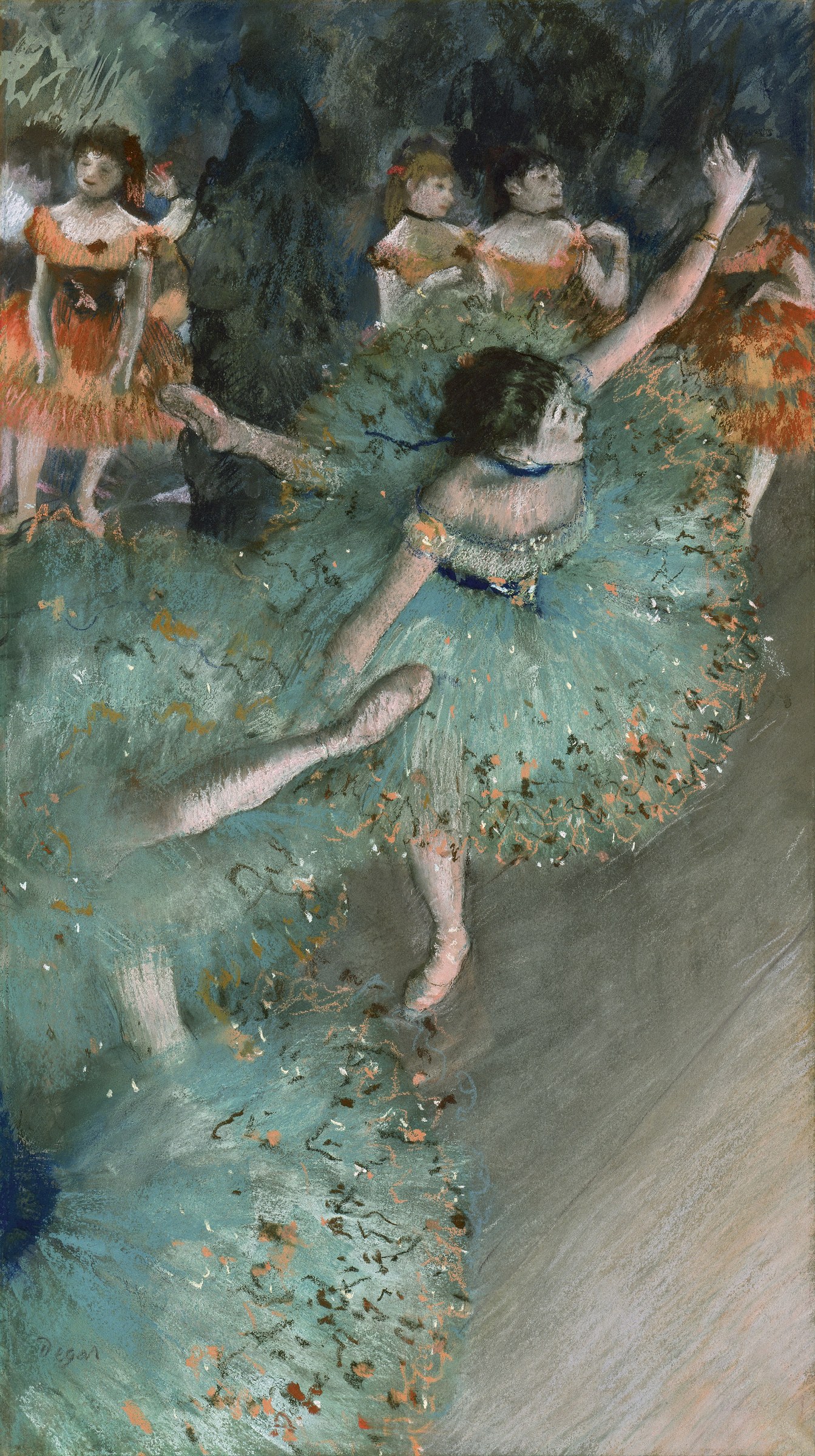
Edgar Degas - Balançant danseurs
Edgar Degas
- Medium:
- Oil Painting
- Dance:
- Ballet
- Era:
- Late 1800s (Victorian Ballroom)
- Source:
- Wikimedia Commons
- Rights:
- Public domain — free to use, share and adapt.
- Recorded as:
- Public Domain
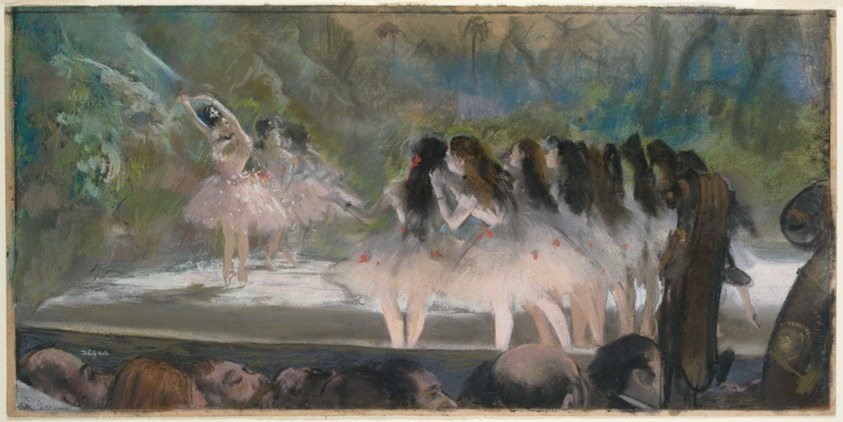
Degas is one of the very few major visual artists to make ballet a primary subject of sustained study, and his works constitute an irreplaceable archive of how ballet was actually danced and rehearsed in the nineteenth century. This painting documents not the choreography or the public performance but the ephemeral moment of rehearsal—the real labour of the theatre.
What you are looking at
A backstage or rehearsal moment at a theatre, captured from an elevated sightline as if from a box seat. Five dancers in peach and orange tutus are scattered across a blue-green stage floor, some waiting, some in motion. The nearest figure—caught mid-pirouette with one leg extended and arms raised—dominates the foreground in sharp focus, her tutu creating a halo of pale fabric. The others, further back, are partially cropped by the frame: one stands upright, another bends forward, a third raises an arm. Dark, heavily worked brushwork fills the upper two-thirds of the canvas, suggesting theatre drapery or scenery barely differentiated from shadow. The lighting is theatrical and artificial, warm on the dancers' skin and costumes, cool in the depths. The composition is radically off-balance, with most of the dancers clustered to the left and upper portions of the canvas, while the lower right is bare stage floor in tan and grey.
The dancing
The central dancer is caught mid-turn in a clear ballet position: one leg bent and lifted, the other supporting; her arms are raised and extended in a frame typical of classical ballet. Her posture shows the control and lift required of the technique. The other four dancers are in varied attitudes—standing, bending, reaching—suggesting different moments in a rehearsal or performance sequence rather than a unified choreography. The artist has rendered the dancers' bodies with anatomical precision in the faces and limbs, though the tutus and silhouettes simplify into blocks of colour. All five wear the characteristic short tutu skirts and appear to be young women or adolescents.
The dance depicted
This is unambiguously theatrical ballet, likely from the Romantic era based on the tutu style and the scale of the skirts. The scene captures a moment between choreographed movement or during rehearsal, which was a frequent subject of Degas's ballet paintings. The composition—the high viewpoint, the cropping of figures, the emphasis on the turning dancer—suggests the artist's interest in capturing the theatre as a space of labour and rehearsal rather than performance perfection. The dancers' varied poses and the casual arrangements suggest this is not a staged moment but rather a glimpse of dancers at work.
How it was made
This is oil paint on canvas, a medium that allowed Degas to build the heavily worked, almost sculptural background and to render the delicate sfumato of the dancers' skin tones against the dark stage setting. The paint handling is loose in the background but precise on the figures, with visible brushwork in the tutus and flesh tones. The technique of applying thin layers of colour and reworking the surface is typical of Degas's approach to his ballet subjects. Oil on canvas allowed for the scale and the exhibition context appropriate to a major Parisian artist of the period.
About this work
This is a snapshot of ballet rehearsal or performance backstage, one of dozens of similar subjects Degas painted from the 1870s onward. The work shows the artist's signature composition—the elevated viewpoint, the bold cropping, the asymmetrical arrangement of figures—applied to a moment of ballet labour. The five dancers in their tutus, some moving and some at rest, are rendered with anatomical knowledge and psychological acuity. The painting belongs to a major tradition of nineteenth-century art concerned with the spaces and bodies of theatrical performance, and specifically to Degas's sustained investigation of ballet as a subject that combined human movement, technical skill, feminine beauty, and the artificial light and geometry of the modern theatre.
How to look at it
Watch the pirouette. The artist has frozen the dancer mid-turn, capturing the lift and extension required to maintain balance on one leg. The positioning of her body—the turned-out supporting leg, the extended working leg, the raised arms in frame—is anatomically exact and shows that Degas understood ballet technique. Notice also how the composition uses the cropping of the other dancers to suggest the theatre as a deep space extending beyond the picture plane. The dark background is not empty atmosphere but the weight of the theatre itself—the drapery, the flies, the hidden machinery. The warm light on the dancers' flesh and pale tutus creates the sense of stage lighting, artificial and focused.
The artist
Edgar Degas (1834–1917) was a French Impressionist painter who maintained a studio pass to the Paris Opéra and painted ballet subjects obsessively from the early 1870s until his death. He approached ballet with the ethnographic eye of a social observer and the technical knowledge of someone who studied anatomy and movement intensely. Unlike many of his contemporaries, Degas was interested not in ballet as spectacle but as labour: the rehearsal room, the backstage corridor, the moment between curtains. His unconventional compositions—high viewpoints, radical cropping, asymmetrical framing—were influenced by Japanese prints and photography, and they allowed him to render movement and momentariness in ways academic painting could not. He made paintings, pastels, drawings, and sculptures of dancers, and his work became the definitive artistic record of Romantic and early modern ballet.
The period
In the 1870s, ballet was undergoing transformation in Paris. Romantic ballet—with its emphasis on pointe work, supernatural heroines, and ethereal movement—was being challenged by new choreographic ideas and by the naturalism of movements drawn from everyday life. Degas painted during this transition, and his interest in rehearsal and off-stage moments reflects a broader late-nineteenth-century artistic fascination with authenticity and the behind-the-scenes truth of modern life. His ballet paintings belong to a moment when artists were beginning to depict labour, bodies, and movement with scientific precision and without the sentimentality of earlier art. The 1877 date places this work in the height of his ballet engagement.
Where it lives
The work is recorded in the catalogue as oil on canvas dated 1877. The holding collection is not recorded in the source data. The source is Wikimedia Commons.
Dance in this work
Questions about this work
Is this a finished painting or a study?
It appears to be a finished work suitable for exhibition, given its scale, the labour of the background, and the refinement of the central figure. However, Degas often reworked paintings over years and the distinction between study and finished work is not always clear in his practice. The painting has the quality of a snapshot, which is intentional: Degas's formal strategy was to make careful compositions look like accidental glimpses.
What is the dance?
This is theatrical ballet, most likely from the Romantic repertory that was standard in Paris in the 1870s. The tutu style, the pointe work implied by the turned-out positions, and the rehearsal setting all point to classical ballet as taught and performed at the Paris Opéra.
Why do some dancers look unfinished?
The partial figures on the left and back are not unfinished but deliberately cropped by Degas's compositional strategy. This cropping—figures cut off at the edge of the canvas—was a radical formal device he adopted from photography and Japanese prints, creating the sense that we are seeing a momentary slice of an ongoing scene rather than a carefully posed tableau.
Where is this set?
The setting appears to be the stage of a theatre, probably the Paris Opéra where Degas had access. The elevated viewpoint suggests we are viewing from a box seat or the gallery, looking down at the stage and backstage area. The dark drapery above is theatre scenery or the flies.
More Ballet artwork