49 works in this view — arrow keys or swipe to move between them.
Dance in Art · 1877
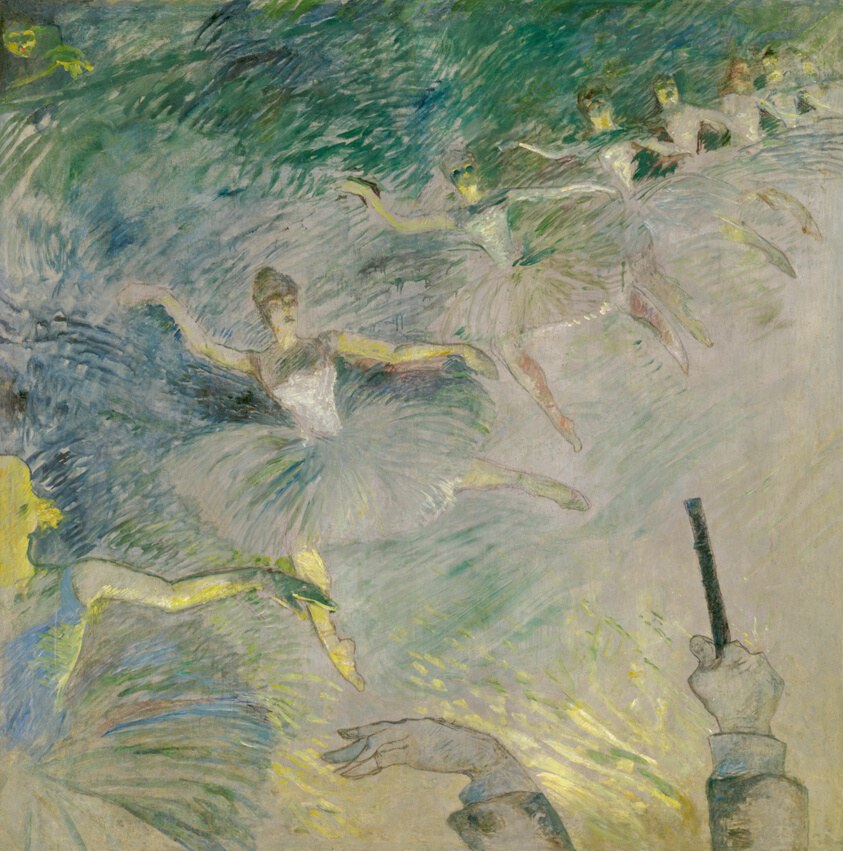
Edgar Degas - Danseuse basculant (Danseuse verte)
Edgar Degas
- Medium:
- Oil Painting
- Dance:
- Ballet
- Era:
- Late 1800s (Victorian Ballroom)
- Source:
- Wikimedia Commons
- Rights:
- Public domain — free to use, share and adapt.
- Recorded as:
- Public Domain
This work documents the Romantic ballet vocabulary—arabesque, tutu, pointe work, the display of individual virtuosity—at a moment when that vocabulary was reaching its height in European culture. For dance historians, it captures how the extreme extensions and arches of Romantic ballet were understood visually by a contemporary artist, without the flattery or idealization of official portraiture.
What you are looking at
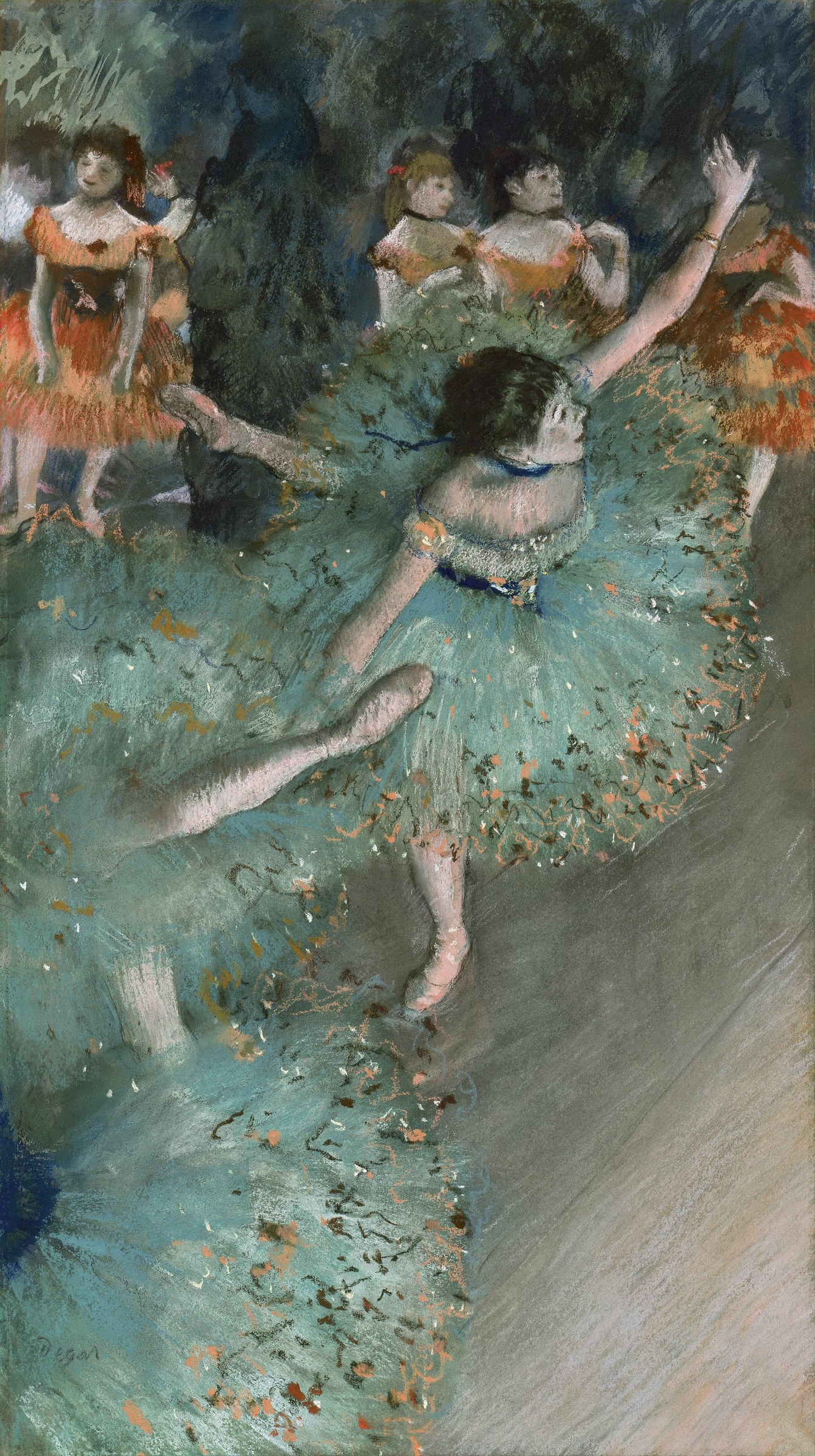
A group of ballet dancers occupies a stage or rehearsal space rendered in muted greens, browns, and grays. Five figures are visible: in the foreground, a dancer in a pale tutu performs a dramatic backbend or arabesque penché, her body arched sharply backward with one leg extended high, her pale arms creating a counterbalance. Behind her, four other dancers in orange-tinted costumes watch or wait, some gesturing, their poses suggesting conversation or instruction rather than synchronized performance. The setting is atmospheric and loosely rendered, with gestural brushwork suggesting architectural elements—perhaps a wall or backdrop—that fades into shadow. The light is diffuse, catching the pale flesh tones and the shimmer of the tutus, while the background remains deliberately murky and undefined.
The dancing
The central figure demonstrates a extreme port de bras and extension characteristic of classical ballet: a deep backward arch with a raised arabesque leg, the torso inverted almost to horizontal, supported by two straight arms. The supporting dancers behind her are rendered less precisely, in looser poses suggesting waiting, conversation, or observation rather than formal positions. None of the figures appear to be in closed holds or partnered embrace; the relationship is observational, suggesting a rehearsal or moment of individual display watched by colleagues.
The dance depicted
This depicts classical ballet, most likely Romantic ballet of the mid-to-late nineteenth century, based on the tutus, pointe work implied by the leg extension, and the vocabulary of the arabesque penché. The title 'Danseuse basculant' (tilting or tipping dancer) refers precisely to the backbend or tilt shown here—a dramatic moment of technical display. The scene appears to show a dancer mid-rehearsal or mid-performance while others observe, capturing a moment of individual virtuosity rather than ensemble work. The informality of the surrounding figures suggests this may be a rehearsal or backstage moment rather than a formal stage scene.
How it was made
Oil painting with pastel-like surfaces and blended brushwork, characteristic of Degas's late work in this medium. The visible pentimenti and loose handling allow the artist to capture transient movement and light effects—the shimmer of fabric, the play of stage light on flesh and costume—without the precision demanded by line-based media. This technique, which blurs forms and emphasizes atmosphere over anatomical clarity, suited Degas's interest in the dancer's body at a moment of extreme exertion, when formal beauty dissolves into strain.
About this work
This is a Romantic-era ballet scene by Degas, probably from the 1870s, showing a soloist in an extreme arabesque penché—a tipping backward arch—while fellow dancers observe or wait in the background. The painting captures not the formal grandeur of ballet performance but the raw physical demand of the form: the arched spine, the held extension, the witnessing of technical display by peers. Degas painted ballet dancers many hundreds of times across his career, and this work exemplifies his mature method: loose, atmospheric handling of paint; an off-center composition with figures at different scales; the choice of a moment of effort or transition rather than balletic perfection.
How to look at it
Attend first to the spine of the main figure: the extreme arch, the commitment of the entire body to a single gesture, and the visibility of effort in that commitment. Note that the other dancers are not posed in the formal lines of classical ballet but seem to be standing, gesturing, observing—suggesting that Degas has caught a moment outside the performance frame. The color palette—greens and browns rather than the bright light of theater—suggests backstage or rehearsal rather than public presentation. The loose brushwork means that detail emerges where the light catches the body, and dissolves into shadow elsewhere; this technique, borrowed from photography and Impressionism, creates a sense of movement and transience even in a still image.
The artist
Edgar Degas (1834–1917) was a French painter and printmaker who made ballet dancers a major subject from the 1870s onward. Unlike many artists, he attended rehearsals and had access to backstage spaces at the Opéra Garnier in Paris, giving him an unusual depth of observation. He was not interested in depicting the finished performance or the public fantasy of ballet, but rather the labor, the strain, the waiting, and the informal moments between performances. His technique—loose, gestural, sometimes unfinished-seeming—was well suited to capturing movement and light in ways that tighter academic painting was not.
The period
In the 1870s, Romantic ballet was still a dominant form in Parisian culture, though it was beginning to be challenged by more realistic dramatic forms and by new music-hall entertainment. The Opéra Garnier had opened in 1875, and ballet was a major draw for the wealthy subscribers who visited. At the same time, Impressionist painters were beginning to question academic conventions of composition and finish; Degas, though often grouped with Impressionists, maintained stronger connections to drawing and structure. The ballet studio and backstage became a space where avant-garde artists could explore movement, light, and the unidealized body—themes that connected to broader late-nineteenth-century interests in modernity and authenticity.
Where it lives
Sourced from Wikimedia Commons. The record does not specify a holding collection or accession number.
Dance in this work
Questions about this work
What is the dancer doing?
The central figure is performing an arabesque penché, an extreme extension of the working leg while the torso arches backward—one of the most demanding positions in classical ballet. The title translates as 'tilting dancer,' referring to this backward tilt. It is a moment of high technical display, held briefly for effect.
Is this a performance or a rehearsal?
The informality of the surrounding dancers—their varied poses, their apparent conversation—suggests a rehearsal or backstage moment rather than a formal stage scene. Degas was unusual among artists in having access to backstage spaces and rehearsals at the Paris Opéra, and he often chose to paint these informal moments over the finished public performance.
What period of ballet is this?
Romantic ballet, mid-to-late nineteenth century. The costume (tutu), the vocabulary (arabesque, pointe), and the style of composition all place it in the era of classical-Romantic ballet that dominated European culture from roughly 1830 to 1890.
Why is the painting so loosely painted?
Degas's loose, blended brushwork and atmospheric handling served his interest in capturing movement, transience, and light effects without academic precision. This technique also reflected broader late-nineteenth-century experiments with Impressionism and photography in art, and suited the unidealized, backstage subject matter.
More Ballet artwork