49 works in this view — arrow keys or swipe to move between them.
Dance in Art · 1895
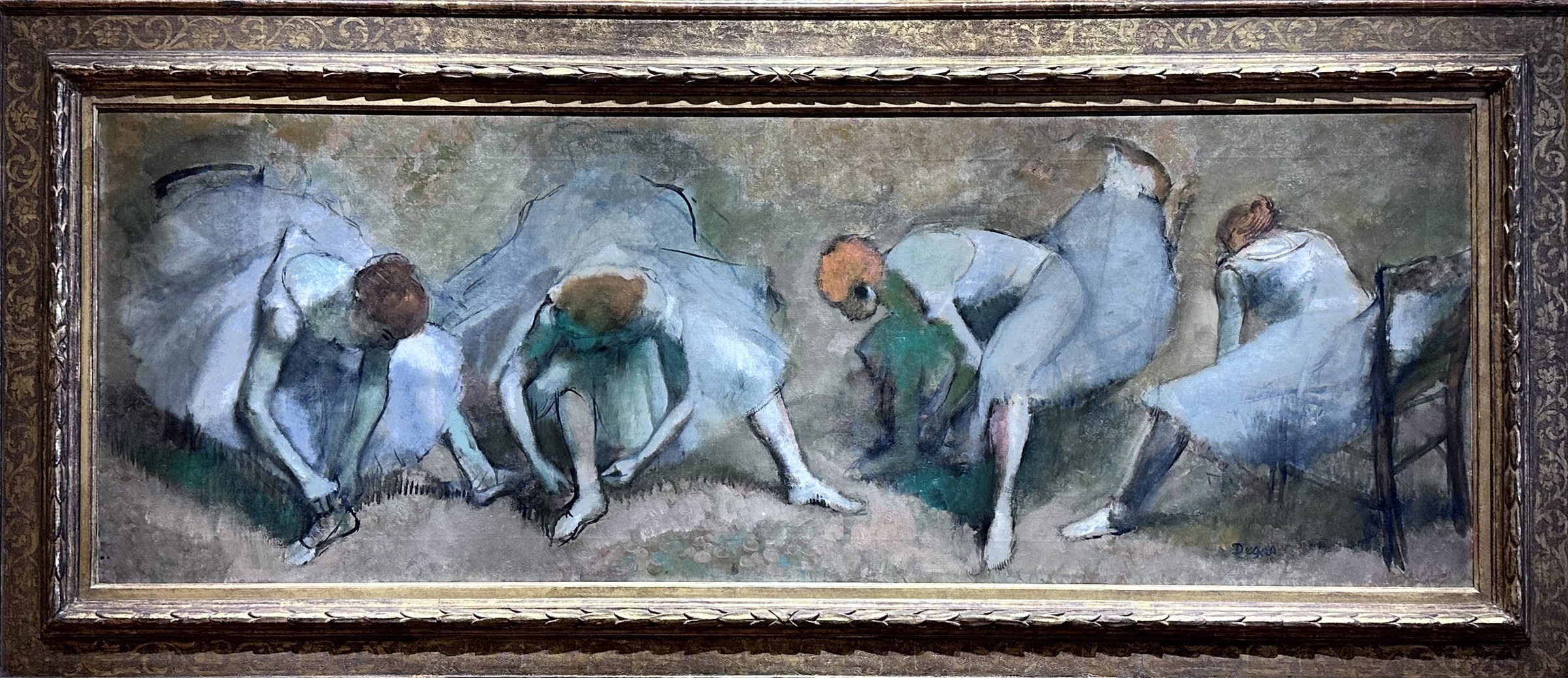
Frieze of Dancers by Edgar Degas
Edgar Degas
- Medium:
- Oil Painting
- Dance:
- Ballet
- Era:
- Late 1800s (Victorian Ballroom)
- Source:
- Wikimedia Commons
- Rights:
- Public domain — free to use, share and adapt.
- Recorded as:
- Public Domain
Degas's late-career ballet paintings fundamentally changed how artists depicted dancers: not as ethereal creatures in tulle, but as athletes and laborers. This image, in its focus on the informal moment and the individual body at work, was influential in establishing the studio, rehearsal, and backstage as legitimate subjects for serious painting. For dance historians, it is evidence of how professional ballet training actually looked in the 1890s, and for how attitudes toward the dancers' own experience—rather than the spectator's fantasy—were beginning to shift.
What you are looking at
Five female dancers in pale blue or white tutus are arranged in a loose frieze across a neutral, mottled ground. They are caught in a moment of informal, almost rehearsal-like activity rather than a staged performance. From left to right, the figures bend, stretch, and adjust themselves in attitudes of preparation or rest—some bending forward at the waist with hands reaching toward the floor, others twisting or turning slightly. The paint is applied loosely, with visible brushwork and a palette of pale blues, whites, greens, and warm flesh tones set against a cool gray-beige background. The composition is horizontal and intimate, suggesting a backstage or studio moment rather than the formality of the stage. The women's bodies are rendered with careful attention to musculature and the particular angles of fatigue or focus—this is a painter interested in what dancers actually do between moments of display.
The dancing
The five dancers occupy distinct positions without a unified formation or facing. The figure second from left bends deeply forward with an arched back, her arms extended downward in a stretch; the third figure (center-left) is twisted at the torso, head down; the central figure stands more upright but still bent forward; the fourth leans to one side with one leg extended or lifted; the rightmost figure also bends forward. None of them appear to be holding a closed ballroom frame, and there is no corps-de-ballet uniformity of line. Instead, each body expresses an individual moment of physical work, strain, or release. The poses suggest flexibility and control, but not the formalized positioning of classical ballet in performance.
The dance depicted
The catalogue identifies this as ballet, and the tutus and the artist's identity confirm a ballet context. However, the scene is not a moment from a classical ballet narrative or a stage performance. Instead, it appears to depict ballet dancers in a rehearsal or warm-up state—what in French academic painting of the late 19th century became a distinct subject: the coulisse, or the studio/backstage space where dancers prepared and rested. The informal, asymmetrical arrangement and the focus on individual bodily effort rather than choreographed unity is consistent with Degas's repeated interest in the actual labor and physicality of dance rather than its theatrical fantasy. These are not Giselles or Sylphides; they are working dancers, captured in a moment of non-performance.
How it was made
Oil on canvas, as recorded. The painting technique is painterly rather than linear: Degas builds form through color and brushwork, with soft edges and a luminous pale ground. The composition is clearly arranged as a frieze—a horizontal band of figures—but the execution is loose and impressionistic, far from neoclassical precision. This suggests a work made for a private or salon audience rather than as a public mural or large academic exhibition piece. The looseness of handling and the intimacy of scale place it in Degas's later practice, when he worked increasingly from memory and imagination rather than from studio observation.
About this work
This is an oil painting by Edgar Degas depicting five ballet dancers in informal, preparatory poses—the kind of moment almost never celebrated in official ballet imagery of the period. Rather than the ethereal and rigidly composed dancers of Romantic ballet, Degas shows actual human bodies at work: stretching, bending, adjusting. The frieze composition is derived from classical art, yet the subject matter—the backstage reality of professional dance—was radical for its time. The painting sits within Degas's sustained artistic project to demythologize ballet and insist on the bodily reality beneath its fantasy. It is a work that belongs equally to art history and dance history: a turning point in how artists saw dancers, and how dancers have come to see themselves in representation.
How to look at it
Pay attention to the variety in the poses—Degas does not repeat a single elegant attitude, but instead shows the dancer's body as fluid and responsive to the moment. Notice the weight distribution in each figure: some are entirely bent forward, others are twisted; some seem to be stretching, others seem almost exhausted. The coloring, too, is key: the pale blues and whites of the tutus are not crisp or artificial, but soft and even dingy, lit by studio light rather than stage light. Look at the faces, which are small and often obscured or turned away—this is not a portrait of beauty, but a study of physical presence. The frieze composition echoes classical art, but the informality and asymmetry of the poses pulls against that classical order.
The artist
Edgar Degas (1834–1917) was obsessed with ballet for nearly five decades. Beginning in the 1870s, he attended rehearsals at the Paris Opéra and produced hundreds of paintings, pastels, prints, and sculptures of dancers. Unlike Romantic-era artists who painted ballet as otherworldly spectacle, Degas was interested in rehearsal, fatigue, the stretch, the adjustment of dress. He had unprecedented access to the backstage and studio spaces, and he used that access to create a new visual language for the dancer's actual life. His late works, made often from memory and with looser, more impressionistic technique, are among his most radical: they strip away narrative and decorum to focus on the body as a site of work and grace.
The period
In the 1890s, ballet was in transition. The great age of Romantic ballet—with its stories of sylphs and spirits—was giving way to a more eclectic repertory. Russian Imperial ballet was rising in prestige, and the training methods and physical vocabulary of dance were becoming more rigorous and more discussed in artistic circles. At the same time, Impressionism and Post-Impressionism had shifted visual culture toward the informal, the fleeting, and the backstage. Degas's ballet paintings were part of this double movement: documenting the actual labor of dance at the exact moment when that labor was becoming more standardized and more visible to artists and critics.
Where it lives
The painting is recorded as held by the Cleveland Museum of Art, though this is not verified in the current record. The source is noted as Wikimedia Commons. Degas's ballet works are in many major museums, and many are undated or dated only to his late period (1880s–1910s).
Dance in this work
Questions about this work
Is this a scene from a specific ballet?
No. This is a rehearsal or backstage moment, not a scene from a narrative ballet. Degas was interested in the actual work of dancers, not in illustrating specific ballets. The absence of props, sets, or other dancers suggests we are seeing a private moment of preparation or rest.
Why are the dancers so informal and asymmetrical?
Degas was deliberately moving away from the rigid, idealized poses of academic ballet painting. By showing dancers in individual, unstaged moments—stretching, bending, turning—he was documenting the real physicality and effort of dance. This was a new subject in art, and it required a new visual language.
What kind of ballet training does this show?
The poses suggest classical ballet training: the deep forward bends, the turned-out legs, the stretched spines. But the context—backstage, informal—shows that this training was rigorous and constant, not just performed on stage. These dancers are working, not performing.
Why did Degas paint dancers so often?
Degas had unprecedented access to the Paris Opéra's rehearsal spaces, and he was fascinated by the combination of physical discipline, grace, and human effort. He saw ballet as a subject that revealed the body in its most demanding and expressive state. For Degas, the dancer was the ideal subject for modern art.
More Ballet artwork