49 works in this view — arrow keys or swipe to move between them.
Dance in Art · 1895
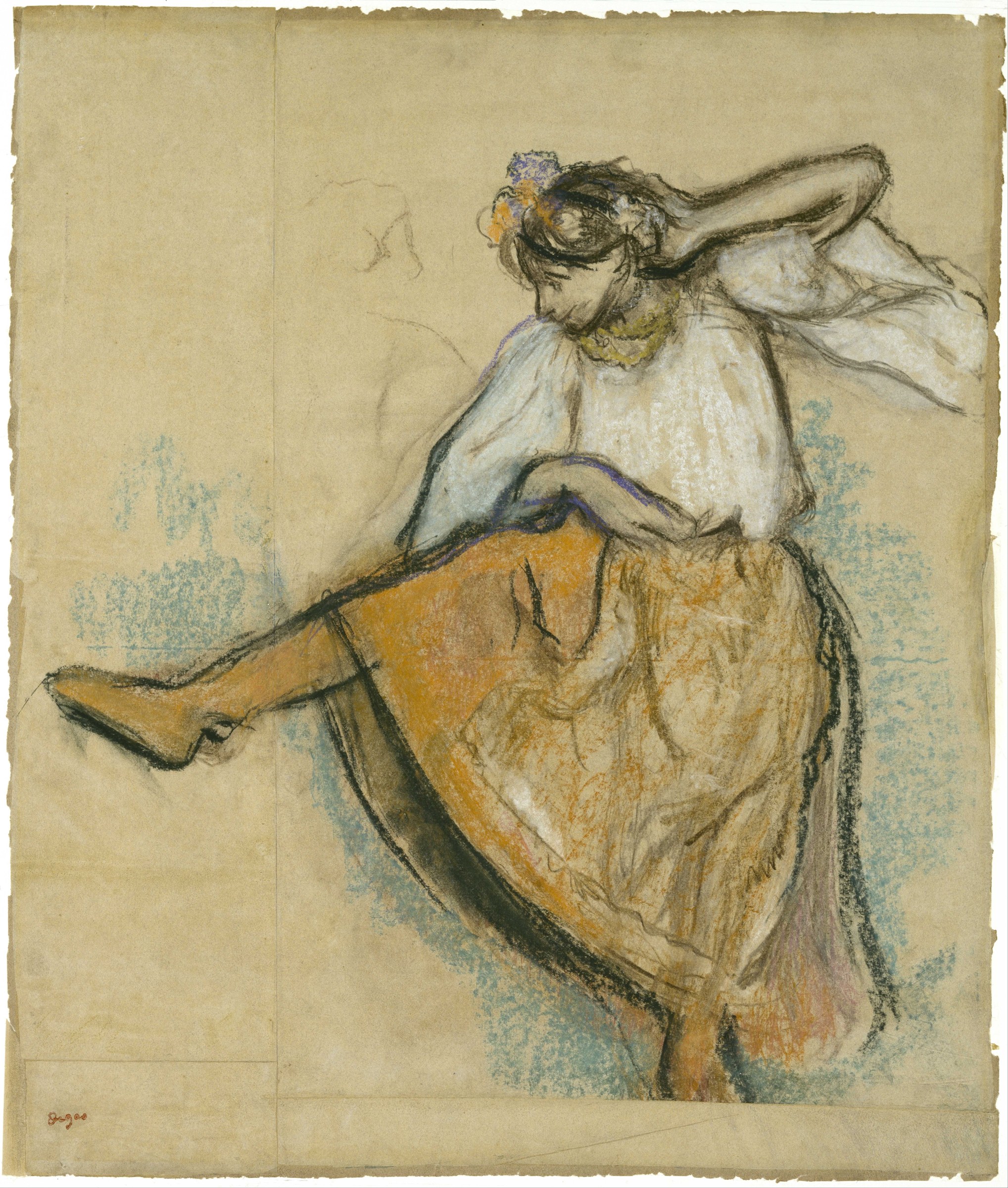
Edgar Degas - The Russian Dancer
Edgar Degas
- Medium:
- Oil Painting
- Dance:
- Ballet
- Era:
- Late 1800s (Victorian Ballroom)
- Source:
- Wikimedia Commons
- Rights:
- Public domain — free to use, share and adapt.
- Recorded as:
- Public Domain
For a dance historian, this work is evidence of how a major artist understood and valued the Russian ballet of its era—not as a formal court tradition but as living, dynamic performance. For a dancer, it demonstrates how an observant artist can capture the essential mechanics of movement through selective detail and energetic line.
What you are looking at
A single female dancer is captured mid-movement against a pale, aged paper ground. She wears a white blouse with puffed sleeves and a golden-brown skirt that swings outward, caught in the moment of a turn or leap. Her dark hair is pinned up and adorned with blue and yellow flowers or ribbons. The figure is rendered with loose, confident linework in charcoal or similar medium, with selective color applied in pastels—blue for the hair ornament, ochre and tan for the skirt, flesh tones for the face and exposed arm. Her body is angled dynamically, one leg extended, the torso twisted, suggesting rapid movement. The artist has left much of the paper bare, with only gestural hatching in blue-green suggesting shadow or ground beneath her. The technique is sketch-like and immediate, capturing the essence of motion rather than photographic detail.
The dancing
One dancer, rendered alone in three-quarter view. Her weight appears to shift onto a bent supporting leg while the other leg extends or lifts. The extended arm reaches across her body; the other arm is raised. Her torso is twisted and off-vertical, a posture characteristic of turning or traveling movement. The quick, assured line-work and the flow of the skirt suggest the artist was describing rapid rotation or elevation rather than a static pose.
The dance depicted
This appears to be a study of a Russian Imperial dancer, likely a soloist from the late 19th century. The pose and costume suggest classical ballet vocabulary, but the informal, almost improvisational quality of the sketch—and the muscular, working position of the body—may indicate a Russian dancer's style. The lack of rigid turnout and the dynamic extension suggest Russian ballet training of the period, which differed from the more formal Cecchetti method. The dancer is shown mid-phrase, in a moment of active performance rather than a posed demonstration.
How it was made
This is a mixed-media work on paper: charcoal or graphite line drawing combined with pastel or chalk in selective areas. The technique allows rapid notation of movement while the selective color—applied to the skirt, hair ornament, and face—draws the eye to the dancer's identity and the key elements of her costume. The sketch-like quality suggests this may be a study from life or memory, a working drawing rather than a finished exhibition piece. This approach was characteristic of Degas's interest in capturing dancers in unguarded moments.
About this work
This is a sketch of a Russian Imperial dancer in classical ballet attire, rendered by a major 19th-century painter in a mixed-media technique that prioritizes the capture of living movement over decorative finish. The work belongs to a sustained body of work by Degas on dancers and performance, in which he explored how the human body moves, how costume frames that movement, and how drawing itself can convey the immediacy of gesture. The title suggests a specific performer or a specific national tradition—the Russian dancer was an exotic and prestigious figure in Paris during the 1890s, when Russian Imperial ballet was beginning its ascendancy in European artistic consciousness. This sketch records not a posed moment but a passage through space.
How to look at it
Attend to the moment Degas chose: not a static pose but a passage, with the body twisted and off-balance in a way that suggests rapid turning. Notice how little is finished—the paper is mostly bare, the face is barely modeled—yet the dancer is unmistakably alive and in motion. The selective color (the golden skirt, the blue hair ribbon) directs attention without cluttering the image. The quick, assured line is not careless; it is precise in capturing the angle of the body and the flow of cloth.
The artist
Edgar Degas (1834–1917) spent much of his career documenting ballet dancers in Paris, particularly at the Opéra. He attended rehearsals, made numerous studies, and created paintings, pastels, and sculptures of dancers in all states of preparation and performance. His interest was anatomical and kinetic rather than romantic; he sought to understand how bodies moved and how costume affected that movement. Late in his career, as his eyesight declined, his line became looser and his color more expressive. This work, dated 1895, falls within that later period.
The period
The 1890s saw the rise of Russian Imperial ballet's international profile. Sergei Diaghilev's Ballets Russes would debut in Paris in 1909, but already in the 1880s and 1890s, Russian dancers and Russian methods were becoming known and admired. Degas, who had documented Parisian opera ballet for decades, would have been aware of this shift. In French art, there was sustained interest in exoticism and in non-Western or peripheral European performance traditions. At the same time, the sketch as a finished work—rather than a study toward a larger canvas—was gaining prestige among avant-garde artists.
Where it lives
The work is sourced from Wikimedia Commons. No holding collection is recorded in the catalogue.
Dance in this work
Questions about this work
Who was the Russian dancer Degas depicted?
The catalogue record does not name the specific performer. Degas made studies of many dancers from different companies and nationalities. Without further archival documentation, the identity remains uncertain.
Why did Degas draw dancers so often?
Degas was obsessed with the problem of representing movement and the human form in motion. Dancers provided him with subjects in whom movement was disciplined, repetitive, and observable. He attended rehearsals where he could study the same gestures many times.
Is this a finished work or a sketch?
It occupies a middle ground. The linework is assured and complete; the color is selective and partial. By late 19th-century standards, it is a legitimate finished work, though not as laboriously detailed as academic painting would have required. Degas often showed such works publicly.
What makes this ballet rather than another dance?
The costume (pointe-appropriate skirt, ballet slipper visible on the extended foot), the turnout and extension, and the pose itself all belong to classical ballet vocabulary. The sketch style and the dynamic off-vertical torso suggest Russian ballet's emphasis on movement quality.
More Ballet artwork