49 works in this view — arrow keys or swipe to move between them.
Dance in Art
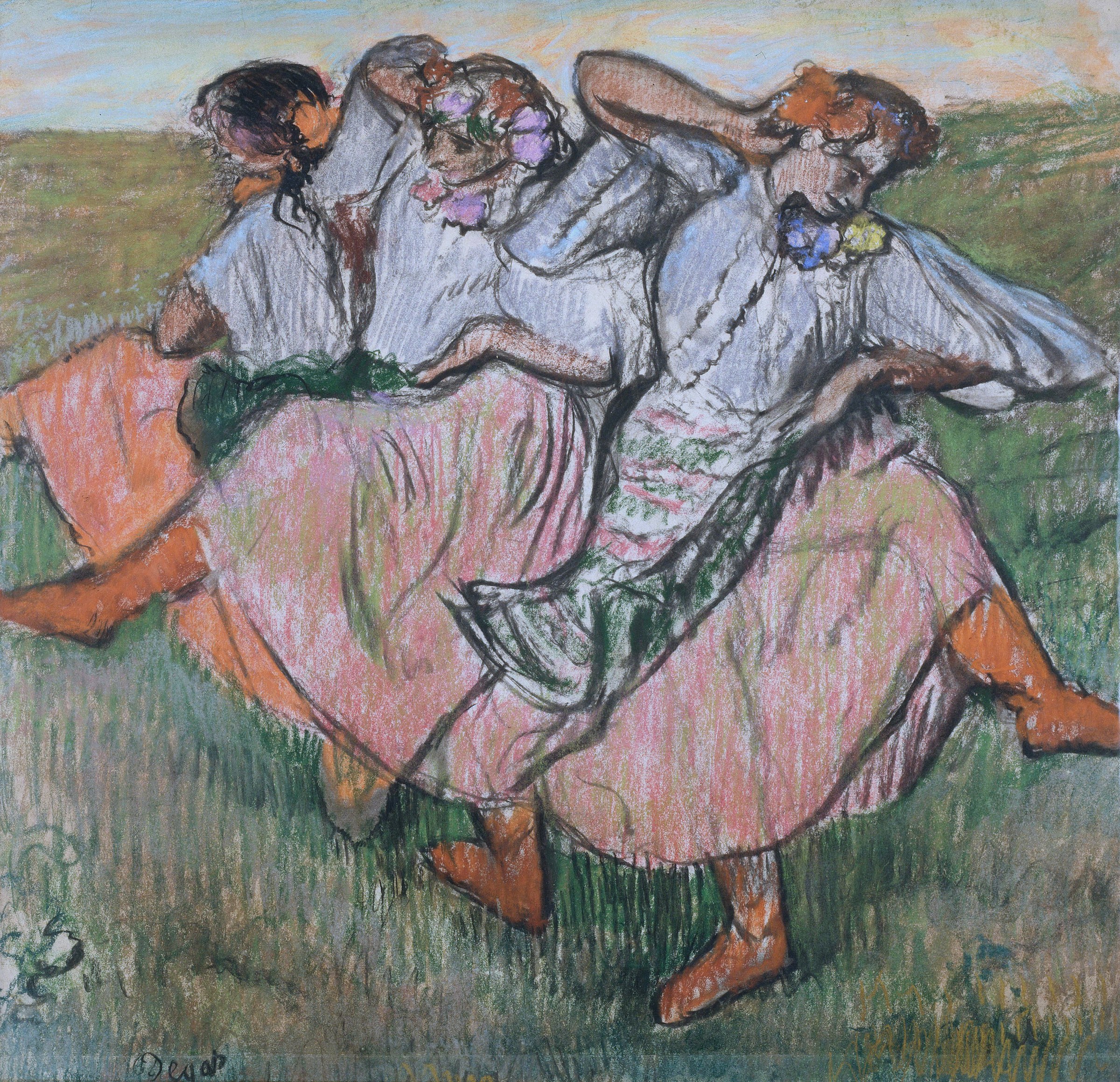
Three Russian Dancers, by Edgar Degas
Edgar Degas
- Medium:
- Pastel
- Dance:
- Ballet
- Source:
- Wikimedia Commons
- Rights:
- Public domain — free to use, share and adapt.
- Recorded as:
- Public Domain
This work exemplifies Degas's revolutionary conviction that the most revealing dance imagery came not from the stage but from the studio and rehearsal room. For historians and dancers alike, it offers evidence of how Romantic ballet technique was actually practiced by the late 19th century, and it demonstrates how modernist artists were finding new aesthetic and social significance in the private, unglamorous work of dancers.
What you are looking at
Three women in pale blue chemises or practice garments dance together in an open meadow or field rendered in soft greens and tans. They are captured mid-movement, their bodies leaning and swaying in concert, their dark hair loosened and flowing. Each woman wears a colored skirt—coral, pink, and mauve—beneath the blue upper garments, with bare or stockinged legs and what appear to be soft shoes or slippers in orange-brown. The figures overlap and intertwine; the woman on the left reaches or gestures with one arm while turning her head, the central dancer's arms are raised and extended, and the rightmost dancer leans back with arms swept wide. The composition is compressed and intimate despite the outdoor setting, with all three figures crowded into the lower two-thirds of the canvas. The landscape behind them is sketchy and atmospheric—soft blue-green fields receding into a hazy horizon—rendering the dancers' bodies and the immediate moment far more vividly than any environmental detail.
The dancing
The three dancers are in close spatial relationship, their bodies neither in formal hold nor entirely independent. Their weight appears shifted and mobile; they are caught in the act of turning and swaying rather than in any fixed position. The nearest dancer (left) inclines her torso and extends her gaze, while the central figure holds her arms aloft in an open, expressive frame. The rightmost dancer's back curves in a deep lean, her arms flung outward in an attitude of release. The footwork is not clearly legible, but the overall carriage is fluid and unfixed—these are bodies in motion rather than executing precise positions.
The dance depicted
The painting does not depict any codified dance style but rather captures an informal or rehearsal moment, likely among dancers training in classical technique. The pale practice garments, the meadow setting removed from a theatre stage, and the exploratory quality of the poses suggest a moment of study or artistic development rather than performance. The title's reference to 'Russian dancers' may indicate these are students from or practitioners of Russian Imperial ballet schools or companies, which by the 1880s were influential across Europe. The gesture and posture echo elements of Romantic ballet vocabulary—the raised arms, the tilted head, the lightness of bearing—but used here in a contemplative or experimental mode rather than within a narrative.
How it was made
Pastel on paper, a medium Degas favored and mastered. Pastel allowed him to build color through layering and blending while retaining sharp, decisive marks—visible especially in the dark contour lines defining the figures' limbs and the blue garments. The technique enabled him to capture the dancers' flesh tones with remarkable subtlety and to render the shimmering quality of movement and fabric. Pastel's immediacy and portability made it ideal for studio work and the kind of closely observed studies Degas produced throughout his career, and its velvet finish and rich color range suited the intimate scale and soft outdoor light of this composition.
About this work
This is a pastel study of three young women in practice dress, likely dancers, moving together in an open field. The work belongs to Degas's sustained investigation of the rehearsal and private moments of ballet dancers, a subject he pursued across five decades. Rather than depicting a staged performance or a named choreographic work, it captures an ephemeral moment of artistic exploration—the kind of private labor that rarely appeared in official ballet imagery of the period. The painting is at once a formal composition concerned with line, color, and spatial relationships and a document of how dancers actually trained and moved when no audience was watching.
How to look at it
Notice how Degas has chosen to freeze the dancers not at a moment of technical precision or display but in a moment of transition—turning, swaying, exploring. The overlapping bodies and the cropped, informal composition give the sense of a glimpse rather than a staged view; you are positioned as if you have entered the studio unannounced. Pay attention to the treatment of the hands and arms: they are not held in classical positions but are expressive and individualized, each dancer's gesture differing from the others. The soft, broken color of the pastel—the way the blues and pinks and ochres blend and shimmer—conveys not just the appearance of fabric and skin but the sense of living, moving bodies.
The artist
Edgar Degas (1834–1917) made dancers the primary subject of his art from the 1870s onward, producing thousands of drawings, pastels, and paintings of ballet classes, rehearsals, and performances at the Opéra in Paris. Unlike many of his contemporaries, he attended rehearsals and classes rather than only sketching from the wings during performances, and he worked from drawings and memory in the studio rather than plein air. His treatment of dancers was unsentimental and focused on the ungainly, muscular, often exhausted realities of training. Pastel became his signature medium for dancer subjects in his later decades, allowing rapid notation and luminous color.
The period
By the 1880s, when this work was likely made, European ballet was in transition. The great age of Romantic ballet (1830s–1860s) had passed, and Russian Imperial Ballet, under directors like Marius Petipa, was becoming the dominant force in classical technique and choreography. Degas's interest in Russian dancers reflects this shift in ballet's center of gravity. In art, Impressionism and its aftermath were fragmenting Academic conventions; artists like Degas were finding new subjects and new ways of framing the human body. The studio and rehearsal had become legitimate subjects for serious art—a democratization of subject matter that paralleled broader social changes in how work and leisure were represented.
Where it lives
The work is recorded as pastel on paper, 62 × 67 cm, signed in the lower left by Degas. It is held in an unspecified collection (not recorded in the available catalogue entry) and was consulted via Wikimedia Commons, suggesting it is in a public collection with digital access.
Dance in this work
Questions about this work
Are these real Russian dancers or imagined ones?
The catalogue record identifies them as 'Russian dancers,' but the title may be Degas's or a later attribution—we cannot confirm from the image alone. They wear practice garments typical of late 19th-century ballet training across Europe. Russian ballet was indeed prominent during this period, and Degas knew dancers from Russian companies working in Paris, but the specific identities of these three women are not recorded.
Why did Degas paint dancers so obsessively?
Degas was fascinated by the ballet as a site of modern labor and disciplined bodily practice. The dancers represented to him a distinctly modern subject—young women at work, in unglamorous conditions, developing strength and skill. The ballet also allowed him to study the human body in movement and at odd angles, in ways that Academic tradition did not encourage.
Is this a finished work or a sketch?
Degas often did not distinguish sharply between sketch and finished work. This pastel appears complete as a composition and is signed, which suggests he considered it finished, but it retains the immediacy and directness of a study. Many of his pastels occupy this middle ground between rapid notation and fully resolved artwork.
What was pastel used for in Degas's time?
Pastel was traditionally associated with quick studies and preparatory work, but Degas elevated it to a fine-art medium in its own right. He built his pastels in layers, sometimes using fixative between layers, and treated them with the scale and ambition of paintings. The medium's vivid color and immediate mark-making suited his interest in capturing movement and the effects of stage and studio light.
More Ballet artwork