49 works in this view — arrow keys or swipe to move between them.
Dance in Art · 1879
Edgar Germain Hilaire Degas 006
Edgar Degas
- Medium:
- Oil Painting
- Dance:
- Ballet
- Era:
- Late 1800s (Victorian Ballroom)
- Source:
- Wikimedia Commons
- Rights:
- Public domain — free to use, share and adapt.
- Recorded as:
- Public Domain
This painting is essential for understanding how ballet was actually experienced in the 19th century—not on stage in costume and makeup, but in the studio at work. It captures the body type, the costume conventions, the pedagogical structure, and the social hierarchies of Romantic ballet at its height. For dance historians and dancers, this is primary documentary evidence of training practices, physical standards, and the everyday reality behind the theatrical illusion.
What you are looking at
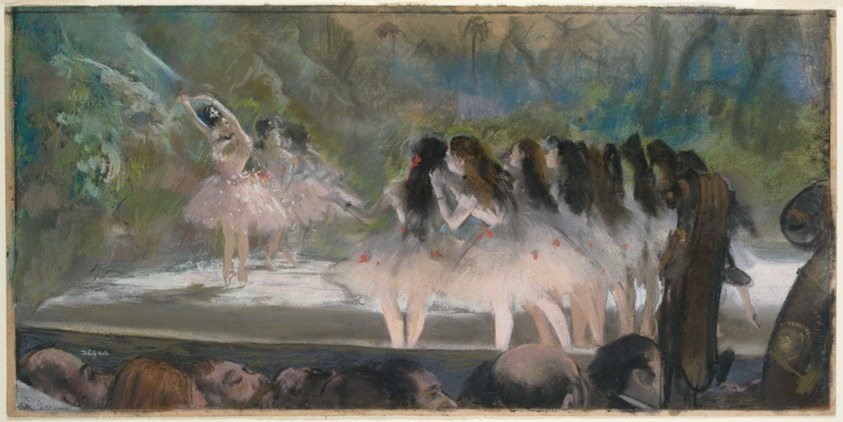
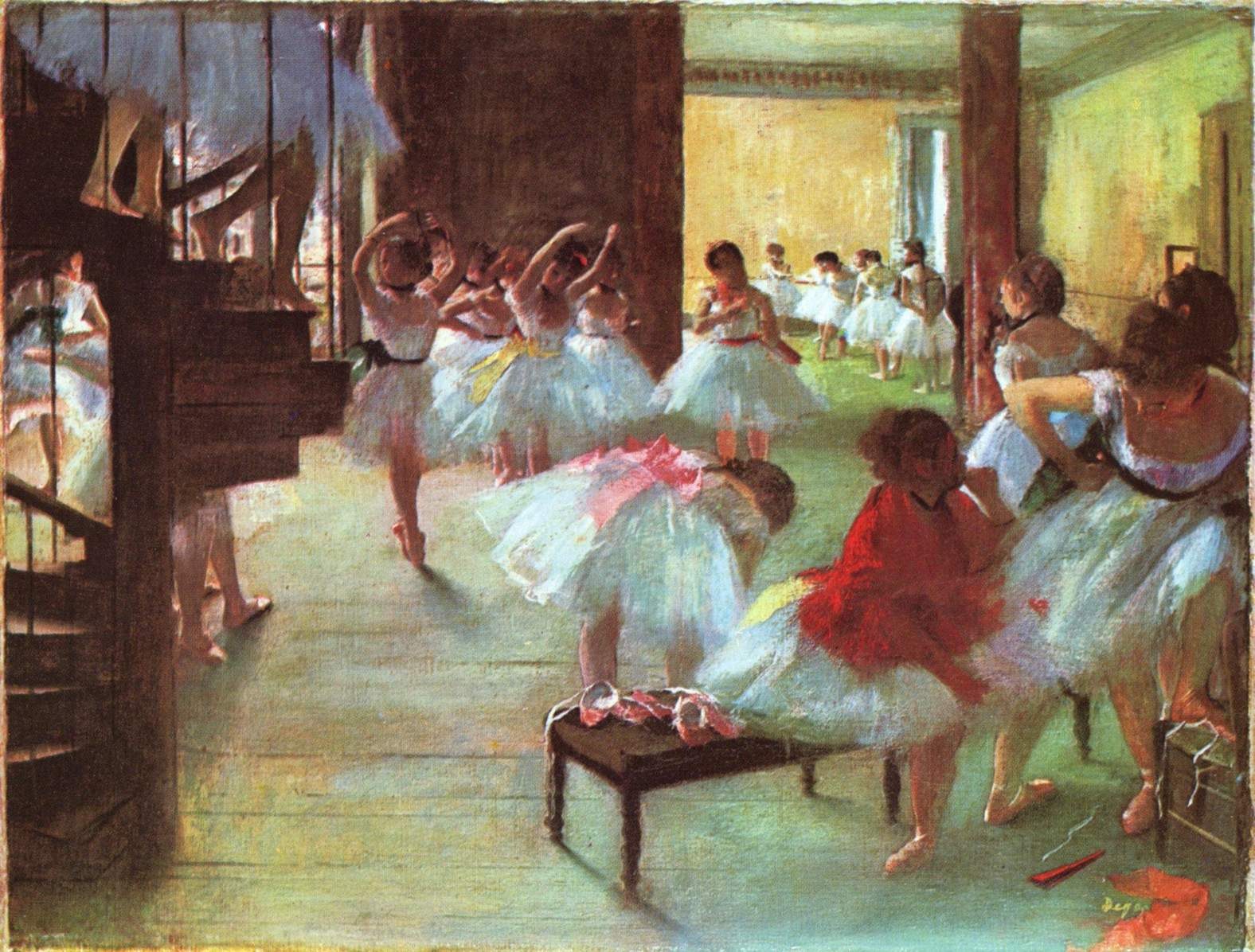
A ballet class or rehearsal observed from the wings, painted in warm earth tones and soft greens. The studio is divided into two connected rooms: in the foreground, a group of young dancers in pale blue tutus with pink accents stand or turn while being watched by seated figures in dark clothing on the right, likely teachers or visitors. In the background, a taller passage lined with pillars opens to a brighter, yellower space where additional dancers in similar costumes continue their work. The light falls from the left, creating strong shadows and lending theatrical depth to the interior. In the immediate foreground, a dark wooden bench and scattered red ribbons or fabric suggest the casual disorder of an active studio. The composition captures the mixture of focus and waiting that characterizes ballet training—some dancers actively engaged in movement, others pausing or observing, all within the formality of the institutional space.
The dancing
The dancers are predominantly in an upright, elongated posture typical of ballet training. Most visible are several figures in profile or three-quarter view, wearing classical tutus and pointe shoes, with arms raised or extended in positions that suggest formal training exercises. The nearest dancer in the foreground left displays a raised leg and extended arms—likely an arabesque or attitude derrière. The young figures are uniformly slender and long-limbed, posed with the balletic extension and turnout characteristic of mid-to-late 19th-century academic ballet. The seated observers maintain formal posture, underscoring the hierarchical structure of the studio.
The dance depicted
This is a rehearsal or class scene of Romantic or Classical ballet as taught and performed in a professional European studio in the mid-to-late 19th century. The dancers' pale tutus, pointe work, and the formal linear arrangement of bodies indicate this is high academic ballet, likely depicting either a rehearsal for a Paris Opéra production or an instructional session. The presence of multiple youth dancers, the pedagogical arrangement, and the monitoring by seated figures suggest this captures the daily reality of ballet training and company preparation rather than performance itself. The style and technique visible—the elevation, the arm positions, the turned-out stance—are consistent with the Romantic or early Classical ballet repertoire that dominated European stages during this period.
How it was made
Oil painting on canvas (as stated in the record). The artist employs a soft, diffused brushwork and a muted palette dominated by ochres, pale blues, and warm browns that creates a sense of observed intimacy rather than formal documentation. The light is deliberately theatrical, raking across the space to emphasize depth and the sculptural quality of the dancers' bodies. This painting technique—fluid, atmospheric, capturing the transient quality of movement—was characteristic of mid-19th-century French painting and particularly suited to capturing the ephemeral world of the ballet studio. The work would have been accessible primarily to a educated, wealthy audience, likely exhibited in Paris Salon exhibitions.
About this work
This is an oil painting of a ballet rehearsal or class, likely from the late 1870s, executed in a style that captures the institutional reality of academic ballet training in Paris during the Romantic era. The work documents the appearance of young ballet dancers at their daily labor: their dress, their bodies, their posture, and the hierarchical structure of the studio environment. Rather than depicting a moment of dramatic performance, it shows ballet as a rigorous discipline and a form of labor, offering insight into how dancers trained and how ballet was understood in practice rather than in theatrical fantasy.
How to look at it
Observe the varied states of the dancers' bodies—some mid-movement with weight committed and lines extended, others paused or waiting—which creates a sense of temporal flow rather than a single frozen moment. Notice how Degas positions the viewer as an observer within or just outside the studio, using an informal, cropped composition reminiscent of Japanese prints and photography, which suggests candidness rather than posed arrangement. Look at the way light articulates the dancers' forms, emphasizing the musculature and structure of their bodies as tools rather than displaying them as decorative objects. The presence of the seated observers introduces an implicit commentary on spectatorship and surveillance, inviting consideration of who looks and why.
The artist
Edgar Degas (1834–1917) was a French painter, draughtsman, and sculptor intensely preoccupied with capturing the world of Parisian dance. Beginning in the 1870s, he made hundreds of studies, paintings, drawings, and pastels of ballet dancers at the Opéra, in rehearsal studios, and in the practice rooms. Degas was granted unusual access to backstage areas and studios, allowing him unprecedented intimacy with dancers' bodies and the process of ballet training. His interest was neither romantic nor sentimental; he pursued the dancers as subjects for investigating human movement, light, composition, and the female body at work. His practice established a tradition of visual documentation of dance that influenced both painting and photography for decades.
The period
This painting dates to 1879, a moment when Romantic ballet was giving way to emerging new forms. The Paris Opéra was at the height of its institutional power, and ballet remained a central form of European artistic and social life. Academic ballet training was rigidly codified, with the body standardized and normalized by pedagogy. Simultaneously, this was the period when avant-garde artists began to question academic hierarchies and to find artistic value in subjects of work, labor, and the quotidian world. Degas's rehearsal paintings coincide with the rise of Impressionism and the turn toward subjects drawn from modern urban life and visible contemporary reality rather than historical or allegorical narrative.
Where it lives
The painting is recorded as sourced from Wikimedia Commons; the current holding institution is not recorded in the catalogue. The work is identified in the record only by an accession-style number (Edgar Germain Hilaire Degas 006) and dated to 1879.
Dance in this work
Questions about this work
Why did Degas paint so many dancers?
Degas was fascinated by the body in motion and by the modern world of labor. Dancers offered him access to unusual body positions, the play of light on moving forms, and a site of female work that was both highly visible and often overlooked as worthy of serious artistic attention. He was not interested in romantic fantasy, but in the actual, physical reality of training and performance.
How did Degas get access to paint inside ballet studios?
Degas had connections to the Paris Opéra and was granted unusual access to rehearsal rooms, practice areas, and backstage spaces. This proximity allowed him to observe dancers at work without the formal posing of portrait or performance contexts, and he used sketches and studies made on site to develop his finished paintings.
What does this painting show about 19th-century ballet?
The work documents the physical appearance of trained Romantic-era dancers, the standardized body type and posture produced by academic training, the structure of the studio and the hierarchy between dancers and teachers, and the daily, labor-intensive reality of ballet rather than its theatrical fantasy. It shows that ballet was a discipline applied to young female bodies in a controlled institutional environment.
Are these real dancers or models?
Degas studied dancers at the Paris Opéra and drew from life, but he developed his paintings from sketches and memory in the studio. The figures in finished works like this are compositions drawing on observed types and movement, not portraits of specific individuals, though they capture authentic poses and the genuine physical reality of ballet training.
More Ballet artwork