49 works in this view — arrow keys or swipe to move between them.
Dance in Art · 1873
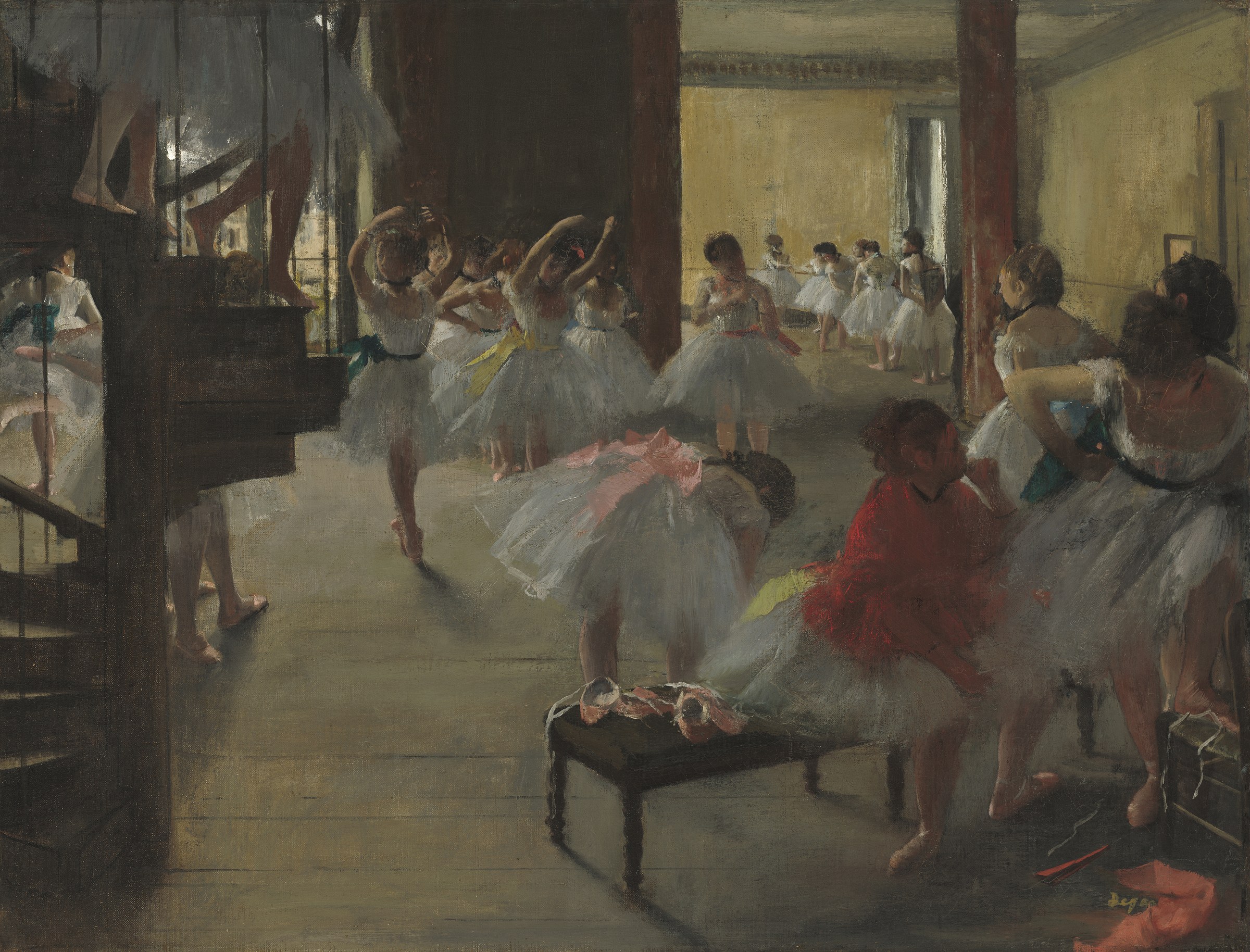
The Dance Class A33234
Edgar Degas
- Medium:
- Oil Painting
- Dance:
- Ballet
- Era:
- Late 1800s (Victorian Ballroom)
- Source:
- Wikimedia Commons
- Rights:
- Public domain — free to use, share and adapt.
- Recorded as:
- Public Domain
This painting shaped how ballet was seen and understood in the late nineteenth century and beyond. Degas painted the studio, not the stage—the place where dancers were made, not the moment of their display. His work legitimized the unglamorous, labor-intensive reality of ballet training as a subject worthy of high art, and his compositional innovations (asymmetry, cropping, unusual viewpoints) influenced how artists and photographers have represented dance ever since.
What you are looking at
A ballet class in progress in a large, high-ceilinged studio with pale yellow walls and dark supporting columns. Multiple dancers in white tutus of varying lengths are scattered throughout the space—some actively practicing in the center, others resting on benches, still others conversing or waiting their turn. The composition is asymmetrical and naturalistic rather than formally arranged. In the foreground, a woman in a vivid red dress sits on a bench with her back to us, watching; scattered across the floor are discarded pointe shoes and a dark rehearsal garment. The light falls from windows at the right, creating a warm, diffused atmosphere. A figure in dark clothes (the instructor) stands or moves at the left. The overall mood is one of work-in-progress: not a performance, but the unglamorous reality of daily training.
The dancing
The dancers are en pointe or in positions that show turnout and upright carriage. Several stand in classical first or fifth position; one in the middle distance holds an arabesque or similar extension with arm raised. The poses are alert but not frozen—they suggest a moment during instruction rather than a finished phrase. The woman in red represents a spectator or perhaps a dancer resting. The individual bodies are rendered with careful attention to the silhouette of tutus and the angle of the head and neck; posture and alignment read as the focus of the artist's observation.
The dance depicted
This is unmistakably a ballet class, most likely in the Romantic or Classical period of the 1870s. The white tutus (some shorter, some longer), the pointe work suggested by vertical stance and foot position, and the studio setting with an instructor all point to the training of professional or aspiring dancers in French or European ballet. Degas was fascinated by ballet as a subject precisely because it combined aesthetic beauty with visible labor and strain. This work is one of several he made of L'Opéra and its rehearsal spaces, capturing the quotidian discipline behind performance.
How it was made
Oil on canvas. The paint is applied with visible directness and freshness: the yellowed walls are suggested with broad strokes, while the tutus and flesh tones receive more detailed attention. The composition reads as a snapshot despite its careful structure—an effect enhanced by the off-center framing and the way figures are cut by the edges or overlap. This technique and viewing angle reflect Degas's interest in Japanese prints and early photography, which were reshaping how European artists understood composition and the captured moment.
About this work
This is Degas's *The Dance Class*, a canonical work of nineteenth-century art depicting the rehearsal space of the Paris Opéra. It is one of several versions he painted exploring the same subject: the interior world of ballet training. The work combines the aesthetic prestige of ballet—its association with grace, beauty, and art—with unsparing attention to the physical reality: the sweat, the fatigue, the waiting, the ordinariness of a working day. For the dance historian, it is one of the most important visual documents of Romantic-era ballet practice and costume; for the art historian, it is exemplary of Degas's modernist approach to composition and his choice to paint contemporary life rather than historical or mythological subjects.
How to look at it
Notice the off-center composition and the way the space unfolds rather than presents itself frontally. The instructor is barely visible; the focus is on the dancers themselves, in various states of readiness. Look at the asymmetry—the density of figures in some areas, the empty floor in others—which creates a sense of candid observation rather than arrangement. The red dress of the watching woman is the only strong accent of color, drawing the eye and establishing a human scale and interest beyond pure form. Degas asks you to look at ballet not as spectacle but as work.
The artist
Edgar Degas (1834–1917) was a French Impressionist painter who broke with the Impressionist focus on landscape and light to paint urban modern life, particularly entertainment and performance. He was obsessed with ballet from the 1860s onward, visiting the Opéra, sketching dancers, and collecting works of art depicting them. He made pastels, drawings, prints, and paintings on the subject—sometimes the same composition in multiple media. Unlike the other Impressionists, Degas was a draftsman first, concerned with line, structure, and movement, and he spent time in the studios and backstage spaces to understand how dancers trained and moved.
The period
The 1870s were a period of significant change in ballet. The Romantic era (roughly 1830–1860), with its emphasis on ethereal, otherworldly female dancers in long white tutus, was giving way to the Classical/Imperial tradition. The Paris Opéra was the most prestigious ballet institution in Europe, and dancers trained under strict, codified methods. This was also the period when photography and Japanese prints were transforming how artists understood composition and perspective. Degas's dance works sit at the intersection of these forces: documenting a living tradition while using modernist visual strategies.
Where it lives
The catalogue record indicates this work is sourced from Wikimedia Commons. The holding collection is not recorded. There are several versions of this composition by Degas; further research would be needed to confirm which version this is and its current location.
Dance in this work
Questions about this work
Did Degas actually go to ballet classes?
Yes. He was given access to the rehearsal spaces of the Paris Opéra and spent considerable time there sketching dancers and studying movement. He was not a casual observer but developed a deep knowledge of how ballet training worked, which is evident in the accuracy of his depictions.
Why is the woman in red sitting alone?
She may be a dancer resting between exercises, or a visitor or staff member watching the class. In the context of a working studio, she is simply part of the scene. Degas does not sentimentalize or explain; he records.
Are the tutus in this painting accurate to the period?
Yes. The mix of tutu lengths and styles reflects the actual practice of the 1870s. The longer tutus seen on some dancers were conventional for some roles and exercises, while shorter ones (approaching the knee-length tutu) appear in others. Degas painted what he observed.
What is the significance of the discarded pointe shoes?
They are a detail of truth and labor. Pointe shoes were (and are) fragile and wore out quickly; dancers went through pairs daily. Their presence on the floor underscores the physical toll of ballet and the reality behind the aesthetic ideal.
More Ballet artwork