49 works in this view — arrow keys or swipe to move between them.
Dance in Art · 1873
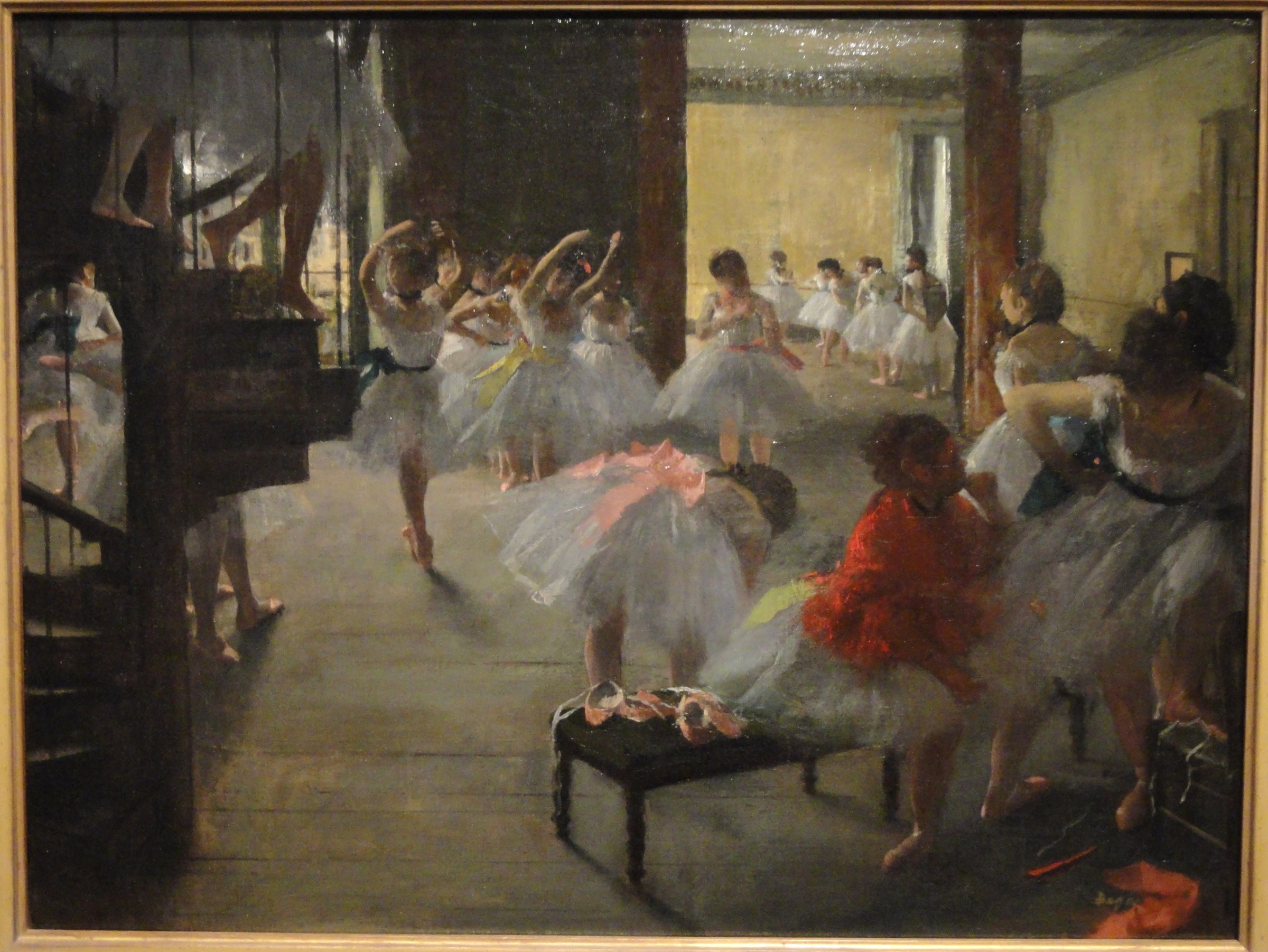
The Dance Class by Hilaire-Germain-Edgar Dega, c. 1873 - Corcoran Gallery of Art - DSC01356
Edgar Degas
- Medium:
- Oil Painting
- Dance:
- Ballet
- Era:
- Late 1800s (Victorian Ballroom)
- Source:
- Wikimedia Commons
- Rights:
- Public domain — free to use, share and adapt.
- Recorded as:
- Public Domain
This painting is among the most important visual records of 19th-century ballet practice because it shows the studio, not the stage—the repetitive work of training rather than the glamour of performance. For dancers and historians, it is primary evidence of how Romantic ballet was physically constructed and taught, what the students looked like, how the studio was organized, and what the relationship between teacher and dancers entailed. The painting captures a moment in the professionalization of ballet when the art form was being standardized through systematic training.
What you are looking at
An instructor in dark clothing stands at the left before a large mirror, gesturing to a group of young female ballet students arranged in the studio. The dancers wear white tutus and pointe shoes, some with colored ribbons (yellow, red, pink) at the waist. They are positioned at various points across the wooden floor—some standing in profile, others facing forward or three-quarter view, and at least one seated on a bench in the foreground wearing a red garment. The studio is lit from windows on the right, creating a warm, diffused glow that falls across the pale walls and floor. The scene captures a moment of instruction or rehearsal, with the students' bodies held in varying degrees of readiness, some with arms raised or positioned in ballet posture.
The dancing
The dancers display the formal upright carriage and turned-out positions characteristic of ballet training. Several stand with arms raised or extended in classical positions; others await instruction with arms at their sides or in preparation. The seated figure in the foreground breaks the formal line, suggesting a brief pause in the class or a moment of rest. The teacher's raised arm and forward lean indicate active demonstration or correction. The young dancers—all female, ranging in apparent age from children to adolescents—are arranged with the casual spacing of a working rehearsal rather than a formal performance.
The dance depicted
This is a ballet class, almost certainly a training session in a professional or semi-professional studio in 19th-century Paris. The students' white tutus, pointe shoes, and the presence of an instructor conducting a lesson identify this unambiguously as theatrical ballet training. The composition captures not performance but pedagogy—the everyday work of ballet instruction, likely Romantic ballet given the date and the aesthetic conventions of costume and studio practice. The mirror visible on the left wall confirms this is a working dance studio where students could observe themselves and the teacher's demonstrations.
How it was made
Oil painting, confirmed by the soft handling of light, the layered application of color, and the subtle gradations in the studio's walls and floor. The painter used a limited palette dominated by whites, pale creams, and warm tans punctuated by the bright accents of the students' ribbons. The technique allows for the capture of the translucent quality of gauze tutus and the specific character of afternoon studio light. Oil was the medium of choice for large-scale studio scenes in the 19th century and permitted the kind of informal composition and observed detail that makes this image valuable as a historical record.
About this work
This is a record of a ballet class in mid-19th-century Paris, painted with the informality of observation rather than celebration. The artist has chosen a moment of instruction—not a performance or a formal arrangement—which makes the image historically valuable as evidence of how ballet was actually taught and practiced in the studio. The work belongs in a gallery of dance imagery precisely because it documents labor, training, and the aesthetic of ballet in its formative era, showing not the polished spectacle of the stage but the working reality of the art form. It is a document of technique and pedagogy as much as it is a composition.
How to look at it
The composition is deliberately informal: the teacher is not centered, the students are scattered rather than symmetrically arranged, and one dancer sits while others stand. This is the opposite of formal dance painting tradition. Look at how Degas uses the mirror and the studio's architectural lines to organize the space while keeping it natural and observed. Notice the varying states of the dancers' bodies—some are mid-gesture, others are paused, waiting. The artist has frozen a moment of genuine instruction, not a moment of spectacular movement. The pale, cool light coming from the window on the right is the real subject alongside the dancers.
The artist
Edgar Degas (1834–1917) made the ballet studio one of his primary subjects over a career spanning five decades. He painted and drew dancers repeatedly—in rehearsal, at rest, in class, and backstage—more than any other artist of his era. Degas was not documenting ballet for sentimental or romantic reasons; he was fascinated by the body in motion, the effects of light and informal grouping, and the social reality of young female dancers as workers within the Paris Opéra system. His repeated engagement with the ballet studio gave him unparalleled access and an acute understanding of the form.
The period
This painting dates to the height of Romantic ballet in France, though by 1873 Romanticism's dominant phase had passed. The 1870s were a period of transition in ballet aesthetics: classical training was becoming more systematic and codified, particularly under the influence of Italian methods. The Paris Opéra was the center of European dance, and Paris studios like this one were training grounds for dancers who would perform across Europe. Degas painted his ballet scenes during this moment when ballet was evolving from Romantic spectacle toward greater technical precision and classical vocabulary.
Where it lives
Held in the Corcoran Gallery of Art (now part of the National Gallery of Art, Washington, D.C.), this is one of Degas's most famous ballet class paintings and is documented from Wikimedia Commons. It is one of several versions and studies Degas made of ballet studio scenes, reflecting his sustained interest in the subject.
Dance in this work
Questions about this work
Did Degas dance himself?
No. Degas was a painter and draftsman who spent decades observing ballet classes, rehearsals, and performances, often attending the Paris Opéra. He gained access to studios and backstage areas and drew dancers obsessively, but he was not a dancer. His knowledge came from intense, systematic observation and from conversations with the dancers and teachers he knew.
Why are some of the dancers' tutus colored while others are white?
The colored ribbons were likely worn at the waist during rehearsal for practical or ornamental reasons—possibly to distinguish dancers or to hold the tutu in place. In class, dancers would wear whatever was practical; the formality of costume was reserved for performance. Degas captures the working reality, not the stage costume.
How old were ballet students in the 19th century?
Students entered the Paris Opéra ballet school young—often in childhood around age 8–10—and trained intensively for years. The girls in this painting appear to range from roughly 10 to 16 years old. Ballet was (and is) a profession entered in childhood, and these young dancers were already in serious training, not amateurs.
Is this painting famous?
Yes. This is one of Degas's most recognized and reproduced ballet paintings, and it is widely used in art history and dance history texts as an example of both Impressionist painting technique and historical documentation of 19th-century ballet. It is iconic both as art and as a historical source.
More Ballet artwork