49 works in this view — arrow keys or swipe to move between them.
Dance in Art
Edgar Germain Hilaire Degas 076
Edgar Degas
- Medium:
- Oil Painting
- Dance:
- Ballet
- Source:
- Wikimedia Commons
- Rights:
- Public domain — free to use, share and adapt.
- Recorded as:
- Public Domain
Degas fundamentally changed how dance was represented in visual art by shifting attention from performance spectacle to the embodied reality of dancers' lives and training. For historians, his work documents the physical culture and social conditions of late-19th-century ballet; for dancers and artists, his compositions reveal a profound understanding of how bodies actually move and hold themselves in space, unguarded. This painting and its companions established dance as a legitimate subject for serious modern art.
What you are looking at
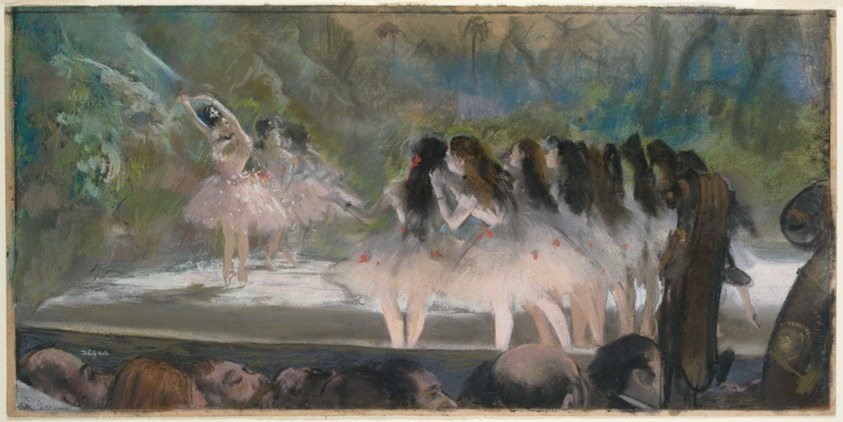
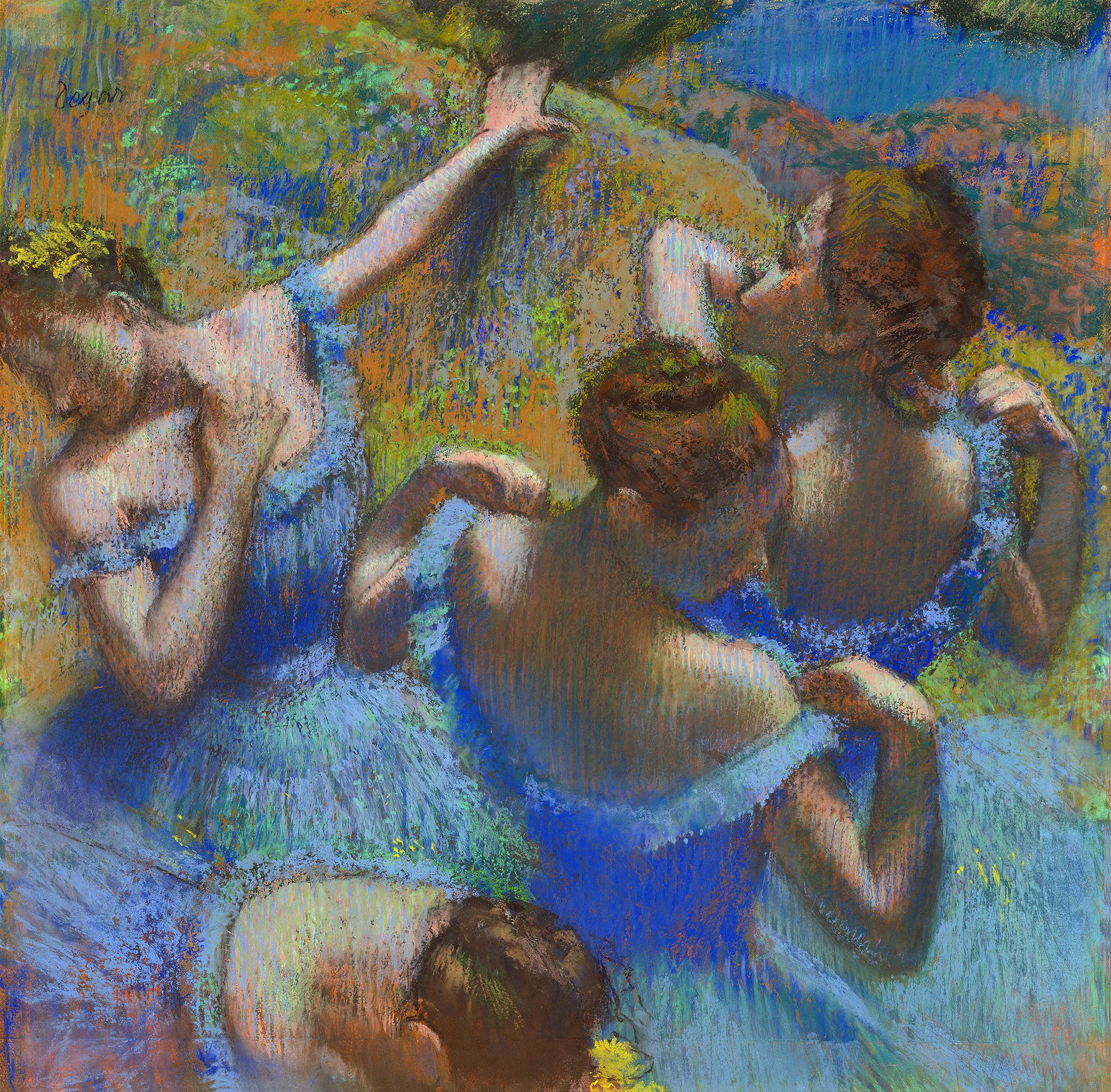
A densely layered composition of five female dancers in a studio or rehearsal space, rendered in Degas's characteristic pastel technique with vibrant blues, ochres, and greens creating an atmospheric haze. The figures are arranged informally across the composition—some seated, some standing, some in motion—suggesting a moment of rest or informal practice rather than a formal performance. The background dissolves into textured color fields of deep blue and golden-brown, creating spatial ambiguity. The foreground shows a young dancer in profile (bottom center) wearing a pale blue skirt, her posture introspective. Behind and above her, other dancers in similar tutus occupy the composition at various angles: one stretches upward with an extended arm, another bends forward, a third stands with arms at her sides. The light is diffuse and cool, characteristic of gaslit or early electric studio interiors. The overall effect is one of captured intimacy—the unguarded moment of professional dancers between performances or during rehearsal.
The dancing
The dancers display a variety of classical ballet postures: upright standing positions with arms held at shoulder level, forward bending from the waist, overhead stretches, and supported weight shifts. The nearest figure (bottom center) sits or kneels with her body angled away, her musculature rendered in soft modeling. Arms are generally held in positions consistent with classical ballet training—either at the sides in repose, extended overhead in a preparation position, or held at chest/shoulder height. No two dancers occupy the same pose, suggesting Degas's interest in capturing the individual variations within a shared physical practice. The spacing and overlapping of bodies creates a sense of crowded intimacy rather than formal arrangement. Bodies are proportioned as trained dancers, with long legs and lifted torsos even in rest.
The dance depicted
This is unmistakably a scene of classical ballet dancers, most likely in a Parisian rehearsal studio of the late 19th century. The tutus, the studio setting, and the body positions all point to theatrical ballet (likely Romantic or early Classical ballet as practiced in the 1870s-1880s). The composition does not depict an active choreography but rather the social and physical reality of professional dancers—the waiting, stretching, and informal gathering between rehearsals or performances. This was Degas's dominant subject across his career: not the spectacle of the stage, but the labor and mundane existence of dancers in the studio. The image tells us that these were trained bodies in a working environment, and that Degas was fascinated by the unstudied gestures of professional practitioners.
How it was made
This is an oil painting using Degas's mature technique of loose brushwork and vivid color notation. The artist has layered paint thinly and applied it with directional strokes that suggest movement and form without precise delineation—a method that allows rapid notation of light and color rather than detailed rendering. The extensive use of blue (perhaps ultramarine or Prussian blue) creates spatial recession and atmospheric unity. The technique suggests this was made with studio immediacy in mind, though the level of finish indicates a deliberate work rather than a sketch. Oil paint allowed Degas to build up the translucent, glowing quality of studio light and to revise forms repeatedly—key advantages over his more constrained pastels, though he used both media.
About this work
This is one of Degas's quintessential rehearsal studio scenes, a subject to which he returned obsessively across five decades. The painting captures the physical life of professional ballet dancers in the moment between formal performance and rest—a world almost entirely invisible to the public of the Paris Opéra. Degas spent years gaining studio access, sketching dancers in motion and repose, building an archive of movements and poses from which he composed studio and theater scenes. This work exemplifies his practice of treating dance not as spectacle but as labor: the composition refuses to arrange the dancers theatrically or to celebrate them as performers. Instead, it renders them as working bodies in a working space, with all the ungainly shifts and pauses that formal ballet on stage would erase.
The painting belongs to the Impressionist moment in which Degas worked, and reflects his parallel interest in modern urban labor and leisure. Where Renoir and Monet depicted the spectacle of public entertainment, Degas pushed behind the curtain. His dancers are not idealized; they are observed with the intensity of a naturalist, yet rendered with a colorist's sensitivity to atmosphere and light. This tension—between realist observation and painterly abstraction—made Degas's dance subjects simultaneously modern and timeless.
How to look at it
Attend first to the spatial organization: notice how the bodies are arranged asymmetrically, overlapping and at different scales, creating a sense of depth through crowding rather than linear perspective. The composition refuses a single focal point; instead, your eye moves from figure to figure, invited by Degas's handling of color and light. Second, look at the color field itself—the blue is not merely background but an active element that unifies and separates figures simultaneously. Third, observe the range of body positions and attitudes: this is not a choreography with unified direction, but rather a lived space where individuals occupy different postures and moments. Finally, consider the moment: these bodies are not in performance mode but in the transitional spaces of professional labor. The artist has chosen to freeze a moment of rest, waiting, or informal practice—a moment the public never sees.
The artist
Edgar Degas (1834–1917) was a French painter, printmaker, and sculptor who devoted an extraordinary proportion of his practice to depicting dancers and the ballet world. Beginning in the 1860s, he gained unusual studio and rehearsal access at the Paris Opéra, allowing him to observe dancers at work. Over more than fifty years, he created thousands of drawings, pastels, prints, and paintings of dancers in training, rehearsal, and performance. He was not primarily interested in the spectacle of the stage; rather, he was fascinated by the bodies of professional dancers—their musculature, posture, weight shifts, and the repetitive labor of training. His late works, particularly, dissolved form into color and light, moving toward increasingly abstracted representations of movement. Degas's approach to dance was simultaneous realist and modernist: scrupulously observed, yet rendered through a vocabulary of color, composition, and fragmented form that was radically new.
The period
This work dates to the mature period of Impressionism (likely 1870s–1880s), when Degas was refining his studio practice and moving away from the outdoor landscape subjects that dominated the movement. The ballet world of the Paris Opéra was undergoing significant changes during this period: the Romantic ballet of the mid-19th century (emphasizing ethereal, spectral femininity) was transitioning toward a more virtuosic, technically demanding Classical ballet. Dancers were becoming increasingly professionalized, and the corps de ballet was growing larger and more rigorously trained. In art, there was a broader shift toward depicting modern urban labor and the realities of contemporary entertainment industries. Degas's dancers fit into this context of modernity while also reflecting his idiosyncratic artistic interests: the play of light in interior spaces, the geometry of informal groupings, and the poetry of captured movement.
Where it lives
This work was sourced from Wikimedia Commons, which typically hosts works in the public domain or held by institutions with open-access policies. The catalogue record does not specify a current holding collection, and the date and provenance details are not recorded. Based on style and subject matter, this is consistent with Degas's mature dance works of the 1870s–1880s, a period during which he was most actively engaged with studio subjects.
Dance in this work
Questions about this work
How did Degas gain access to ballet studios to paint these scenes?
Degas had unusual permission to observe rehearsals and classes at the Paris Opéra, granted through connections in Paris's artistic and social circles. He spent countless hours sketching dancers in motion, building an archive of poses and movements from life. This direct observation was fundamental to his practice; he did not invent ballet poses but rather recorded and rearranged them from careful study.
Are these real dancers or invented figures?
Degas began with life study but composed his finished paintings from combinations of sketches rather than from single sessions. While individual poses and body types came from observation, the assembled groups were often imaginative recombinations. The effect is documentary realism achieved through artistic construction, not literal transcription.
Why did Degas focus so heavily on ballet?
Degas was attracted to ballet as a subject because it combined his interests in modern urban labor, the human body in motion, and the play of light in interior spaces. Ballet dancers represented a new form of professional femininity in modern Paris, and their training bodies offered endless formal and compositional possibilities. The subject allowed him to merge realist observation with modernist abstraction.
What ballet technique are these dancers using?
The body positions and clothing indicate classical ballet training of the mid-to-late 19th century, consistent with the methods taught at the Paris Opéra during Degas's active engagement with the subject. The dancers show the upright carriage, turned-out positions, and formal arm positions characteristic of Romantic and early Classical ballet traditions.
More Ballet artwork