49 works in this view — arrow keys or swipe to move between them.
Dance in Art · 1897
Дега. Голубые танцовщицы
Edgar Degas
- Medium:
- Oil Painting
- Dance:
- Ballet
- Era:
- Late 1800s (Victorian Ballroom)
- Source:
- Wikimedia Commons
- Rights:
- Public domain — free to use, share and adapt.
- Recorded as:
- Public Domain
For historians of dance, this work documents the physical appearance and working reality of late-19th-century ballet dancers in ways that no other visual record does with such intimacy and accuracy. For art historians, Degas's dancers represent a revolutionary break from academic convention: the insistence that modern life—labor, fatigue, the body's unglamorous reality—was a subject worthy of serious aesthetic attention. The work inaugurated a way of seeing dancers that persists in contemporary performance documentation and in the art world's fascination with process and rehearsal.
What you are looking at
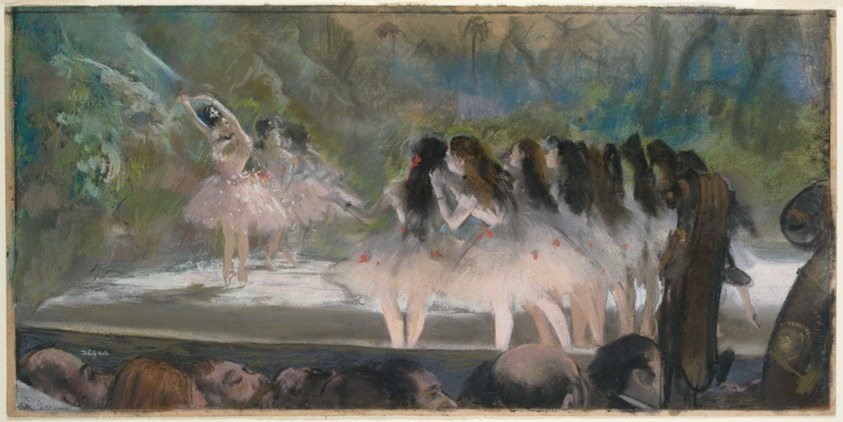
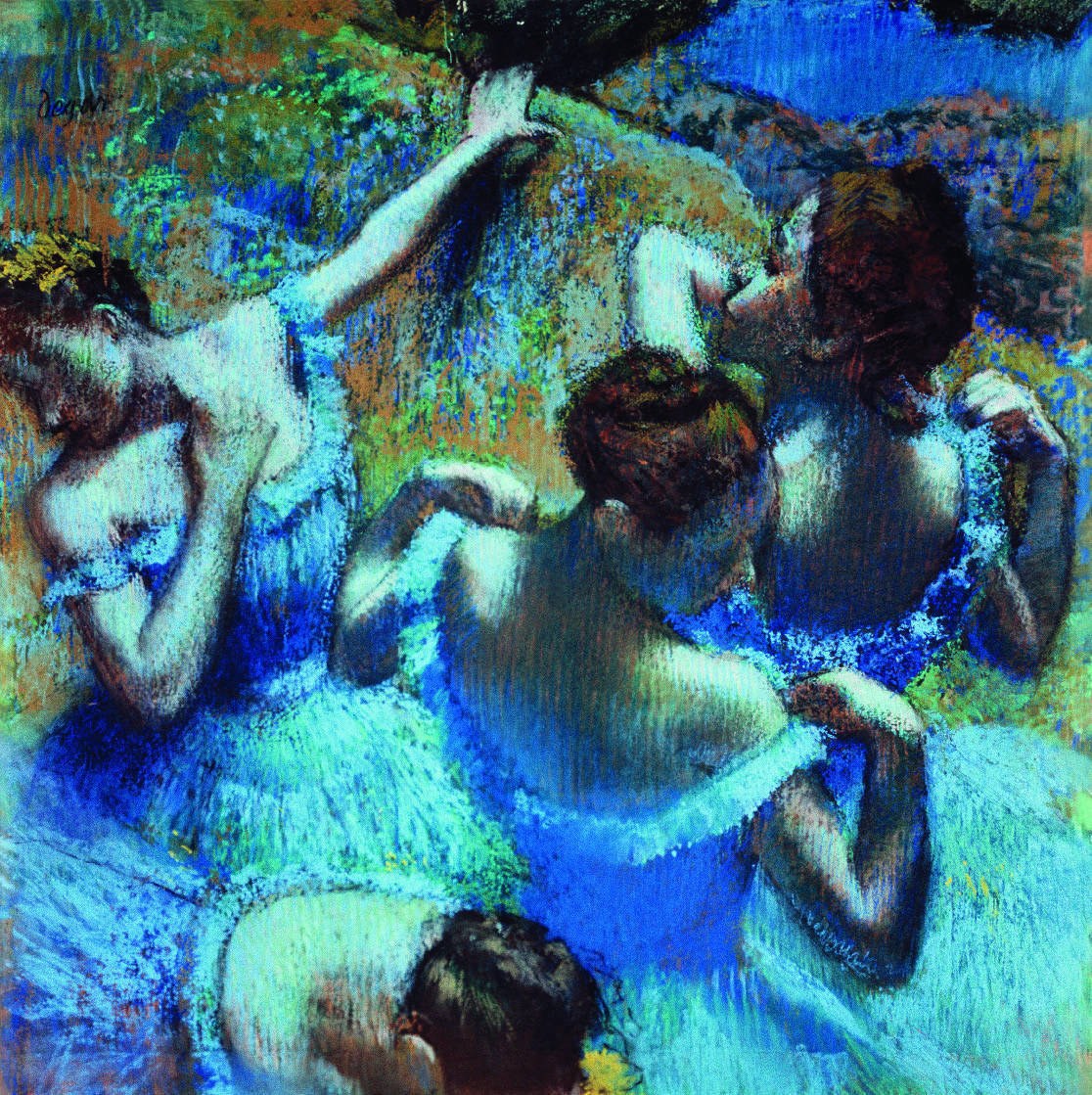
Four ballet dancers in pale blue tutus occupy the center of a composition suffused with rich blues, greens, and earthy ochres. The figures are caught in an intimate moment of rest or preparation rather than active performance—they bend, stretch, and adjust their costumes with the unselfconscious absorption of dancers between rehearsals or in the wings. The paint is worked in soft, feathered strokes that blur contours and dissolve form into atmosphere; the background is less a defined space than a wash of color, suggesting stage lighting or the hazy warmth of a dressing room. A fifth figure, darker and less distinct, appears lower right. The palette—dominated by the cool blues set against warm earth tones—creates a sense of quiet intimacy, as if the viewer has stepped behind the curtain to witness something private. The composition is asymmetrical and cropped, giving the sense of a snapshot rather than a formal arrangement.
The dancing
The dancers are arranged at varying heights and angles, their bodies soft and pliable rather than rigidly extended. One figure stretches an arm overhead; another bends forward in a deep curve; a third sits or reclines. The tutus are visible but unstudied—the fabric falls and bunches naturally rather than presenting the crisp geometry of formal ballet dress. There is no obvious spatial relationship between the figures; they seem to occupy their own private moments even as they share the frame. The bodies convey fatigue, concentration, or absorption rather than the lifted, outward presentation of performance.
The dance depicted
This is a scene of ballet offstage—dancers at rest, adjusting costume, or warming up rather than executing a choreographed phrase. The pale tutus and the subject matter confirm the theatrical-ballet genre, though the moment depicted is from rehearsal, preparation, or respite rather than the action of the ballet itself. This was a signature interest of Degas: the unglamorous, unposed reality of dancers' work and bodies, captured in postures and moments that break the illusion of effortless grace. The image tells us that Degas valued the physical truth of the dancers' labor and bodies over the fantasy the ballet stage presented to the audience.
How it was made
The catalogue record identifies this as pastel, a medium in which Degas worked extensively and with extraordinary sophistication. Pastel allowed him to build complex color harmonies through layering and blending, visible here in the subtle modulations of blue, green, and ochre. The technique also enabled rapid revision and reworking, which suited Degas's practice of working from observation and memory. Pastel was more intimate and portable than oil paint, allowing him to work quickly and capture transient poses; it was also valued by collectors and galleries in the late 19th century as a fine-art medium distinct from drawing, commanding serious prices and attention.
About this work
This pastel is one of Degas's numerous studies of dancers, a subject he pursued obsessively from the 1870s until his death. Degas had privileged access to rehearsals and backstage spaces at the Opéra in Paris, and he used that access to depict ballet not as spectacle but as labor—bodies at rest, in transition, being fitted and adjusted. The work belongs to a tradition of theatrical subject matter in 19th-century art, but Degas departed radically from convention by refusing to romanticize or elevate his subject. Instead, he found visual richness and profound humanity in the mundane and the private. The soft palette and feathered handling convey both the physical reality of the dancers and a sense of intimacy with the viewer, as if we too have been admitted backstage.
How to look at it
Look first at the distribution of the figures in space: they are not arranged in a hierarchy or a narrative sequence, but scattered across the canvas as if the artist is capturing a moment of no particular significance. Notice how the eye must work to find and read each figure, and how the warm and cool colors seem to pull them forward and push them back. Attend to the handling of the pastel itself: the feathering and blending of color, the way the strokes follow and suggest the forms beneath without defining them sharply. The choice of the moment is crucial—Degas has not chosen a moment of obvious grace or extension, but of rest, adjustment, and private absorption. This asks the viewer to find beauty and meaning in the unglamorous and the transient, a retraining of the eye that was central to modern art.
The artist
Edgar Degas (1834–1917) was a French painter, draughtsman, printmaker, and sculptor trained in the academic tradition but profoundly influenced by photography, Japanese prints, and the visible world of Paris in the Second Empire and Belle Époque. Though often grouped with the Impressionists, he resisted the label and differed from them in his commitment to drawing, his interest in form and movement, and his focus on interior and social spaces rather than landscape and light. His practice was built on close observation and extensive preparatory work; he would attend rehearsals, make rapid sketches, and then work these up into finished pastels and oils in the studio. The ballet became his laboratory for exploring problems of composition, movement, the seated and standing body, and the relationship between artist and subject. He left hundreds of works on the subject—paintings, pastels, sculptures, prints—many of them unstudied fragments or studies rather than finished exhibition pieces. His late pastels, made when his eyesight was failing, are among his most abstractly beautiful works, with color and handling taking precedence over descriptive detail.
The period
The 1890s were a period of profound change in ballet and in its representation. The Paris Opéra Ballet, where Degas had access, was the center of European ballet, and the dancers (nearly all of them women from working-class backgrounds) were employed as both performers and, in the social economy of the opera house, as objects of male desire. Degas's commitment to depicting them as workers—as bodies engaged in the concentrated effort of their art—was itself a kind of realism and a quiet refusal of the sentimentality and eroticism that often attended representations of ballet dancers. In the broader art world, the 1890s saw the consolidation of Impressionism and the emergence of Post-Impressionist and Symbolist movements; Degas's late pastels, with their sophisticated color and increasingly abstract handling, sit at the intersection of these currents. The pastel medium itself was experiencing a revival among avant-garde artists as a serious medium capable of subtle color and complex surface effects.
Where it lives
The work is recorded as a pastel from 1897, currently listed as held in an unspecified collection. The source is Wikimedia Commons, suggesting it is now in the public domain or a public collection that has made high-resolution images freely available. Many of Degas's dancer pastels are held in major museums (the Musée d'Orsay in Paris, the Metropolitan Museum in New York, the Art Institute of Chicago), though numerous works also remain in private collections or have uncertain location.
Dance in this work
Questions about this work
Is this painting or pastel?
The catalogue record identifies it as pastel, and the handling visible in the image—the soft feathering, the translucency, the way color is layered and blended rather than built up in opaque strokes—confirms this. Pastel was Degas's preferred medium for many of his dancer studies because it allowed rapid work, complex color harmonies, and easy revision.
What are the dancers doing?
They appear to be resting, preparing, or warming up rather than performing—adjusting their tutus, stretching, or simply sitting. This was characteristic of Degas's interest in capturing dancers in moments of labor and preparation rather than in the formal presentation of the ballet itself.
Why did Degas paint dancers so often?
Degas had privileged access to rehearsals and backstage spaces at the Paris Opéra, and the dancers offered him an endlessly rich subject for exploring problems of movement, the body in space, composition, and the relationship between the artist and the observed world. He was fascinated by the gap between the public illusion of ballet and the private reality of the dancers' labor.
Why is the color so unusual?
The blue of the tutus is heightened and somewhat artificial, pushed toward cool tones and set against warm earths and ochres in the background. This creates a harmonious but slightly dreamlike or theatrical quality—the color is not naturalistic but poetic, suggesting stage lighting and the artificial world of the theater.
More Ballet artwork