49 works in this view — arrow keys or swipe to move between them.
Dance in Art · 1870
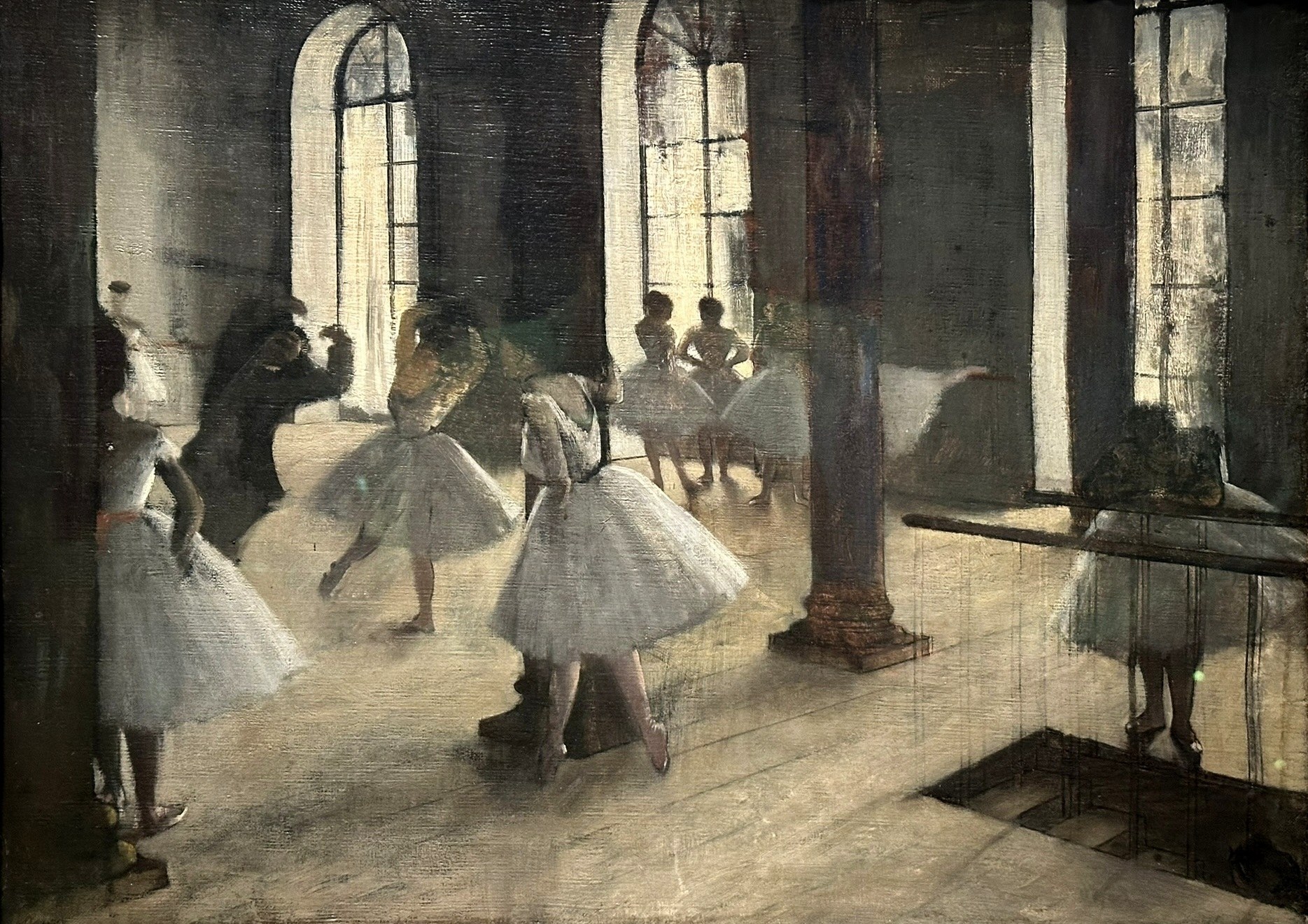
Rehearsal at the dance hall
Edgar Degas
- Medium:
- Oil Painting
- Dance:
- Ballet
- Era:
- Late 1800s (Victorian Ballroom)
- Source:
- Wikimedia Commons
- Rights:
- Public domain — free to use, share and adapt.
- Recorded as:
- Public Domain
This work is foundational to modern art's recognition of ballet as a subject worthy of sustained aesthetic attention, and it documents the institutional training practices of the ballet world at a moment of transformation. The painting's interest lies in the ordinary, the rehearsal, the work—not the spectacular moment—and in its sophisticated use of light and atmosphere to convey the quality of a specific world. For dancers and historians, it provides a rare visual record of the physical and spatial conditions of professional ballet training in the 1870s.
What you are looking at
A rehearsal studio suffused with pale, diffused light from tall arched windows, rendering the entire space in tones of cream, grey, and soft shadow. The floorboards are bare and pale. Multiple young female dancers in white practice dresses occupy the studio at various distances from the viewer—some in the foreground close enough to read the fall of their skirts, others receding into atmospheric perspective toward the far windows. A few figures stand or sit; most appear to be in movement or waiting. The architectural setting is austere: tall columns, high arched windows with dark framing, simple walls. The light is cool and uniform, flattening form and emphasizing the geometries of the space rather than dramatic incident. No instructor is prominently visible. The mood is contemplative and workmanlike—this is a moment of instruction or preparation rather than performance.
The dancing
The dancers wear simple white practice dresses of mid-calf length, consistent with late 19th-century ballet rehearsal costume. Postures vary: some figures appear to stand in classical alignment, others are caught mid-movement, still others sit or rest. The nearest figure in the foreground (left) seems to be in a standing position; several middle-ground figures show arms extended or bent in positions consistent with classical ballet port de bras. The dancers' frames are upright and controlled; weight appears to be held in the torso rather than released into swing or sway. No partnered holds are visible; dancers occupy the space individually rather than in couples or close formation.
The dance depicted
This is a ballet rehearsal, most likely from a professional or institutional school setting in the late 19th century. The white practice dresses, the architectural setting of what appears to be a purpose-built rehearsal hall, and the calm, attentive postures all support identification as classical ballet training under the academic method. The specific style—Russian Imperial, Cecchetti, or equivalent European academy—cannot be determined from the image alone, but the formality of the space and the discipline implied by the figures' bearing suggests institutional ballet pedagogy of the period. The image captures a moment between exercises or during individual instruction rather than a formal combination.
How it was made
Oil painting on canvas. The artist has used soft, diffused application to create atmosphere and distance; the figures in the background are rendered sketchily, with less definition of feature and dress, while foreground figures show more articulated brushwork. The palette is deliberately restricted—whites, creams, greys, browns, blacks—which concentrates attention on form and light rather than color. This technique creates a mood of cool observation rather than spectacle, appropriate to the private, working nature of a rehearsal rather than a public performance. The painting technique allows the artist to capture the quality of studio light and the transient nature of movement in ways photography of the period could not yet fully achieve.
About this work
A late-19th-century oil painting of young ballet dancers in a rehearsal studio, rendered in a restrained palette and soft light. The work documents the private, disciplined world of classical ballet training at a moment when such institutional rehearsal was becoming professionalized and architecturally formalized. The painting captures not the drama of performance but the quotidian work of becoming a dancer—waiting, practicing, receiving correction—in a luminous, ordered space. This is one of a series of rehearsal and performance scenes the artist produced, marking a sustained interest in the ballet world as a subject for modern painting.
How to look at it
Attend to the quality of light: notice how it fills the space evenly, flattening the figures and creating a mood of calm concentration rather than drama. Observe how the artist has compressed spatial depth—the distance from foreground to background is suggested more through atmospheric fading and size diminution than through linear perspective. Look at the individual dancers' postures: are they frozen in a single moment, or does each figure seem caught at a different point in a sequence? Notice the emptiness of the space around the figures, and what that void contributes to the sense of a private, working moment. The painting rewards slow looking: each figure, each gesture, each play of light on white fabric carries meaning.
The artist
Edgar Degas (1834–1917) was a French Impressionist painter with an exceptionally sustained engagement with the ballet world. He attended rehearsals at the Opéra regularly, made numerous studies of dancers, and produced paintings, pastels, drawings, and prints on ballet themes throughout his career from the 1870s onward. Unlike other Impressionists, Degas used the ballet studio as a laboratory for exploring form, light, perspective, and human movement; his interest was as much in the geometry of the space and the structure of the body as in narrative or emotion. He had unusual access to the Paris Opéra's rehearsal spaces and was known to the dancers and staff, allowing him to observe and sketch in ways that informed his highly composed, formally deliberate works.
The period
In the 1870s, ballet was undergoing significant institutional transformation. The Paris Opéra ballet was hierarchically organized, increasingly professionalized, and subject to rigorous daily training. This was the period of transition from Romantic to Classical ballet aesthetics, and the professionalization and rationalization of ballet pedagogy—the codification of technique, the systematization of training. Simultaneously, in the visual arts, Impressionism was emerging as a major force, with artists exploring new ways to represent light, movement, and contemporary urban life. Degas's ballet paintings were revolutionary in bringing the seemingly ephemeral, private, and quotidian world of the ballet studio into the gallery—treating dancers not as mythological figures or performers but as workers, as bodies in space, as subjects of formal investigation.
Where it lives
The painting is held in The Phillips Collection, Washington, D.C., where it is catalogued under the title 'La Répétition au foyer de la danse' (Rehearsal at the dance hall). The work is part of the Collection's holdings of Impressionist and early modern art and is accessible to the public.
Dance in this work
Questions about this work
Is this a real rehearsal hall, or did Degas invent it?
The setting is based on the actual rehearsal spaces of the Paris Opéra, which Degas visited repeatedly. However, the painting is not a literal documentary record; Degas composed the space, adjusted proportions for aesthetic effect, and arranged the figures for formal effect. The architecture is recognizable and plausible, but the painting is a constructed image, not a sketch.
What was the white dress worn by ballet dancers in rehearsal?
The white practice dress shown here was standard attire for ballet rehearsal in the late 19th century. It was a simple, loose-fitting garment worn over a leotard and tights, allowing freedom of movement while maintaining modesty. Unlike the elaborate tutus worn for performance, the practice dress was utilitarian and unmarked by decoration.
Why did Degas paint so many ballet scenes?
For Degas, the ballet studio was the perfect subject: it combined his interests in the human figure in motion, in light and atmosphere, in spatial composition, and in the contemporary life of Paris. He was drawn to the discipline and geometry of classical ballet and to the social world of the dancers. Ballet scenes allowed him to explore modern urban life while maintaining the formal structure of academic training.
How is this painting different from Degas's performance scenes?
Rehearsal paintings like this one emphasize the private, working world of the dancers—the training, waiting, and discipline behind performance. Performance paintings show the spectacle, the light from the stage lamps, the drama of the moment. Rehearsal scenes are cooler, more intimate, more focused on form than on narrative or theatricality.
More Ballet artwork