49 works in this view — arrow keys or swipe to move between them.
Dance in Art · 1877
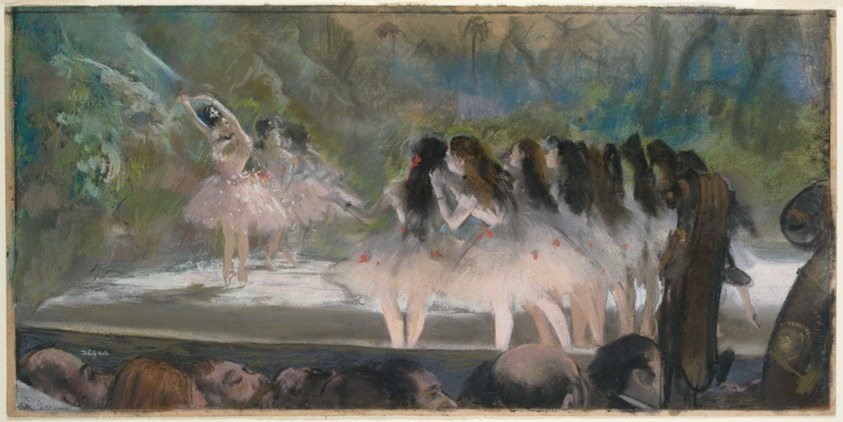
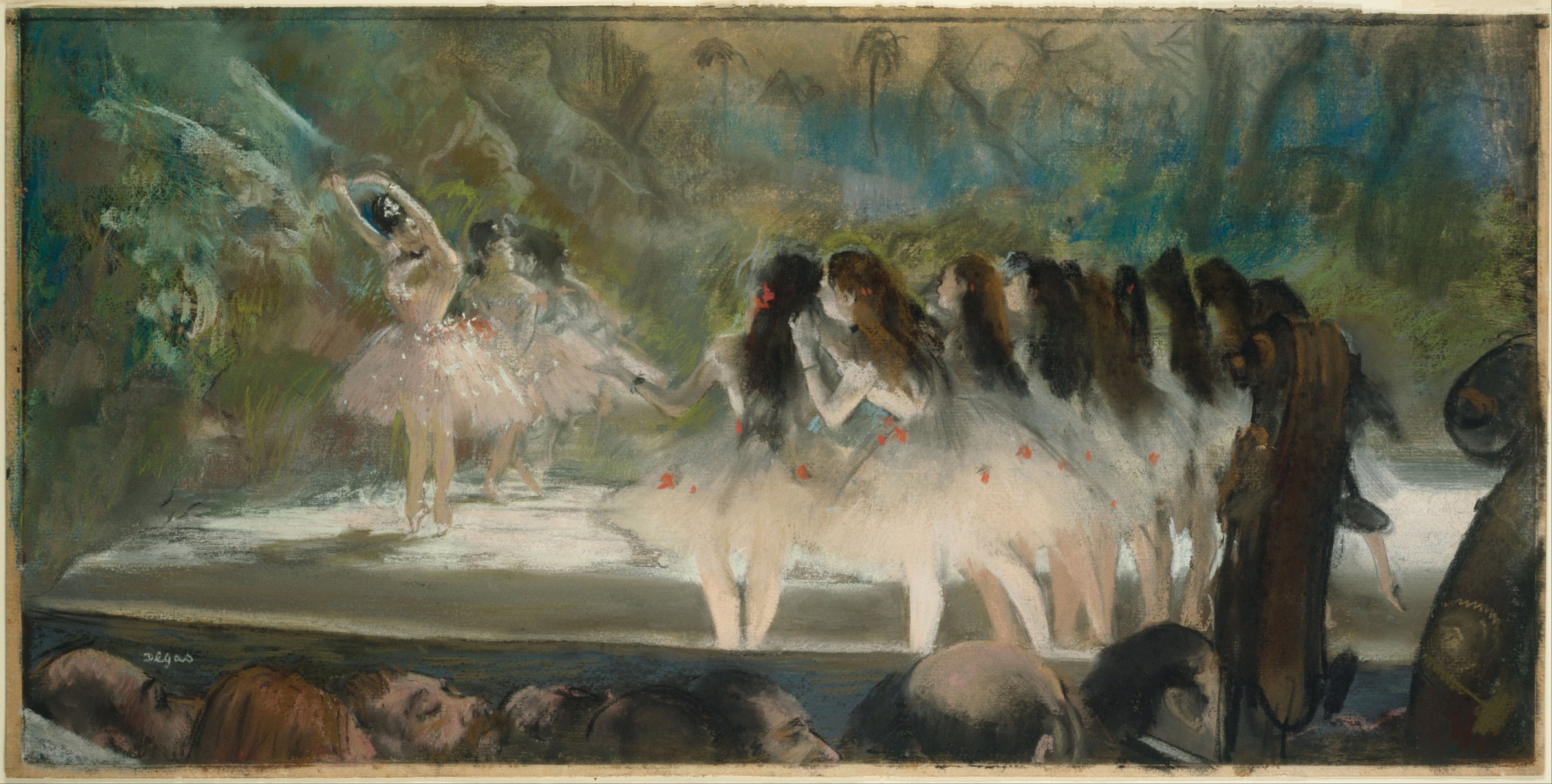
Edgar Degas - Ballet at the Paris Opéra
Edgar Degas
- Medium:
- Oil Painting
- Dance:
- Ballet
- Era:
- Late 1800s (Victorian Ballroom)
- Source:
- Wikimedia Commons
- Rights:
- Public domain — free to use, share and adapt.
- Recorded as:
- Public Domain
Degas is the first painter to treat ballet seriously as a subject for sustained artistic investigation—not as romantic pantomime or spectacle, but as labor, geometry, and light. His hundreds of ballet images, of which this is one, constitute the largest and most detailed visual archive of how dancers actually worked and moved in the nineteenth century. For anyone studying ballet history, the Romantic era, or the intersection of modernist painting and dance, Degas is indispensable.
What you are looking at
A ballet rehearsal or performance in a grand interior, likely the Paris Opéra house. The stage is a wooden platform bathed in pale light. On stage, a corps de ballet of approximately a dozen dancers in pale tutus stands in a loose line, their bodies angled toward a soloist in the center-left who wears a more ornate, flesh-toned costume. The soloist appears to be in an arabesque or similar lifted pose, commanding attention. Behind and above the dancers, the architecture of the theatre rises in shadow—a cavernous space with hints of scenery (palms or tropical elements visible in the background flat). In the foreground, darker figures occupy the pit or lower level—musicians, stage hands, or rehearsal staff—their heads and shoulders visible in profile. The palette is dominated by cool grays and greens, with flesh tones and white tutus standing luminous against the murky background. Degas's signature sketch-like handling of paint creates a sense of immediacy, as if glimpsed from an odd vantage point—neither quite from the audience nor from backstage, but suspended between them.
The dancing
The corps dancers stand upright but relaxed, not in rigid formal alignment; several are in profile, others three-quarter view. The soloist in the center commands the composition with a lifted, extended leg and arched back—an arabesque or attitude derrière. The poses suggest momentary pauses rather than held positions, captured mid-phrase. The dancers' arms are variously placed, some held at the side, others extended. The tutus—pale, voluminous, and roughly rendered—are characteristic of mid-nineteenth-century ballet silhouette. The bodies are willowy and elongated, the postures reflecting the turned-out positions of classical ballet vocabulary.
The dance depicted
This is almost certainly a Romantic or Classical ballet, staged at the Opéra. The pale tutus, the arabesque, the corps formation, and the theatrical interior all point unambiguously to theatrical ballet of the 1870s. Degas was obsessed with the ballet world of the Paris Opéra; his many sketches, pastels, and paintings of dancers and rehearsals constitute one of the largest bodies of dance imagery in art history. The image captures not a performance but a rehearsal or a moment during one—the informality of pose and the overhead vantage point are characteristic of Degas's interest in the quotidian life of dancers rather than the idealized spectacle offered to the paying audience. The painting documents the physical type and costume conventions of mid-Victorian ballet.
How it was made
Oil painting on canvas, as recorded. Degas's technique here is deliberately loose and impressionistic by academic standards—the background is sketchy and atmospheric, the figures are suggested rather than laboriously finished, and the composition is off-center and asymmetrical. This painterly freedom, combined with the unusual viewing angle (from above, from the wings, or from an oblique position in the auditorium), was radical for its time and influenced by his study of photography and Japanese prints. The handling conveys movement and light in ways that tight finish could not; the pale tutus glow against shadow because Degas applied pigment economically and let the canvas show through. The work would have circulated among Paris collectors and the avant-garde, positioning Degas as a painter who saw the ballet not as high romantic spectacle but as a site of labor, geometry, and modern visual experience.
About this work
This is one of several paintings Degas made of the Paris Opéra ballet in the 1870s, a period of intense fascination with dancers in rehearsal, performance, and repose. The work is neither portrait nor narrative but a study of light, form, and the ballet body in motion. Degas's unusual vantage point—neither from the audience nor from backstage, but in some liminal space—transforms the theatre into a subject as much as the dancers themselves. The painting belongs in a gallery about dance because it captures a specific historical moment in ballet's evolution: the conventions of the Romantic tutu and the classical body, filtered through a modernist eye. The work is also documentary—it is among the most reliable visual records of how ballet looked when it was danced, how the corps was trained, and how the Paris Opéra functioned as a space. For dancers and historians, it is invaluable not as idealization but as witness.
How to look at it
Notice the vantage point first: you are not sitting in the audience. You are somewhere above, or to the side, or even backstage—a position that gives you an anthropological view of the theatre as a workspace. This was radical. Look at how Degas handles the soloist: she is not centered or formally posed, but caught mid-movement, with unequal weight distribution and asymmetrical arm placement. The corps behind her is not a rigid corps de ballet line but a loose cluster of individuals, some attending to the demonstration, some inattentive. The pale tutus seem to float in the gloom, almost ethereal—and yet the bodies inside them are sturdy, trained, at work. The painting asks you to see ballet not as romantic fantasy but as a modern labor practice and a subject for formal visual experiment.
The artist
Edgar Degas (1834–1917) was a founder of Impressionism and one of its most disciplined draftsmen. Unlike other Impressionists, who focused on landscape and light effects, Degas was drawn to the theatre, the ballet world, and the female body in motion. He had access to the Paris Opéra through connections and spent decades sketching and painting dancers in rehearsal, in the wings, in dressing rooms, and on stage. His ballet paintings and pastels number in the hundreds and span from the 1870s until near the end of his life. He was not a gentle observer: his compositions are often unflattering, his viewpoints unconventional, and his interest was in awkwardness, fatigue, and the physical reality of training as much as in beauty. He worked in pastel, oil, charcoal, and printmaking—media that allowed him speed and flexibility. His work on ballet has had profound influence on how artists and photographers have since represented dance.
The period
The 1870s were a pivotal moment for ballet. The Romantic ballet (with its emphasis on ethereal, spectral heroines in gauze and pointe) was giving way to a more technically demanding, less narrative Classical form, exemplified by the Russian Imperial Ballet under choreographers like Marius Petipa. In Paris, the Opéra was still one of Europe's grandest theatres and most prestigious institutions. The ballet was not yet the democratized, modernized art form it would become in the early twentieth century; it was still the domain of a professional, hierarchical company with a long training pipeline. Photography was still new enough to influence painting composition; Degas was intimately aware of photographs and prints. In art, Impressionism was consolidating itself around 1877 (the date of this work, or close to it), and artists were beginning to reject academic finish in favor of immediacy, unusual angles, and optical truth.
Where it lives
The work is recorded as an oil painting by Degas from 1877, housed in an unspecified collection (likely a major museum, given its prominence in Degas scholarship). It was sourced from Wikimedia Commons, suggesting it is either in the public domain or held in an institution that allows digital reproduction. The title 'Ballet at the Paris Opéra' is descriptive rather than original; many Degas ballet paintings bear similar generic titles.
Dance in this work
Questions about this work
Why is the perspective so strange?
Degas often painted from unusual angles—overhead, from the wings, from boxes or the orchestra pit. This was influenced by his study of photography and Japanese prints, which use cropping and asymmetrical composition. The odd vantage point serves his purpose: to show ballet as a modern, lived experience rather than as a framed spectacle. It also forces the viewer to work harder to understand the spatial relationships, making the painting feel more immediate and less like a decorative history painting.
Is this a rehearsal or a performance?
Most likely a rehearsal or the wings of a performance. The informality of the dancers' poses, the sketchy background, and the presence of what appear to be staff or musicians in the pit suggest a working moment rather than a finished show. Degas was most interested in the ballet world off-stage and backstage, where the real work happened.
What is the style of ballet being shown?
This appears to be Classical or late Romantic ballet, based on the costume (the pale tutu), the body positions (turnout, arabesque), and the time period (1877). By this date, the ethereal, narrative ballets of the Romantic era (mid-1800s) were being displaced by more technically demanding, plotless or loosely-plotted ballets from Russia and France. Degas's dancers are trained, professional, and executed—not waifs or ghosts.
How do we know this is the Paris Opéra?
The title records it, and Degas's extensive documentation of the Opéra ballet—he had sketched there for decades—makes identification plausible. The grand interior, the scale, the professional corps, and the soloist all fit. Degas painted dozens of scenes in the same theatre and had deep knowledge of its architecture and personnel.
Why did Degas paint so many ballet subjects?
Degas was fascinated by the ballet as a subject that combined several of his core interests: the human figure in motion and strain, light effects in enclosed spaces, the geometry of composition, and the modernity of labour. He had access to the Opéra, which granted him extraordinary freedom to sketch backstage and in rehearsal. The ballet also allowed him to study the female body from many angles without the constraints of life modeling or portrait conventions.
More Ballet artwork